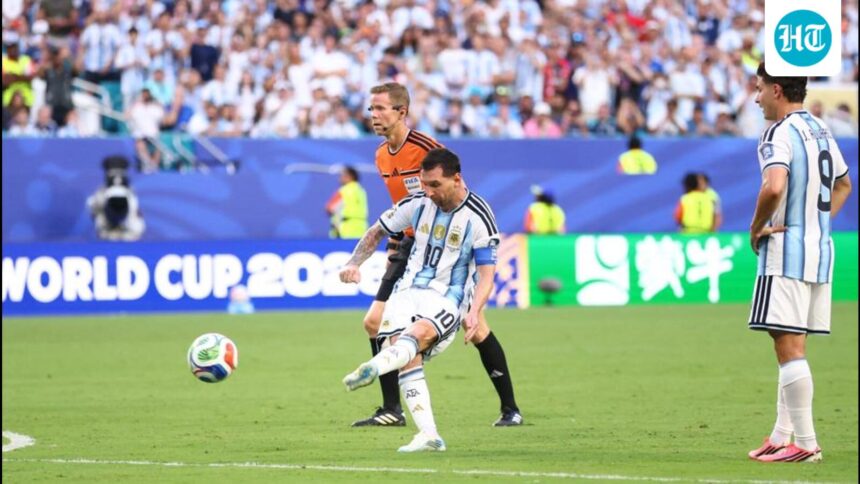
Argentina coach Lionel Scaloni stood on the bench, rubbing his eyes and forehead. This is how he reacted when his team scored the winning goal in their round of 32 match at the FIFA World Cup. On the field, near the corner flag at Miami Stadium, Argentina’s players piled on top of each other to celebrate while Scaloni stood with a pensive look on his face.

With the defending champions taking on Cabo Verde, who are participating for the first time in the tournament, it was expected to be a high-scoring contest. Five goals were scored in 120 minutes of football. Argentina emerged victorious 3-2.
A draw that, on paper at least, rated as the biggest mismatch in the knockout stage of the competition, proved to be a World Cup fixture.
This match saw the two teams tied 1-1 at the end of regular time. A match that witnessed a wonderful goal scored by Lionel Messi at the end from an unusual pass from the halfway line. The match that gave this World Cup its goal of the tournament, when Sidney Lopez Cabral fired a long-range shot from an acute angle that reached the top corner of Emiliano Martinez’s goal, giving Cabo Verde a 2-2 tie in extra time, which is beyond the scope of reason.
Despite Argentina’s extensive history and experience in the sport, the team whose key defender was discovered via LinkedIn raised questions that the three-time champions had difficulty answering.
Ultimately, once the dust settles, and perhaps once this tournament is over, one of the biggest unanswered questions will be what Argentina will do now that captain Messi has decided to retire from his international career.
Messi himself, who, at 39 years old, continues to set new milestones. He opened the scoring on Friday in Miami in the 29th minute to score his seventh goal of this tournament, taking his total to 20 in his 30 World Cup matches, while also extending his record of scoring goals in eight consecutive World Cup matches.
What a goal.
These days, Messi spends most of his time walking on the field. He went for a casual walk behind the defenders into a non-threatening offside position. After reading the play, he returned to his position just in time to dash forward in a sprint and collect Lisandro Martinez’s long ball from the halfway line. A flawless first touch with the outside of his left boot kept the ball under control. The second goal was scored past the inspired Cabo Verde goalkeeper Fozenha, who had another great game.
Admittedly, Messi is the focal point of Argentina’s attacks. But Argentina also has the likes of Julian Alvarez, Lautaro Martinez, Thiago Almada and Alexis McAllister, all of whom are capable of launching and finishing attacks. But after taking the lead, the Spanish team seemed content to allow the opponent to keep the ball.
Until Deroy Duarte scored in the 59th minute.
Messi is no longer as quick as he used to be, but he chooses his moments devastatingly. However, he is tireless in urging his teammates on. However, for the constellation of stars that Argentina has in its squad, no one has shown much of a killer instinct.
Argentina scored eight goals in the group stage, with only two scored by players other than Messi – both scored when he was not on the field (from a free kick and a penalty kick, which Messi would have taken had he been playing).
But against Cabo Verde, while the attacking players struggled to produce anything that bothered the in-form Fusenha, it was defender Lisandro Martinez who scored a goal that would have been the envy of even the strongest strikers, in the second minute of extra time.
However, Cabo Verde could not let go, as Cabral equalized with a stunning goal.
The team from the island nation with a population of around 500,000 – roughly half the population of Messi’s hometown of Rosario – was threatening to take the defending champions to penalties.
It took another kick of Messi’s foot to give Argentina victory. In the 111th minute, from a corner kick, Messi sent a perfect cross, which was eventually blocked by Christian Romero. But the header came out of the hands of Cabo Verde defender Digne and was officially declared an own goal.
There was plenty of time for more attacks from Cabo Verde in search of a third equaliser, giving the fans and the Argentine defense a few more moments of heartburn.
There is a certain magic in silencing a crowd of people. In front of 64,478 spectators inside Miami Stadium, where the vast majority were Argentine fans, the match began with singing and dancing emerging from the stands. Then Cabo Verde twice silenced the celebrations.
In the final few minutes, there was noise again, this time over a plea for their team to cross the goal line. Eventually, they did.
Argentina reached the round of 16 with Messi continuing to lead the team forward. But also with the need to search for some additional answers to the many questions that have arisen in Miami.