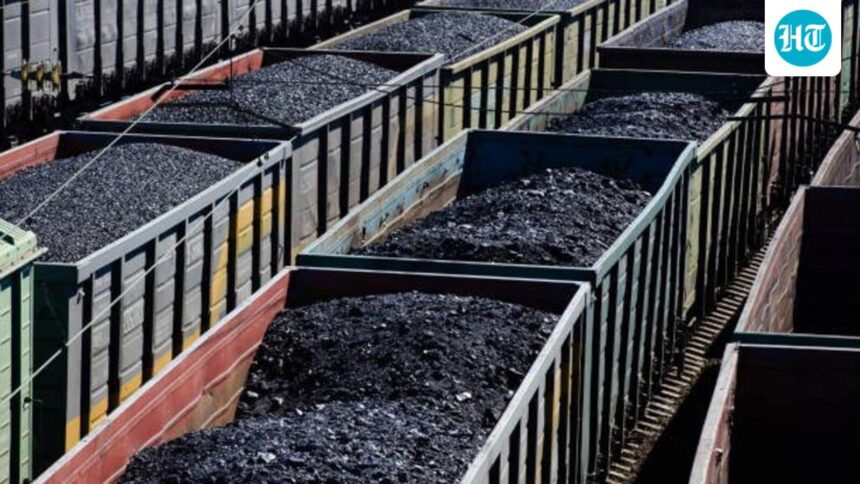
The Union Cabinet on Wednesday approved a coal/lignite gasification plan with a financial outlay of Rs $37,500 crores.

It is a step towards achieving the national goal of converting 100 million tons of coal to gas by 2030, enhancing energy security, and reducing dependence on imports of key products such as LNG[LNG(morethan50%imported)urea(~20%imported)ammonia(~100%imported)andmethanol(~80-90%imported)theCabinetDecisionsMemorandumsaid[liquefiednaturalgas[(morethan50%imported)urea(~20%imported)ammonia(~100%imported)andmethanol(~80–90%imported)thenoteonCabinetdecisionssaid
India’s import bill for liquefied natural gas, urea, ammonium nitrate, ammonia, coke, methanol, etc. was approximately $2.77 lakh crore in FY25, a vulnerability exposed by the ongoing geopolitical situation in West Asia, the memorandum emphasized.
The new scheme is based on the National Coal Gasification Mission (2021) and $The Rs 8,500-crore scheme was approved in January 2024 (under which eight projects worth $6,233 crore in progress).
Coal gasification is a thermochemical process that converts coal into a synthetic gas consisting of carbon monoxide and hydrogen.
New scheme with financial expenses $Rs 37,500 crore to catalyze new surface coal/lignite gasification projects for production of syngas and its downstream products, targeting gasification of approximately 75 million tonnes of coal/lignite.
Read also: $20 thousand compensation and a job for the family of the victim in the coal slurry accident
Financial incentives of a maximum of 20% of the cost of plant and machinery will be provided. Selection will be made through a competitive bidding process, with an evaluation framework that measures project cost, coal inputs and synthetic gas outputs.
The financial incentive will be capped for any single project $5000 Crores. For any single product (except synthetic natural gas and urea) max $9000 Crores. Any maximum of one entity group $Rs 12,000 crore across all projects.
The memorandum stated that coal gasification is of strategic importance.
“Diversified utilization of coal resources and imports of alternatives to LNG, urea, ammonia, ammonium nitrate, methanol and coke, protecting India from global price fluctuations and geopolitical supply chain disruptions, and furthering the goals of Atmanirbhar Bharat and Make in India,” it said.
The plan is expected to create about 50,000 direct and indirect job opportunities through 25 projects in coal-producing areas.
India has one of the world’s largest coal reserves (~401 billion tons) and lignite reserves (~47 billion tons). Coal represents more than 55% of the country’s energy mix.