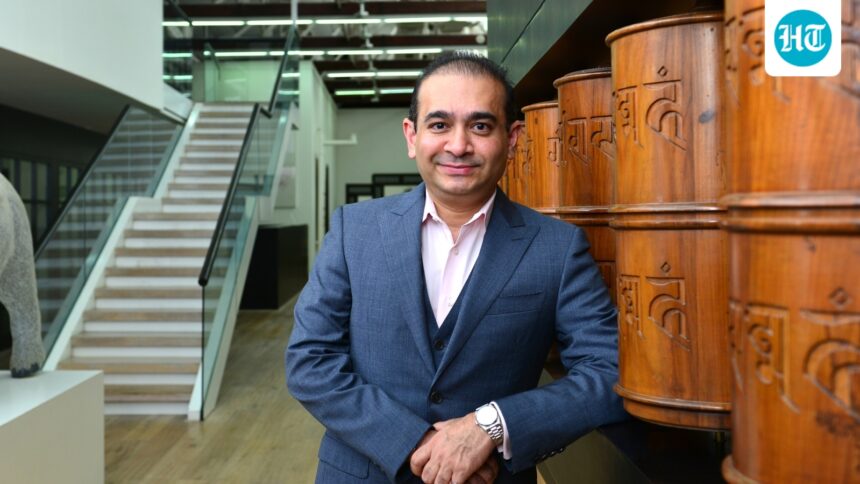
The High Court in London on Wednesday refused to reopen the diamond extradition case of fugitive Nirav Modi, in a ruling that appears to exhaust his last legal recourse in the UK and potentially pave the way for his return to India after more than seven years in British custody.

The ruling relied on assurances from the Indian government – delivered in September 2025, December 2025, and through a note verbale from the Indian High Commission in London in February 2026 – that Modi would not be questioned by any of the five investigative agencies handling his cases. The safeguards have proven important – Modi has sought to reopen his extradition case by citing the case of defense counsel Sanjay Bhandari, whose extradition last year was blocked by a British court on human rights grounds, arguing that the same risk of torture applied to him.
The court said that had it not been for the government’s undertakings, it would have been appropriate to reopen the appeal.
$13,700 crore Nirav Modi scam case, hearing on April 13 $Nirav Modi Rs 13,700 Crore Scam Case, Hearing on April 13
A panel of Justices Lord Jeremy Stuart-Smith and Justice Robert Jay found that the assurances were “specific rather than general and vague”, made by a Home Office official with jurisdiction to bind the Government of India, the state of Maharashtra and all five agencies. The judges said the guarantees were given “in good faith and with the intention of them being binding”, adding that they “did not consider evading them”.
But the referee made it clear how close the result was. The court acknowledged that Bhandari’s ruling presented a “troubling picture” of the use of prohibited treatment to obtain confessions, which it described as “common and endemic”.
The CBI, which has been seeking Modi’s extradition since 2018, said its investigating officers traveled to London to assist the prosecution in countering Modi’s request. The agency said on Wednesday that the challenge posed by Bhandari’s ruling had been “successfully overcome” through “sustained and coordinated efforts”.
Separately, Modi on Wednesday appeared in a London court to hear a petition filed by the Bank of India seeking the encashment of a personal guarantee provided by the fugitive linked to a multi-million dollar lending facility.
India did not dispute that Bhandari’s findings applied to Modi, and rested its case entirely on the quality of the safeguards, which the order indicated with the court’s acceptance of that approach. It said the bilateral relationship between the UK and India, the high-profile nature of the case, and Modi’s guaranteed day-to-day access to lawyers and medical team under previous safeguards were all factors that worked in India’s favor – although the new safeguards would not be officially monitored. The court also noted that although India is not a signatory to the UN Convention against Torture, it is satisfied that torture is not permissible under Indian law.
In the Bhandari case, India’s attempt to appeal to the Supreme Court was rejected in April 2025, leaving Bhandari – accused of being a middleman in defense deals as part of the CBI corruption investigation – a free man in London.
Modi’s legal team presented testimony from Indian lawyer Ashul Agarwal and former Supreme Court judge Justice Deepak Verma to argue that he would face the risk of being questioned by agencies. The court did not give any weight to their evidence.
HT first reported, on September 19, that the court had accepted Modi’s request to reopen the case.
The same court had rejected Modi’s appeal against his extradition in November 2022, and then refused him permission to go to the UK Supreme Court.
He is accused of defrauding Punjab National Bank $Rs 6,498 crore – part of the total $13,578 crore fraud, with approx $Rs 7,000 crore linked to his uncle Mehul Choksi – Modi has been in a UK prison since his arrest by Scotland Yard on March 19, 2019, on India’s extradition request. A district judge at Westminster Magistrates’ Court ordered his extradition on 25 February 2021.
India informed British authorities that Modi would be housed in Arthur Road Jail in Mumbai. The court said it did not need to resolve the issue of whether the prison’s videoconferencing facilities were sufficient to attend his trial remotely.
Modi has been declared a fugitive economic offender under the Fugitive Economic Offenders Act, 2018. The Enforcement Directorate has seized assets worth $2,598 crore under the Prevention of Money Laundering Act $Rs 981 crore has been recovered to the affected banks