Dear reader,

In the morning, we carry our sketchbooks to Sabali, the café above the Manalso River. The rain has stopped, and the day is clear. All around us are hillsides filled with coniferous forests, and in the distance the snows of Pir Panjal.
I say: “Let’s draw trees.” It’s tough or rough How does one capture the myriad shades of emerald green, green and sap with hints of white and Prussian blue? How does one get the textures of thorny grass and old bark, brown and black and burnt sienna, and soft light and shade?
We spread our paints on long wooden tables. Abidal, a software engineer from Sudan who created this beautiful cafe, brought us our order. For a moment, the only sounds are the clinking of china cups, the scraping of wooden chairs, and the distant murmur of the Manalso River. We settle into the work of research.
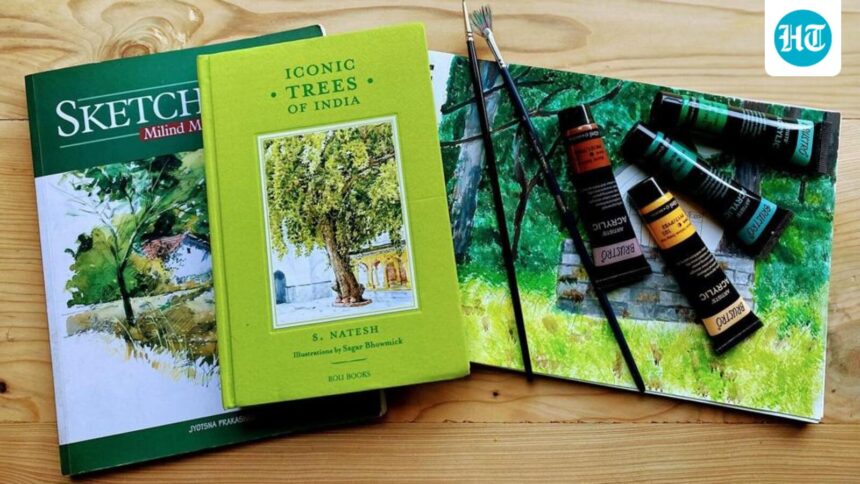
The bee traces the hillsides around us. Vivs opens Milind Mulick’s sketchbook, while I leaf through S. Natesh’s Iconic Trees of India with illustrations by Sagar Bhowmik. Here is the flaming red ceramic of Naseem Bagh. Then come the magnificent deodharas of Jageshwar, centuries old and nine meters in circumference.
We stopped at one of these magnificent deodars earlier this morning – a tree that serves as a temple to the warrior Ghatokasha, son of the Pandava Bhim and the goddess Hidimba. As we stand at its base, looking up at the ancient tree surrounded by the animal spirits of centuries upon centuries, we now feel the weight of history, mythology and botany that haunts us all day long.
The twentieth
After that old deodar, it becomes impossible to look at the trees casually. In Sabali, I sip a cappuccino and look across the Manalso River to the Van Vihar Forest. Large areas of this forest have been uprooted to make way for a road. The ground looks distorted.
We used to take picnics here, following the little moss-covered paths that wound their way down to the river until we came to a place with little pools of calm, still with bits of water flowing from the currents and swirling eddies of the main river. We would dip our feet into the icy water and count as far as we could go. When we could take it no longer, we would drag our frozen feet out and watch them slowly come back to life on the sun-warmed rocks. We would dip bottles of cider and beer into the icy water, and bring them all out chilled to drink with cheese and tomato sandwiches and carrot cake.
We can’t do any of this anymore.
The forest is now separated from the river by barbed wire. There are tin huts and JCBs where deodar trees once dominated. The pools of water disappeared.
Witnessing the destruction of this beloved forest makes our book for the month painfully relevant. The Manali Book Club reads “The Overstory” by Richard Powers. It seemed slow going at first, with stories of pioneers settling the American Midwest and the chestnut tree and immigrants from China with their mulberry tree.
But I was gradually drawn in. Today I read about Nilay Mehta, a crippled computer expert who goes to Stanford and designs a game about trees. The story reminds me of Richard Powers’ recent book, “The Playground.” What strikes me about both books is how strongly Richard Powers is attuned to technology and artificial intelligence, and how he incorporates these elements into the core of his stories. Through Neelay, Powers makes the programming seem strangely alive, almost vegetal. For this reason alone this chapter is worth reading.
Tomorrow I will plant magnolia trees, placing a magnolia with white flowers next to another with purple flowers. My assistant Atbari, her young daughter Ritika, and I will take our shovels, dig three feet into the ground, place each tree in its place, cover its roots with fresh soil, make a circle around it, and compact the clay.
I hope these trees survive.
The trees I planted last year did very well, sprouting beautiful, delicate green leaves and growing taller. But in August, the floods came and water collected around the trees. By the time the rain ended, the leaves began to wilt. The trees died slowly, as their roots rotted in the water.
This year I will be more careful. I will hang every tree, surround it with stones, and pray to the gods of sun and rain to keep it safe.
However, I can’t help but think of the Van Vihar Forest across the river, the barbed wire, the JCB boards, the ravaged land once dominated by hundreds of deo trees, and wonder what difference a couple of magnolia trees would make. But I will plant anyway. What is there to do when you, dear reader, do you have a tree?
Sonia Dutta Chowdhury is a Mumbai-based journalist and founder of Sonya’s Book Box, a personalized book service. For all questions about life and literature, email sonyasbookbox@gmail.com.