Dear reader,

It’s early morning in the woods and I feel a tap on my arm.
All around me and above me are ancient deodar cedar trees, their green, needle-covered branches rising a hundred feet into a clear blue sky. Below me, the cold gray stones of the temple courtyard. Sounds surround me: the loud, clear tones of the conch, the rhythmic beat of the drums, the ringing of temple bells. The smell of incense fills the air.
Today is the Gods’ birthday, and I’m excited to join in the celebrations. I arrived early and the Hadimba musicians were still playing their instruments: the dhawansi, the dhol, the nagara drums, the long, curved narasingha trumpets, the ransingha trumpets, and the shankh.
A mother and her two school-going children sit on the rock and take off their shoes before going to the temple. A group of teenage boys are scolded by a teacher for taking pictures of themselves before entering a temple, and a furry brown dog wanders around.
And then it starts. The musicians of Goddess Hadimba gather in a semicircle in front of the temple. The conch player steps inside, and begins the ritual with a long, high celebratory note that soars into the Himalayan sky. Next, the drums take over – first the deep, two-sided dhol, then the nagara drums, which build from a faint rhythmic percussion to a powerful rhythmic wave. The long, curved brass ransingha trumpets perfectly punctuate this primal call to prayer, their crescent shapes catching the morning light as their notes climb and climb. And through it all, the soothing, echoing tinkle of the temple’s brass bells.
Standing surrounded by the sounds of the temple, watching the warm glow of the fire inside as the priest performs the aarti prayer, I want to embrace this moment, feeling the cool, crisp Himalayan air, the sight of the ancient temple before me, its triple-layered roof, its magnificent wood carvings, the ancient antler and antler on its walls. I want to bottle the warmth of streaming sunlight, the golden glow it gives to the marigolds that adorn the temple, the way it illuminates the faces of two old women dressed in traditional batus kolo, sitting on the plinth of the temple, holding incense ends in their folded hands.
So I put my hand in my pocket, took out my phone, put it on my chest and started filming.
And then I feel a tap on my arm. An old man with a sunburned face and dark, weary eyes, wearing a cowboy hat and waistcoat, motions to me: Put your phone down.
For a moment, I freeze. I can feel the muscles tightening on my cheeks. How right he is. How stupid I was. I feel the old man’s eyes on me again, wary and alert, watching quietly, unsure if I’m the type to start shooting again.
This is a sacred moment. Along with everyone around me, I must live it with all my being. It’s foolish to try to cram it into a bottle. The truth is, if I took a clip and watched it even years later, it would never have the intensity and energy that this moment has. Moreover, I am disrespectful and clumsy. I am the tourist I tried not to be.
I think back to the early morning – I woke up early and took longer than usual to choose what to wear. No jeans, no dress. I chose a navy blue kurta and salwar, clothes that would help me blend in, not stand out as part of the stream of tourists who come to visit this city all summer long. Should I wear the blue and green colo hijab that my neighbor bought me? “You look good in it. You should wear it more often,” she said. Or will wearing the hijab be an appropriation? In the end, it’s easier not to.
Later in the day, there will be a mela, stalls everywhere with hand-knitted wool socks, wooden key chains, and name boards painted with images of pine trees and red-roofed houses. People living in the village of Dongri and Old Manali host open houses, and we’ll wander from house to house, eating traditional kadhi chawal, rajma, and local chicken and mutton curry.
Right now, I’m walking through the forest to the market. I think about the goddess and her many origin stories. Local folklore links it to the ancient sage Manu, from whom the valley town of Manali gets its name. The two are sometimes viewed as brother and sister. In some celebrations, these two gods share a chariot. In another version, the goddess Hadimba is the protector of the sage Manu Rishi, who was washed up in Manali after surviving a great flood.
Others say that Hadimba and her two brothers, Ghipan from Lahaul and Jamalu from Malana, came from the high Himalayan plateau in Tibet and took refuge in the valleys of the Indian Himalayas, after fleeing evil demons.
In the most famous version, the goddess Hadimba Devi is referred to in the epic Mahabharata as the wife of Bhima and the mother of the warrior Ghatotkacha. Kavita Kain’s historical novel Bhima’s Wife gives her a romantic storyline – a beautiful girl, a violent brother, Bhima as liberator.
Thinking about these stories, I can’t help but think how insidious the trend is. Hadimba is a local, tribal girl, described as a rakshasi, an asura, a demon, who was saved through marriage to a common man, the brother of the Pandava Bhima from mainland India.
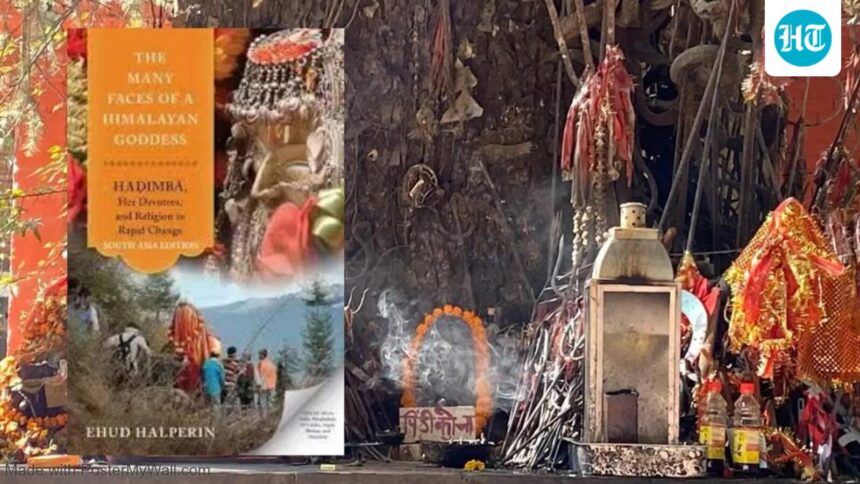
When I got to the market, I headed to my favorite café. I took out the orange-covered book I had been carrying for the past few days: The Many Faces of the Himalayan Gods. Israeli author Ehud Halperin delves into myths and legends, speaking to the Pujaris of local Devtas and referencing historical accounts and travelogues found here. I love the book for the depth of its research, how it allows this goddess to be many things at once, without having to resolve it, and how it links the goddess Hadimba to the economy and ecology of the Kullu Valley.
(Sonia Dutta Chowdhury is a Mumbai-based journalist and founder of Sonya’s Book Box, a personalized book service. For all questions on life and literature, email sonyasbookbox@gmail.com.)