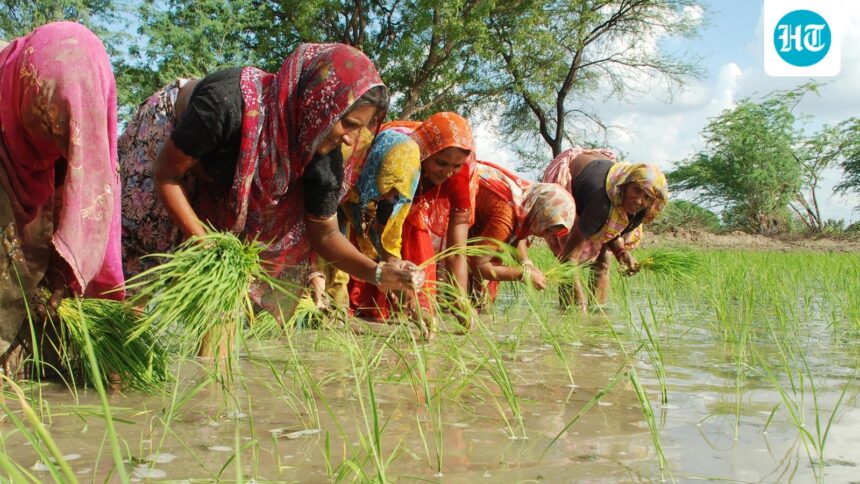
Although rainfall improved during the first 10 days of July, kharif planting in India continued to lag behind last year’s pace. As of July 10, farmers had planted 350.85 lakh hectares, about 16% less year-on-year. However, the gap narrowed from a 21% deficit the previous week as rainfall temporarily improved.
However, the recovery may be short-lived, experts say. After widespread rains helped reduce the country’s cumulative rainfall deficit from 40% at the end of June to 14% by July 9, monsoon activity weakened again, pushing the nationwide deficit to 18% by Monday. The India Meteorological Department (IMD) has forecast faint rains over the northwestern plains, west-central India and southern peninsular India over the next six to seven days, raising concerns about fresh delays in planting operations.
Read also: Home-cooked meals are becoming more expensive. This is why the cost of your thali is higher now
As of Monday, several key agricultural regions — including eastern Uttar Pradesh, Bihar, Jharkhand, Punjab and parts of Gujarat, Maharashtra, Telangana and Karnataka — continued to record rainfall deficits exceeding 20%, with some areas facing shortfalls of up to 47%.
“Reduced rainfall in key agricultural regions of Madhya Pradesh, Maharashtra, Karnataka and Gujarat since July 8 means that rising temperatures and lower soil moisture may start impacting crop yields. Based on the current conditions, we can confidently say that the area under pulses, millets and oilseeds is likely to decline. The biggest concern is the rainfall forecast over the next seven to 10 days,” said Garima Jain, CEO, Torq Commodities.
Read also: Center says 15 fertilizer ships cleared Hormuz, alleviating concerns about Kharif supplies
Sowing data already points in this direction. The area of pulses reached 2.3 million hectares, a decrease of 23.3% compared to last year, while more than 7.1 million hectares were planted with oilseeds, a decrease of 21%. The area planted with coarse grains decreased by 22.5% to 5.3 million hectares, while the area under cotton decreased by 15.3% to 9.2 million hectares. Rice was the only major food grain to show signs of recovery, with the area under cultivation reaching 4.8 million hectares, still 8.6% lower than last year, but 17.3% higher than normal after improved rainfall in eastern India.
Concerns are particularly acute in the monsoon core zone – an area stretching from Gujarat across central India to West Bengal – which accounts for a large share of India’s rain-fed agriculture. The area is critical for crops such as soybeans, pulses and millet, and any prolonged dry spell during the peak sowing period could reduce the area under cultivation and begin to impact production prospects later in the season.