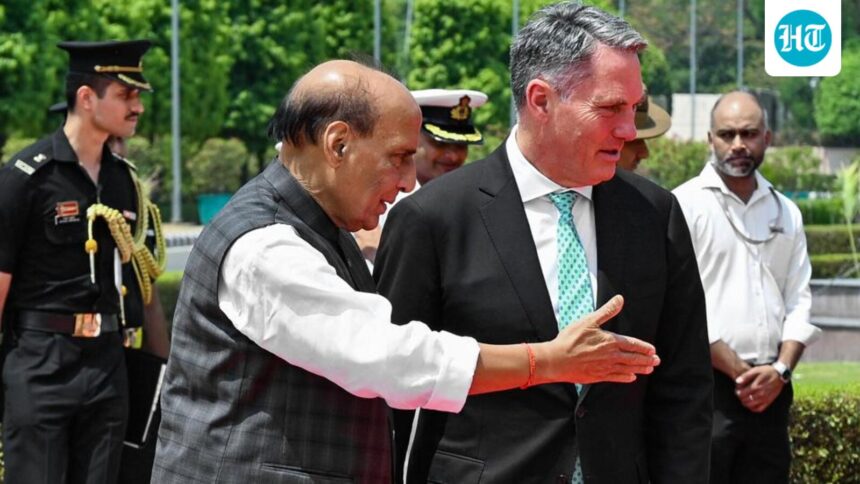
Defense cooperation will be a key part of Prime Minister Narendra Modi’s upcoming visit to Australia, including an updated framework guiding security cooperation and a new roadmap for joint action on maritime security, Australian Deputy Prime Minister Richard Marles said on Monday.

Marles, who is also Defense Minister, told a small group of Indian reporters after participating in the second dialogue between the defense ministers of India and Australia with his counterpart Rajnath Singh that Australia considers India a “key partner” in the Indian Ocean region because of the common strategic alignment underpinned by “full trust.”
Defense cooperation between the two countries, both members of the Quad, has grown significantly in recent years, including the launch of a 2+2 dialogue between the defense and foreign ministers, the signing of a logistics support agreement for mutual access to military bases in 2020, and the conduct of increasingly complex exercises.
A joint statement said the two sides welcomed progress towards strengthening the Joint Declaration on Defense and Security Cooperation, reached in 2009, and discussed finalizing a joint roadmap for maritime security cooperation. They also agreed to enhance collaborative maritime domain awareness activities and explore opportunities to “enhance maritime domain awareness.”
Noting that he and Singh met before Modi’s visit to Australia for an annual summit with Prime Minister Anthony Albanese, Marles said: “We know that defense will be a key part of the discussion that our heads of government are having, because in their previous summits, defense was very pivotal.”
He added: “We are really pleased that we are close to finalizing the renewal and strengthening of the Joint Declaration on Defense and Security Cooperation, and that significant progress has been made on the Joint Roadmap for Maritime Security Cooperation, both of which are really important in the context of the upcoming Ministerial Summit.”
Although the two sides have not yet officially announced Modi’s visit, he is expected to travel to Indonesia, New Zealand and Australia in early July, sources familiar with the matter said.
Joint exercises between the two sides have grown in complexity, with the Indian Army joining Australia’s Talisman Saber exercise for the first time last year, the Indian frigate INS Nilgiri participating in the Australian Navy’s multinational Kakadu exercise earlier this year, and a detachment of the Indian Air Force’s Rafale fighter jets set to join Pitch Black next month.
“We live in a world [with] Enormous challenges, as there is a great deal of uncertainty [and] “In all of this, I cannot overstate how much we value, from an Australian perspective, our defense relationship with India. We are doing more with India, in terms of maritime security cooperation in the Indian Ocean, than any other country,” Marles said.
In the context of enhancing awareness of the subsea domain, Marles said the two sides are exploring cooperation in underwater activity against the backdrop of “more gray area activity” targeting seabed infrastructure around the world. A rules-based order in the maritime domain “should apply to the seabed,” as well as to the surface in terms of maritime trade and freedom of navigation.
“This increases our need for cooperation, and this requires advancement in innovative technologies. We are keen to work with India on all of this,” Marles said.
In response to a question from Hizb ut-Tahrir regarding Japanese Defense Minister Shinjiro Koizumi’s proposal on Sunday that India host the Quad defense ministers’ meeting, Marles said that there is already great coordination between the defense ministers of India, Australia, Japan and the United States.
“First, we just witnessed a very successful meeting of Quad foreign ministers here in India last week. As part of that, they announced Indo-Pacific maritime security cooperation, which in turn was a really important step forward in terms of Quad activities,” he said.
“When it comes to defense, we talk to each other a lot. Literally, in the last 48 hours, I’ve been face to face with each other. [US defence] secretary [Pete] Hegseth, Minister Koizumi, and Minister Singh. So we all talk to each other all the time, and it would be correct to say that, from the Australian perspective, we look at our defense relationship with… the United States, Japan and India. [being] “At the high water mark,” he added.
Marles also said Australia’s work within the AUKUS security partnership with the UK and US to acquire nuclear-powered submarines is intended to deter “any adversary who may seek to coerce Australia” and contribute to the collective security of the northeastern Indian Ocean, Southeast Asia and the Pacific.
“This is about establishing a balanced deterrence that maintains peace… We see ourselves working very closely with India, in terms of how we operate all our maritime assets,” he said.