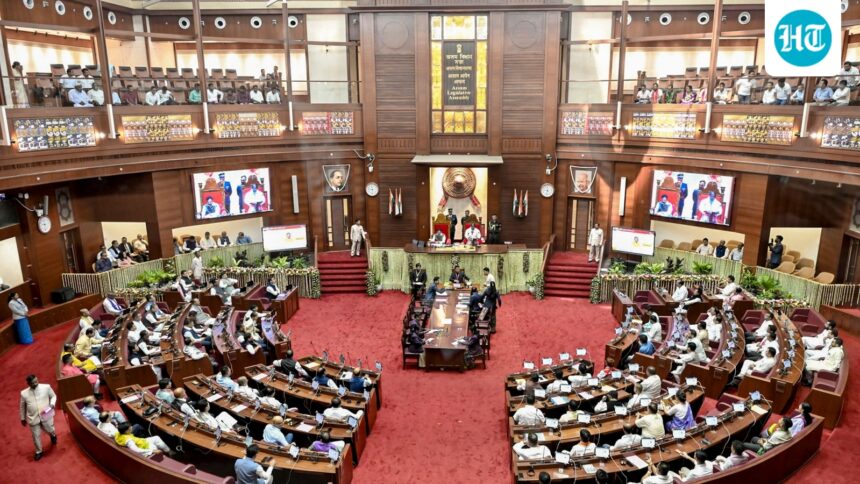
Mandatory registration of live-in relationships, prohibition of polygamy, and registration of all marriages and divorces, including when one of the partners is a resident of the state, were among the key provisions of the Uniform Civil Code (UCC) bill introduced in Assam on Monday.

The UCC is a controversial and polarizing issue that refers to a common set of laws regarding personal matters such as marriage, divorce, inheritance, and succession for all citizens. Article 44 of the Constitution, one of the directive principles of state policy, calls for the establishment of UCC. But religion-based civil laws have governed personal matters since independence.
Assam Minister Atul Bora introduced the Assam Uniform Civil Code Bill, 2026 – which keeps tribals out of its ambit – making the north-eastern state the third BJP-ruled state to introduce such legislation. The bill is scheduled to be discussed and voted on on Tuesday, the last day of the first session of the 16th Assembly that was formed after elections in April.
“The introduction of the Uniform Civil Code Bill, 2026 in the Assam Vidhan Sabha paves the way for a recorded discussion on why UCC in Assam is the need of the hour and how it will help in achieving the path set by our founding fathers,” Chief Minister Himanta Biswa Sarma posted on X.
The BJP promised to introduce UCC in Assam in its manifesto ahead of the 2026 Assembly elections. The state cabinet approved the legislation in its first meeting on May 13.
Opposition parties, especially the Congress Party, opposed introducing the draft law without prior consultation with stakeholders. But Parliament Speaker Ranjit Kumar Das allowed the legislation to be tabled after a voice vote.
Congress MLA Jakir Hossain Sikdar said: “Wide-ranging consultations should have been conducted with political parties, organizations and other stakeholders before submitting the bill to the House. But such a practice did not take place.”
The draft law stated that it aims to “control and regulate the laws related to marriage, divorce, inheritance, live-in relationships, and related matters.” It considered that members of Scheduled Tribes (STs) would not fall under its ambit. Tribals account for 12.45% of Assam’s population and Muslims 34.22%, according to the 2011 census.
The legislation stipulates 21 years as the minimum age for marriage for men and 18 years for women. It stated that neither party should have a living spouse at the time of the marriage, or if they had any previous marriage, it should be annulled. She added that marriage should not be concluded by force, coercion, deception or fraud.
“Neither party shall, at the time of marriage, be incapable of giving valid consent, or be suffering from a mental disorder of such or such a nature as to render them unfit for marriage, or be liable to frequent fits of insanity, though capable of doing so.”
The draft law added: “It is not permissible for the two parties to be in a forbidden relationship, unless the custom or custom of one of them permits marriage between them, provided that this custom is not contrary to public order and morals. Finally, marriage is not forbidden under any law.”
The draft legislation states that marriage may be solemnized in accordance with existing religious beliefs, practices, rituals and ceremonies, including the Anand Marriage Act 1909, the Special Marriage Act 1954, the Arya Marriage Verification Act 1937 and the Hindu Marriage Act 1955. No Islamic laws?
The bill makes it mandatory to register all marriages and divorces in the state, including those where at least one party is a resident of Assam. Failure to do so will result in a fine of up to $25000.
The marriage may be considered invalid if the previously mentioned conditions are not adhered to. The draft law stipulates that divorce can be granted if the partner has sexual relations with others, treats the partner cruelly, deserts for more than two years, has conversion, mental disorder, incurable venereal disease, renounces the world, disappears without a trace for more than seven years, or enters into another marriage.
Divorce may be granted by mutual consent, and the wife may also petition the court for annulment of the marriage on the grounds that the husband is guilty of rape or an unnatural sexual offense or that the husband has had more than one wife from marriages solemnized or contracted before the commencement of the Act.
The legislation stipulates prison sentences ranging from six months to seven years and fines for violating the stipulated conditions or marriage. In addition, the provisions of the Bharatiya Nyaya Sanhita (BNS) Act and the Child Marriage Prohibition Act will also be implemented as and when applicable.
Regarding the issue of succession, the legislation created two broad categories of direct heirs. The first includes immediate family members such as husbands, children, daughters-in-law, grandchildren, etc. The bill stipulates that they will all receive equal shares of the property. The second category includes stepfathers, siblings, spouses, children of deceased siblings, siblings of parents, and maternal and paternal grandparents. The law clarifies how the deceased’s property will be divided between his wife, children, and others.
The bill also includes regulations on live-in relationships. “Partners in a live-in relationship within the state, whether they are residents of Assam or not, must submit a statement of live-in relationship to the Sub-Registrar under whose jurisdiction they live,” the order said.
Residents of Assam in a live-in relationship outside the state may submit a live-in relationship statement to the Sub-Registrar within whose jurisdiction they ordinarily reside. The Sub-Registrar will in turn forward the statement of the live-in relationship to the officer in charge at the local police station for registration and, if either partner is under 21 years of age, inform the parents/guardians of such partner(s).
Any child in a live-in relationship must be a legitimate child of the couple. The law states that a direct relationship may not be registered when the partners are in a “prohibited relationship”.
It stipulates that the prohibitions will not apply to people whose customs and customs permit the relationship, “provided that these customs are not contrary to public order and morals.”
Failure to submit a statement regarding the direct relationship to the Sub-Registrar within a month, or submitting a false statement or failing to submit a statement upon notification, will result in imprisonment for a period of three to six months and fines of up to $25000.
A live-in relationship will also not be recorded if at least one of the persons is married or already in a live-in relationship, where at least one of the persons is a minor; Or when one partner’s consent is obtained by force, coercion, undue influence, misrepresentation or fraud as to any material fact or circumstance relating to the other partner, including his or her identity.
The draft law stipulates that “if a woman is abandoned by her life partner, she has the right to demand alimony from her partner who lives with her, and for that purpose she may resort to the competent court that has jurisdiction in the place where they last lived.”
In February 2024, Uttarakhand became the first state in the country to pass the UCC Act. The other BJP-ruled state of Gujarat followed suit in March. The BJP-ruled Madhya Pradesh state has formed a committee to draft the UCC. In Goa, the Goa Civil Code, derived from the Portuguese Civil Code of 1867, provides for mandatory registration of marriage before a civil authority.