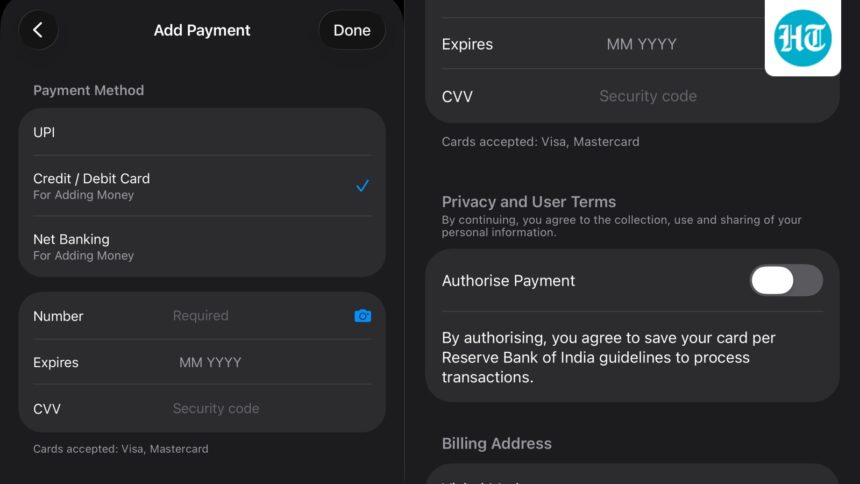
After a nearly five-year hiatus, Apple has re-enabled support for credit and debit card payments for subsequent app purchases and App Store subscription transactions. This means that Apple is now fully compliant with the Card Transaction Coding Guidelines issued by the Reserve Bank of India (RBI).

Currently, credit and debit cards on the Mastercard and Visa networks can be set up as a payment method to add money to an Apple account, which can then pay for app purchases and recurring subscriptions including iCloud+. A credit or debit card cannot currently be used to make purchases directly on the App Store, and must be paid for through your Apple Account Wallet.
Read also | Apple prices just went up — but these Prime Day 2026 deals could save you thousands
Visa and Mastercard are supported for adding funds in stages, and all Apple accounts should open access in the coming days. UPI functionality to add money remains available alongside. As per HT’s experience, at least one UPI account should remain linked to an Apple account for now.
Sources confirm to HT that support for RuPay cards will be added in the coming weeks.
Read also | MacBook Air M5 and MacBook Neo are back at launch prices: Don’t miss these deals
The Device-Based Tokenization Guidance for Card Transactions, which was implemented in 2021 and later updated in 2023, stipulates that physical card details must be replaced with an alternative unique code called a “token,” which is a combination of the card used to make the payment, the token requestor or payment recipient that forwards the request to the card network to issue a token, and the device used to complete the transaction.
A tokenized card transaction is more secure as the actual card details are not shared with the merchant while processing the transaction. Apple and other online merchants must not save physical credit or debit card identifiers, including card numbers or expiration date details, and must instead generate a unique encrypted token for them.
Read also | The government orders Apple and Google to remove 7 mobile applications that obstruct e-rickshaws
After the initial push for tokenization in 2019, the RBI expanded the scope in 2023 beyond mobile phones and tablets, and allowed this process to be completed on laptops, desktops, and wearable devices such as smartwatches and Internet of Things (IoT) devices.
One of the key elements is that all tokenized data, along with transaction details, must be stored locally – that is, on servers physically located within India’s borders.
However, Apple’s compliance with RBI guidelines for tokenization and localization of payment data does not mean that Apple Pay has been launched, or is scheduled to be launched in India. Apple Pay is an on-device digital payment system that allows users to tap their iPhone on payment terminals to complete purchases in physical stores, as well as link payments on shopping sites.
In India, Samsung Pay on the company’s Galaxy phones as well as Galaxy smart watches works on the same premise. As is Google’s own Google Pay, although slightly differential features are supported for iPhone and Android.
The RBI E-Mandate framework strictly regulates automatic debits for subscriptions like iCloud+ or Apple Music. The process requires a one-time registration using an additional authentication factor such as a one-time password or a one-time password sent via message or email, with banks required to alert the user about an upcoming transaction at least 24 hours before it is scheduled to be automatically processed, during recurring payments up to up to $15,000 can be processed automatically without a one-time password (OTP) after initial setup, and amounts higher than that will require user authentication.
Adding a card to an Apple account requires users to confirm the addition as well as tokenize it with a one-time password (OTP). The saved card can be deleted later.