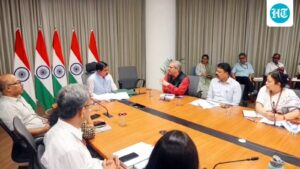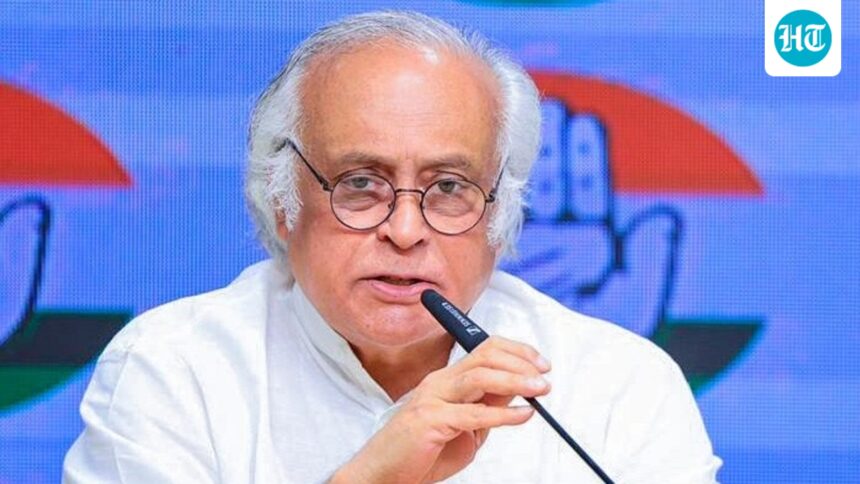
Ahead of the India Caucus meeting on June 8, senior Congress leader Jairam Ramesh on Saturday asserted that the opposition alliance remains united despite some parties choosing to withdraw from attendance “for their own reasons”.

In ‘X’ post, Ramesh announced that twenty-three political parties will attend the meeting to be held at the Constitution Club in the national capital.
Ramesh stressed that despite their non-attendance, the parties had expressed their opposition to the “policies and actions” of the central government.
“…They strongly oppose those policies and actions of the Modi government that disenfranchise millions of Indians, attack the Constitution daily, target opposition leaders through investigative agencies, cause massive damage to the livelihoods of millions of Indians, continually disrupt household budgets through persistent inflation, betray the hopes and aspirations of thousands of youth, weaken the investment climate, and harm national interests through their foreign policy. Like India, India stands united by its diversity,” the statement said. Ramesh on “X”.
The meeting is crucial for the opposition caucus not only because of the challenge posed by the BJP’s growing political dominance but also because of the differences within it.
The Dravida Munnetra Kazhagam (DMK), which has been a strong pillar of the Indian bloc, decided not to participate in the meeting due to “betrayal” by the Tamil Nadu Congress, which decided to support the Tamil Nadu Vetri Kazhagam (TVK) after the elections.
The Congress contested the elections as part of the DMK-led alliance and won five seats. Congress’s decision led to tension in the relationship between the two parties.
In the letter announcing their decision not to attend the meeting, the DMK said it would, “as always, continue to raise its voice on issues affecting the welfare of the nation that may be raised by other parties participating in the meeting.”
Also read I DMK to skip India bloc meeting on Congress ‘betrayal’ after elections
Meanwhile, Trinamool Congress (TMC) chief Mamata Banerjee on Sunday left for Delhi to participate in the All India Caucus meeting. TMC leaders Dola Sen and Kalyan Banerjee were also present at the Kolkata airport.
This is the first meeting of the India Caucus after the Trinamool Congress lost the West Bengal Assembly elections.
After the BJP’s landslide victory in West Bengal, the Trinamool Congress also faced internal opposition following a rebellion by 58 BJP members supporting ousted leader Ritabrata Banerjee.
Reports suggest that as many as 20 Lok Sabha MPs may also break away from the party. In response, the TMC announced a change in leadership, with Derek O’Brien and Dola Sen appointed as national joint secretaries and Chandrima Bhattacharya taking over state leadership responsibilities from the ailing Subrata Bakshi.
Also Read The India bloc is likely to meet in Delhi on June 8 to discuss strategy and strengthen unity
The CPI(M) has also expressed concern to the Congress over the “systematic campaign” against its leadership during the Kerala Assembly elections, but the party has decided that John Prithas, its MP, will attend the India Caucus meeting scheduled for Monday.
CPI(M) general secretary MA Baby has written to Congress president Mallikarjun Kharge seeking clarification on the allegations made by Congress leaders during the Kerala Assembly elections against the party and its leadership.
In the letter, Baby said Congress general secretary KC Venugopal informed him of the India Caucus meeting and raised concerns over what he described as a “systematic campaign” by the Congress leadership in Kerala which claimed that the CPI (Maoist) and the BJP had reached an agreement.
He stated that Congress leaders, including opposition leader Rahul Gandhi, Congress general secretary Priyanka Gandhi and Karg himself, repeatedly claimed during the election campaign that CPI(M) leader and then Kerala Chief Minister Pinarayi Vijayan had reached an understanding with Prime Minister Narendra Modi.
“KC Venugopal has informed me about the All India Bloc parties meeting scheduled to be held on June 8, 2026. In this regard, I would like to cite the recent political development during the Assembly elections. There was a systematic campaign by the Congress leadership during the Kerala Assembly elections, where the Communist Party of India (Maoist) and the BJP reached an agreement,” MA Baby said.
“Moreover, it was alleged that senior leader of the Communist Party of India (Maoist), Politburo member and then Prime Minister, Comrade Pinarayi Vijayan, had also struck a deal with Modi. The question arose: ‘Otherwise, why was he not interrogated or arrested by the Enforcement Directorate?’ These were not stray statements in the midst of an election campaign, but the centerpiece of your political campaign. All national leader, Rahul Gandhi added: “You and Priyanka Gandhi have made such allegations time and again.”
Also Read I CPI(M) chief criticizes Rahul for allegedly linking BJP with the Left
The CPI (Maoist) leader said the India bloc was created as a broad platform to fight the BJP politically and parties with different ideologies have come together for this purpose.
On the other hand, West Bengal minister and BJP leader Agnimitra Paul questioned the importance of the India bloc, pointing out that CPI-M general secretary MA Baby has already written to the Congress over allegations of CPI-M-BJP misunderstanding and that the TMC is in disarray under the previous leadership of Mamata Banerjee.
“The Indian alliance has been completely sidelined and ignored by the people of the nation,” she said.
While Jairam Ramesh maintains that the coalition remains “united” in its ideological opposition to the central government, the DMK’s absence and simmering internal disputes point to a complicated path forward.
As the bloc deals with growing friction between its member parties, the upcoming meeting is likely to be pivotal in determining whether the BJD is able to bridge its internal divisions or whether it faces further fragmentation in the face of persistent political challenges.