Tests by Air India engineers on the fuel switches of a Boeing 787 Dreamliner, which was grounded after the pilot reported a possible problem with one of them, showed that the components were working within satisfactory parameters when operated as per the procedures recommended by the aircraft’s manufacturer, the aviation regulator said on Monday.
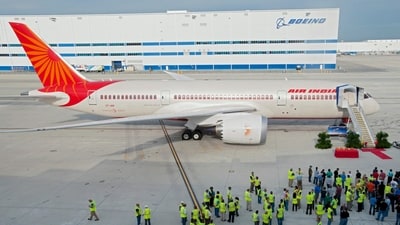
File photo of a Boeing 787 Dreamliner aircraft during delivery to Air India (PTI).The Directorate General of Civil Aviation (DGCA) said in a statement that it has advised Air India to educate its crew on the procedures recommended by Boeing for operating the switches that control fuel flow to the aircraft’s engines. that its fuel switches were in the “cutoff” position. The final report is still pending.
The fuel control switch – a Dreamliner has two, one for each engine – alternates between two positions, “run” and “cutoff”, and has a locking feature. Once it is engaged, the pilot must deliberately lift the switch to change its position.
On Monday, Air India referred the matter to Boeing after the pilot in command of flight AI132 from London to Bengaluru reported a possible problem with the switches. Based on Boeing’s instructions, engineers tested the pull-to-unlock force on the affected plane’s fuel control switch, the replacement unit and a switch on another plane. All the readings were found to be within the prescribed limits, said the controller, which was inspected in the presence of DGCA officials.
“Both the left and right switches have been checked and found satisfactory as per Air India engineering, the locking tooth/paw is fully seated and does not slip from RUN to CUTOFF. When full power was applied parallel to the base plate, the switch was secured,” the controller said. However, the regulator warned in the test that “applying an external force from an incorrect direction causes the switch to move easily from RUN to CUTOFF, allowing the angled base plate to slip when pressed incorrectly with a finger or thumb.”
More Read

The DGCA statement also clarified the sequence of events due to which the pilot flagged the matter on Monday.
“During the engine start at London, on two occasions, the crew noticed that the fuel control switch did not stick positively in the ‘RUN’ position when light vertical pressure was applied. On the third attempt, the switch stuck correctly in the ‘RUN’ position and subsequently remained stable. Before proceeding with the rest of the process, it was fully confirmed by the crew that the process was completely done and positively stuck in the “RUN” position.”
The DGCA said the crew did not observe any “abnormal engine parameters, warnings, cautions, or related system messages” during or after engine start.
More Read

The DGCA said the operating crew member was briefed about the observation. “Unnecessary contact with the switch was avoided, and the engine indication and warning systems were closely monitored by the crew for the remainder of the flight. The flight was completed without incident,” the civil aviation watchdog said.
However, after landing in Bangalore, the pilot reported the error in the Pilot Defect Report (PDR). The log read- “A/C (aircraft) turning to the left.. Left fuel control switch cut off from run and slightly pushed, it does not lock into position..”
The airline, which has 33 Boeing 787 aircraft in its fleet, ordered a precautionary fleet-wide re-inspection of fuel control switch latches. These switches were earlier inspected on the orders of the DGCA after the initial report of the Ahmedabad accident came out in July.
“To date, no adverse findings have been reported for the aircraft for which this re-inspection has been completed. We would like to remind all crews to immediately report any malfunctions observed during operations and to ensure that all necessary actions are completed before receiving the aircraft,” read an internal communication to pilots operating 787s.
Airline officials said the fuel control switch unit from the grounded aircraft, with tail number VTN-ANX, may be sent to a Boeing facility for detailed analysis.