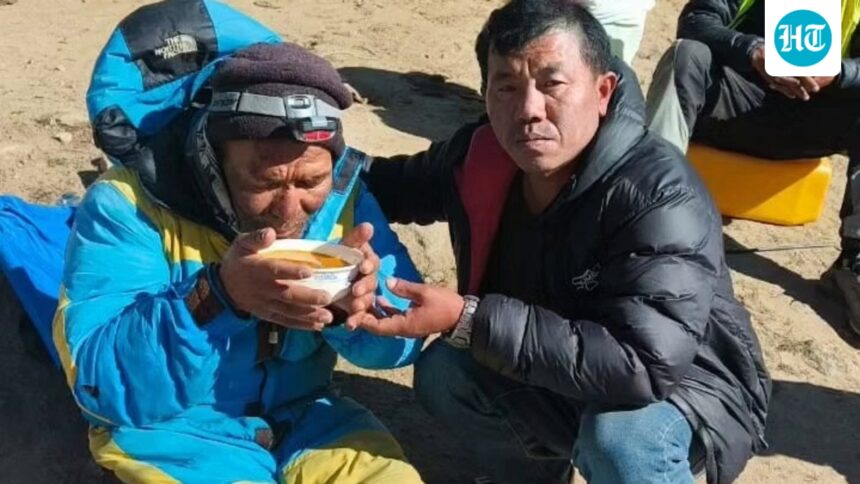
Dawa Sherpa, 52, was returning with a European climber when he disappeared between Camps Three and Four on May 29. He returned alive on June 4.

His family had begun preparing for his last rites. The search team lost hope, believing he was dead. It has been six days since Dawa Sherpa, a Nepalese mountaineer and climbing guide, disappeared on the upper slopes of Mount Everest, the highest mountain in the world, in bitter circumstances.

He lost all hope until a miracle happened. A team of sanitation workers from the Sagarmatha Pollution Control Committee, which is working to remove waste left on the mountain, spotted a man walking near the base camp. Cleaning workers rushed to bring him to the camp, where he was transported by helicopter to the hospital on a trolley.
Dawa Sherpa (52 years old) was returning with a European climber when he disappeared between camps three and four.

“A SPCC team found him this morning near the base camp, and he was crawling underneath,” Pemba Sherpa of 8K Expeditions, which is overseeing search and rescue efforts, told AFP.
The daughter did not believe at first that her father had returned
Dua’s family said he was in good condition and was undergoing treatment for frostbite and other complications, according to Reuters.
“He knows me…he is good and talks,” said Mohandu Lamu Sherpa, the guide’s daughter. “We are happy.”
Read also | “9 hours and 55 minutes”: An American climber, a cancer survivor, climbs Mount Everest in record time.
“Dawa survived alone for nearly a week without food, water or supplemental oxygen while navigating the treacherous Khumbu Icefall (even after removing the fixed ladders for the season),” Nepal Hiking Everest said in a social media post. “This is nothing short of a miracle.”

Dawa Sherpa’s wife, Damu Sherpa, said her family was thrilled.
“We were so happy to hear the news,” she said. “We had lost hope.” “We also started the puja (last rites prayer) yesterday.”
Read also | 3 Indians out of 274 who climbed Mount Everest set a new record
His daughter, Mindo Lamu Sherpa, said they almost couldn’t believe it when they received the phone call telling them he had been found.
She said: “At first we were not sure if it was him, but they sent us pictures to confirm, and then I felt happy.”
How was he left behind?
Chris Thrall, a former British Royal Marine who climbed Mount Everest this season with 1,000 others, was the climber Dawa Sherpa was helping.
Thrall posted a video detailing what happened on May 29 around 5 p.m., when the two began descending from Camp Four.
In a video message posted Wednesday on Instagram, he mourned Sherpa’s supposed death. Like the others, he also thought he would never come back.
He added: “He sat down to take a rest with his backpack. These men carry huge loads.”
“And I turned around and said, ‘Hillary, are you okay, bro?’ He said, ‘Yes, yes, okay Chris, please go, go!’ This is nothing new, you know, I’ll move on, he’ll move on.”

The Sherpa was known among climbers and friends as “Hillary,” after the great Edmund Hillary, who was among the first to reach the summit of Everest.
While descending, Thrall came across a Polish climber who was suffering after running out of supplemental oxygen and suffering from frostbite.
“It was a long journey to the summit,” Thrall said. “What should have taken us five days to the summit and back took us 11 days, that’s how tough the conditions were.”
“So, do I go back to Sherpa, who will probably shine and be fine, as he has done hundreds of times before?”
“Or do I help my fellow climber, who’s out of oxygen, has frostbite on his fingers, and you’re clearly not far from hypothermia back there?”
Thrall described the difficult conditions, explaining how he shared his oxygen cylinder with the Polish climber during their descent. The trip to Camp III took 11 hours; Under normal circumstances, it would only take two.
“I realized we had a really dangerous situation,” he said.
Search teams set out to find the Dawa Sherpa, but he was not seen again until Thursday morning, after making his way down on his own.
(With inputs from Reuters and AFP)