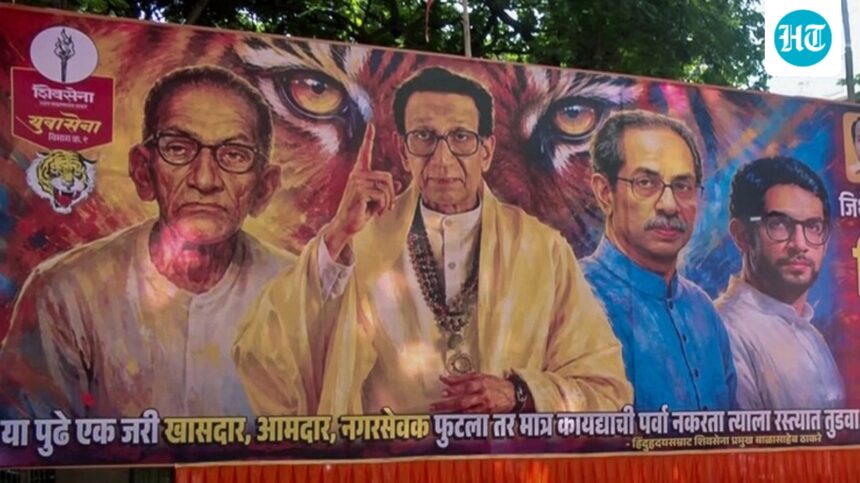
As the Shiv Sena celebrates 60 years since its founding by Bal Thackeray on June 19, 1966, the party is facing another insurgency.

Just four years after Eknath Shinde’s revolution split the party and wrested control of its name and symbol, six of the nine Lok Sabha MPs Shiv Sena (UBT) chief Uddhav Thackeray are now likely to resign, aligning themselves with the Shinde-led faction.
The recent unrest is the latest chapter in a six-decade political journey that has seen the Shiv Sena evolve from a Mumbai-centric regional movement into one of the most influential political forces in Maharashtra, while also witnessing multiple splits, leadership transitions and shifting alliances.
Read also: Second Sena split in 4 years: How Thackeray’s party is falling apart again
A timeline of Shiv Sena’s 60-year journey
June 19, 1966: Bal Thackeray founded the Shiv Sena. A year later, the party won its first civic polls in Thane and entered civic politics in Mumbai in 1968.
1985: The Shiv Sena came to power in the Brihanmumbai Municipal Corporation (BMC) for the first time, laying the foundation for its long dominance of the civic administration in Mumbai.
1990: The party allied with the BJP in the Maharashtra Assembly elections, winning 52 seats and emerging as the major opposition force in the state.
1991: Senior leader Chhagan Bhujbal engineered the party’s first major split, leaving with 18 MLAs to join the Congress.
1995: The Sena-BJP alliance formed the government in Maharashtra for the first time, with Manohar Joshi becoming the chief minister.
January 2003: Bal Thackeray appointed his son Uddhav Thackeray as the party’s chief executive, signaling a generational shift in the organisation.
2005: Raj Thackeray, Bal Thackeray’s nephew, resigned from the Shiv Sena after disagreements within the party and later launched the Maharashtra Navnirman Sena (MNS).
November 2012: Bal Thackeray died at the age of 86 after suffering a heart attack. Uddhav Thackeray officially took over as party president.
2014: The Shiv Sena contested the Maharashtra Assembly elections independently and won 63 seats. Despite initial disagreements, she joined the BJP-led government six months later.
September-November 2019: After winning the Assembly elections alongside the BJP, the Shiv Sena parted ways with its old ally over the chief minister’s post. Uddhav Thackeray joined hands with the Congress and NCP to form the Maha Vikas Aghadi (MVA) government and became Prime Minister.
June 2022: In the largest rebellion in the party’s history, senior leader Eknath Shinde led a revolt that brought down the MVA government. Shinde subsequently became Prime Minister as part of the BJP-backed Mahayoti alliance.
February 2023: The Election Commission has given the name ‘Shiv Sena’ and the famous bow and arrow symbol to the Shinde faction. The Uddhav Thackeray camp was renamed Shiv Sena (UBT) and allocated a burning torch symbol.
February 2026: The Thackeray-led faction lost control of the BMC, ending a decades-long association between the party and the Mumbai civic administration.
June 2026: Reports have emerged that six of the nine Lok Sabha MPs from the Shiv Sena (UBT) have sought to form a separate group, sparking speculation that they may eventually ally with the Shinde-led Sena. If the move materializes, it would represent another major split in a party whose history has been increasingly defined by internal rebellions.