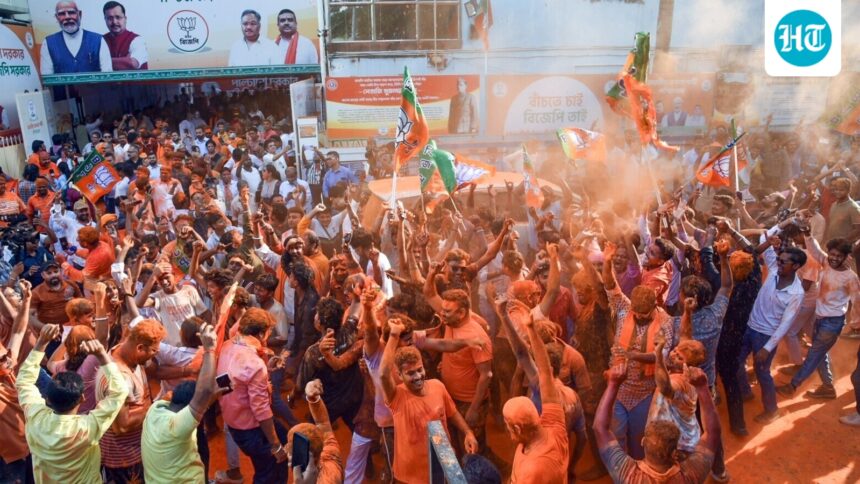
The BJP’s attempt to shed its ‘bohiragutu’ (outsider) label, its success in stoking fear of illegal immigrants, and its campaign that avoided personal comments on West Bengal Chief Minister Mamata Banerjee, even while highlighting mismanagement, succeeded in West Bengal, giving the party its first-ever electoral success in the state, party leaders said.

As of around 11:30 p.m., the BJP had won 206 seats in the Assembly — ensuring that the state that birthed Syama Prasad Mukherjee, the founder of the BJP’s predecessor – the Jana Sangh, would have its first BJP chief minister. Track latest updates on 2026 Assembly elections here
The above-mentioned leaders also credited the party’s local campaign, which used slogans like ‘Joy Ma Kali’ and ‘Joy Ma Durga’ instead of ‘Joy Shree Ram’ and focused on booth-level management, for its victory.
“Lotus flower in West Bengal! The 2026 West Bengal Assembly elections will be remembered forever. People power has prevailed and BJP’s good governance policy has triumphed. I bow down to every person in West Bengal. The people have given an amazing mandate to the BJP and I assure them that our party will do everything in its power to fulfill the dreams and aspirations of the people of West Bengal. We will provide a government that ensures opportunities and dignity to all sections of society,” he said. X.
Monday’s victory means the BJP has strengthened its grip on eastern India, with the exception of Jharkhand. Odisha and Bihar have BJP party resolutions (a first for them) and now Bengal will have its own. “We have succeeded in dismantling the opposition’s narrative that the BJP is a force in the Hindi-speaking belt and our ideology, based on the premise of nation first, has limited appeal. Mamata Banerjee’s loss is not just limited to the state, it is a message to the India assembly as well,” said a senior party leader, speaking on condition of anonymity.
According to several senior leaders involved in the BJP campaign, the party changed its tactics after its loss in 2021 to establish itself as a local entity.
This time, the BJP has selected state leaders to lead the campaign on the ground, with key strategists like Union Minister Bhupendra Yadav and national general secretary Sunil Bansal behind the scenes.
After the election of veteran BJP leader Samik Bhattacharya as state president, the party sought to bridge the gap with old members who had felt marginalized over the years.
“Many old members were brought back and all of them worked in the party this time. Some like Ritesh Tiwari, got tickets and others got some other posts in the party,” another senior leader said. Tiwari won Kashipur-Belgachiya by a margin of 1,651 votes.
The threat of “Gisbethia”.
The major focus of the campaign was on the threat from “gospiethia” or illegal settlers. This fear has been emphasized by everyone from the karyakarta (volunteer) at the lowest level to the Prime Minister. A third senior leader said the BJP had pushed the incumbent to overlook the dangers of porous borders for the sake of votes.
Union Home Minister Amit Shah, who oversaw every minute detail of the strategy and campaign, and was in the state for at least two weeks, turned his guns on the state government for not allowing border fencing.
Addressing several rallies, he declared that the BJP will not allow India to become a ‘dharamshala’ (shelter) and will ‘detect, delete and deport’ all illegal settlers.
Instead of directly attacking Banerjee at the rallies, the Prime Minister referred to the TMC-led government as “Nirmam Sarkar”, and highlighted crimes against women, such as the rape and murder of a medical student at RG Kar Medical College in Kolkata, the rape at a law college in Kasba, and attacks on women in Sandeshkhali, which leaders said helped inflame anti-incumbency sentiment.
“Do you remember the ‘diddi-o-didi’ sarcastic tone that Modi used many times to attack Mamata Banerjee during his campaigns ahead of the 2021 Assembly elections? You did not hear a single such comment this time. Personal attacks against the sitting Prime Minister are completely missing,” said Rabindranath Bhattacharya, former political science professor at Burdwan University.
“Political observers were confident that the TMC would benefit from the SIR controversy. But the BJP was able to control the narrative… We said these are names of either illegal settlers or deceased. There may have been some exceptions, but this was largely an exercise by the Election Commission to clean electoral rolls,” a fourth senior leader of the party said, referring to the 9.1 million deletions under the SIR.
Dissatisfaction with administrative lapses
The party machinery also built on resentment against administrative lapses, infrastructure, employment gaps, and law and order, strengthening working-class support.
The party’s manifesto presented the ‘Bhurushar Chopoth’ (Department of Trust) focusing on issues of immediate concern and balancing regional aspirations. “We promised $3,000 for women, unemployed graduates, implementation of the Seventh Pay Commission – all these are issues that resonate with people. “There is something for everyone from students to farmers and those who want Bengal to shake off its communist vestiges and grow into a bustling economy,” the first leader quoted above said.
The monthly cash incentive was used to shrink the TMC’s women’s vote base and promise to launch the Ayushman Bharat scheme, which guarantees free healthcare up to $5 lakh per family, opposes the Swasth Sathi health insurance scheme.
One of the TMC’s biggest strengths has been the social welfare programmes, many of which involve cash grants, launched by the state administration over the years – Lakshmir Bhandar, Widow’s Pension and Krishak Bandhu. The BJP, in its 2021 campaign, criticized the schemes but did not come up with any alternatives leading to TMC claiming that the BJP will stop the schemes if it comes to power.
“But this time, the party confronted the TMC by promising different schemes if it comes to power with double benefits. While the TMC gives $The BJP promised 1,500 for women under Lakshmir Bhandar $3,000 under Matrishakti Bharosa card,” said a fifth senior BJP leader.
Management at ward level
Unlike past elections, the BJP worked on management at the booth level. Party leaders said the booth-level analysis has identified around 180 seats where the party will battle. This is in addition to the strongholds in North Bengal and the tribal areas.
Biswanath Chakraborty, a political commentator, said the BJP was able to highlight corruption and focus on very local issues.
The second party leader quoted above said: “The tag of buhirajutu (outsider) was a hindrance…even if it was a fallacy. The founder of the Jana Sangh, Syama Prasad Mukherjee, was a son of Bengal. The state is the land of Shakti (goddess) and cultural richness which is passionately Bharatiya. So, how can a party that embraces all this become an outsider.”
Addressing an event in New Delhi to celebrate the election result, Home Minister Amit Shah said: “This historic victory for the BJP in Bengal is the result of the sacrifices, struggles and martyrdom of countless of our workers. It is a victory for the patience of those families who, even while enduring violence, never abandoned the saffron flag.”