A couple and their son were killed and several homes were set on fire as new violence erupted in the ethnic violence-hit state of Manipur, where two armed groups exchanged fire on Friday, although the hostage crisis remains unresolved in the northeastern state.

Residents and community organizations said the shooting started around 4:10 a.m. in the Loybul Khlin area of Kangbukpi district. Officials said Litkunjam Hokip, his wife Tinmari Hokip and their son Jangminlal Hokip were killed in the violence.
Deputy Prime Minister Nimcha Kipgen described the killing of the three and the burning of homes “by unknown armed assailants” as a tragic and unacceptable act. He said that the government takes the incident seriously. “Necessary steps are being taken and those responsible will be dealt with in accordance with the law. The safety and security of our people remains our priority.”
Kipgen appealed to everyone to remain calm and not be provoked by those who seek to incite fear and division. “At this moment, we must stand together and support the families and communities affected.”
Kuki Inpi Manipur (KIM), the apex body of Kukis, said seven houses were destroyed and property was severely damaged. It blamed armed cadres of the National Socialist Council of Nagalim-Isak Muivah, a Naga armed militant group, and a faction of the Zeliangrong United Front-Kasum, for the violence against the Kukis. The organization described the incident as a “barbaric attack” that targeted civilians.
There was no immediate response from the groups mentioned in KIM’s statement.
Kim described the killing of the three and the destruction of the homes as a serious human rights violation and called for accountability. She urged the Union government and security agencies to conduct a thorough investigation, identify those responsible and take necessary measures to protect vulnerable villages from further attacks.
The new violence came days after a hostage crisis escalated tensions between the Naga and Kuki, the latest in a series of crises in the northeastern state, where ethnic violence has continued on and off since May 2023. Tribal leaders, associations of chiefs, church forums, charitable groups and lawmakers have sought to end the tensions.
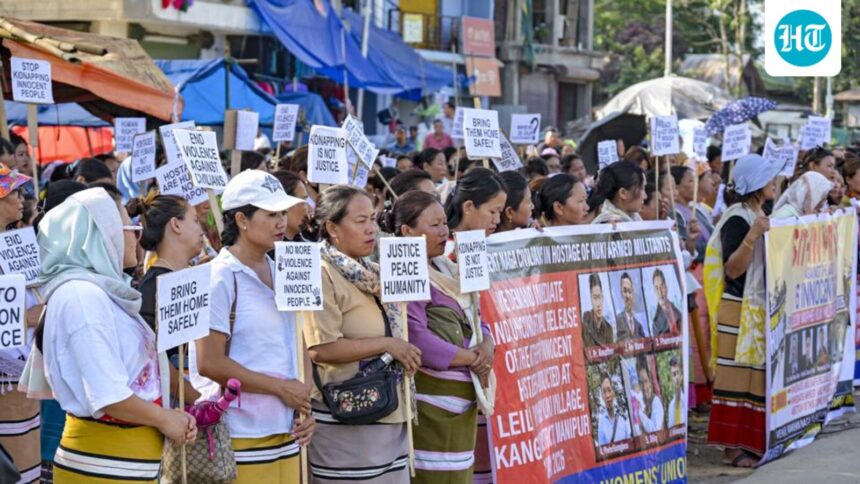
Tensions between the Naga and Kuki escalated following the double ambush on May 13 that left four people dead, including three church leaders. Following the ambushes, 48 people were taken hostage, leading to protests, closures and blockades along the state’s three national highways.
State Home Minister Govindas Kunthugam said both Kuki and Naga have been taken into custody. Fourteen of the Kuki and Naga hostages were released on May 15. The United Naga Council, a community body, said six Nagas were taken hostage, prompting security forces to launch a search operation.
The National Investigation Agency took over the investigation into the whereabouts of the six Nagas, after security forces were unable to find them in the Kuki-Zu area. The fourteen captive Kuki-Zos are in captivity and are being counted.
Ethnic clashes in Manipur first began between the Meitei and Kuki communities before encompassing almost all communities. The state’s Meite and Kuki Zou communities have isolated each other from areas they dominate since ethnic clashes began in May 2023 and left at least 260 people dead and 60,000 displaced.
The Metis people, most of whom are Hindu, live largely in the Imphal Valley. The Kuki family, most of whom are Christians, reside in the hills. The state government confirmed that there are no buffer zones dividing communities in the state, but it has identified some sensitive areas.
In February, a new state government was formed, almost a year after the “presidential law” was imposed. It includes representatives of the three main communities as part of an attempt to maintain ethnic balance.