“How good would you be at something if you had been doing it for over a hundred years?”

So goes the theme of The Royal Edit, an ongoing exhibition featuring 105 heirloom sarees that were originally woven for the Mysore royal family by Vijayalakshmi Silks Limited (VSL), and recreated by them to celebrate 105 years of their business (they turned 100 in 2020, amid the Covid-19 pandemic). Judging by the take-out record on opening day, that’s pretty good!
The story of VSL is closely linked to the history of silk in Karnataka. If India is the second largest silk producer in the world after China, Karnataka is the largest producer of mulberry silk in India, contributing a whopping 45% of the country’s production. Bengaluru itself is at the heart of India’s silk ecosystem, sandwiched between Asia’s largest silk cocoon market at Ramanagaram (45 km south-west), India’s second largest at Sidlagatta (65 km north), the major sericulture centers of Kolar and Chintamani (70 and 85 km north-east) and the central silkworm germplasm resource center at Hosur (45 km south-east). Even the notorious traffic gridlock in downtown Bengaluru — the Silk Board Junction — is part of the story.
Silk came from China to India via the sea route – on the Coromandel Coast, the Pallavas were the first to weave Chinese silk threads into cloth in their capital, Kancheepuram, in the 7th century. In the 15th century, “treasure voyages” fleets sponsored by the Ming Dynasty reached the Malabar Coast. In the 16th century, the Vijayanagara Emperor Krishnadevaraya designated Kanchi as the center of silk weaving in the empire, sparking enthusiasm for… Devangas and saligar, Master weavers from Andhra moved to Kanchi, where they incorporated temple-inspired designs into their weaving, creating the famous Kanjeevaram saree.
The founding of Bengaluru House in 1537 attracted many weaving communities, making the city famous as a weaving centre. But it was not until the 1780s, when Tipu Sultan, impressed by the length of fine silk given to him by a Qing ambassador, decided to cultivate silkworms, and sericulture began in earnest. By the time his delegation returned from Bengal with a collection of Chinese silkworms, 22 designated centers across the kingdom had begun cultivating the mulberry. The silkworm adapted to the climate of Mysore and evolved into a completely new race – the pure race of Mysore.
After Thibaut’s death in 1799, sericulture declined until 1866, when it was revived by the Italian expert, Signor de Vecchi (Italy was by then becoming Europe’s leading producer of fine silk, aided by technological innovation), who obtained silkworm eggs from Japan, which began to surpass China in expertise. In 1893, J. N. Tata went further, hiring a Japanese couple, the Uzos, to run a free training school – the Tata Silk Farm – on land given by the Maharani Kempanangamani on the edge of Basavanagudi. Rolled and woven silk from the Tata Silk Farm won ten gold medals at the 1912 London Silk Exhibition, bringing international fame to Bengaluru silk.
In 1911, Maharaja Nalvadi Krishnaraja attended Delhi’s Wadiyar Durbar and was so impressed by the luxurious silks worn by King George V that he ordered 32 advanced power looms from Switzerland in 1912, as part of Mysore’s push toward industrialization. The fine liquid silk woven by these powerful looms – Mysore Silk – was among the first Indian products to bear the GI mark.
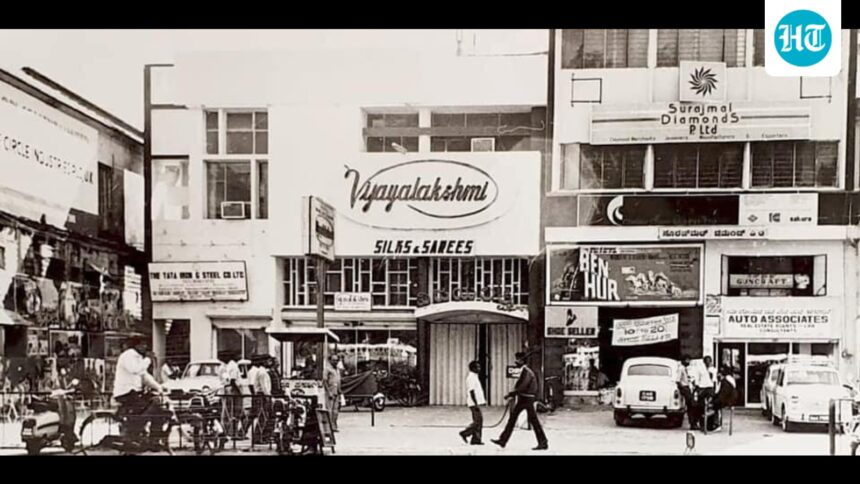
In this exciting environment, a precocious 14-year-old named Devatha Adappa Venkat Ratnam Setty, the scion of a merchant family from Kolar, set up his first shop in Chickpet – Sree Vijayalakshmi Hall. In 1963, firmly established as Bangalore’s pre-eminent suppliers and custodians of fine silks from across the country, VSL moved out of Pete’s and onto the main street, establishing its first saree store on MG Road, the beloved landmark we know as Vijayalakshmi Silks and Sarees.
Royal Liberation by VSL continues at Sabha on Kamaraj Road till April 24.
(Rupa Pai is a writer who has had a long-lasting love affair with her hometown of Bengaluru)