India on Thursday quantified the damage inflicted on Pakistan during Operation Sindoor, with a senior military official saying the armed forces struck terror camps, airports and aircraft in a calculated operation that began after the Pahalgam terror attack.

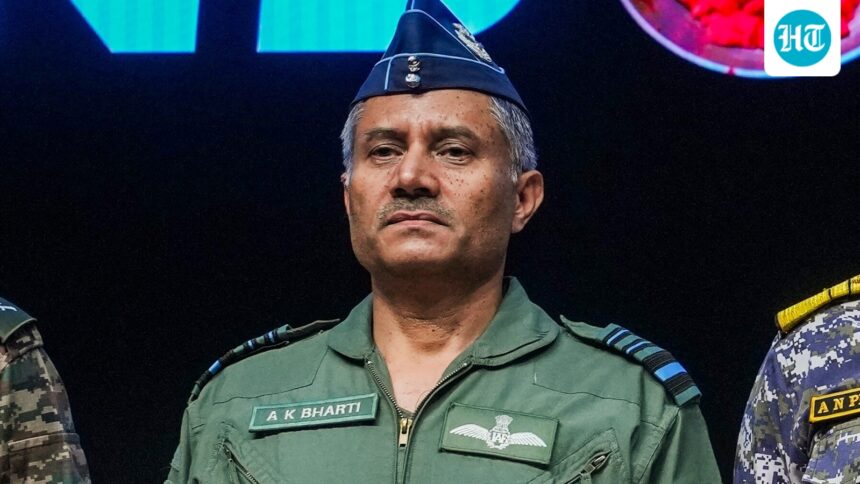
Addressing a press conference marking the first anniversary of the operation, Air Marshal AK Bharti said India carried out precision strikes on terrorist infrastructure across Pakistan and Pakistan-occupied Kashmir.
He said: “We struck and destroyed all nine of their terrorist camps on May 7. The proof is there for all to see. We struck 11 of their airfields. We destroyed 13 aircraft either on the ground or in the air, including a high-value aircraft airborne at a record distance of more than 300 kilometres.”
Bharti was also asked during the briefing about the losses incurred by the Indian side during the military operation and the escalation that followed it. In response to the question, he said: “Neither our military infrastructure nor the civilian infrastructure was damaged.” He added that they “were unable to cause any serious damage.”
“Live and let live”
Air Marshal Bharti stressed that India’s actions were specifically targeting terrorist infrastructure and were carried out with restraint.
He said that India has traditionally followed the philosophy of “live and let live”, but stressed that the country responds firmly whenever this spirit is challenged.
According to him, Operation Sindor reflected a “calculated but forceful response” designed to deter future attacks.
Referring to the Pahalgam terror attack that took place on April 22, 2025, in which 26 civilians were killed, Bharti said India cannot undo the loss of lives, but it can work to ensure that such incidents do not recur.
He noted that Operation Sindoor, which remains temporarily stalled, was launched to achieve precisely this goal.
The operation began after the Pahalgam attack
Operation Sindoor began on May 7, 2025, days after the terror attack in Pahalgam. During the operation, the Indian Armed Forces targeted nine terrorist bases located in Pakistan and PoK.
Bharti said that the armed forces were given clear strategic direction along with complete operational freedom to execute the mission.
He described the strikes as a decisive operation against “officials and their supporters,” adding that the planning was based on intelligence and carefully carried out to minimize collateral damage.
He said operational ethics remained central to the mission, with efforts made to avoid civilian casualties.
Pakistan’s response and call for a ceasefire
Following Operation Sindoor, Pakistan launched retaliatory drone and drone attacks targeting Indian air bases and logistics infrastructure, according to officials.
But India said that these attempts were successfully neutralized.
On May 10 last year, Pakistan’s Director General of Military Operations (DGMO) made a hotline call with his Indian counterpart.
This conversation eventually led to an agreement between the two sides to cease all fire and military actions across land, air and sea as of 5 p.m. EST on the same day, according to an official statement issued at the time.