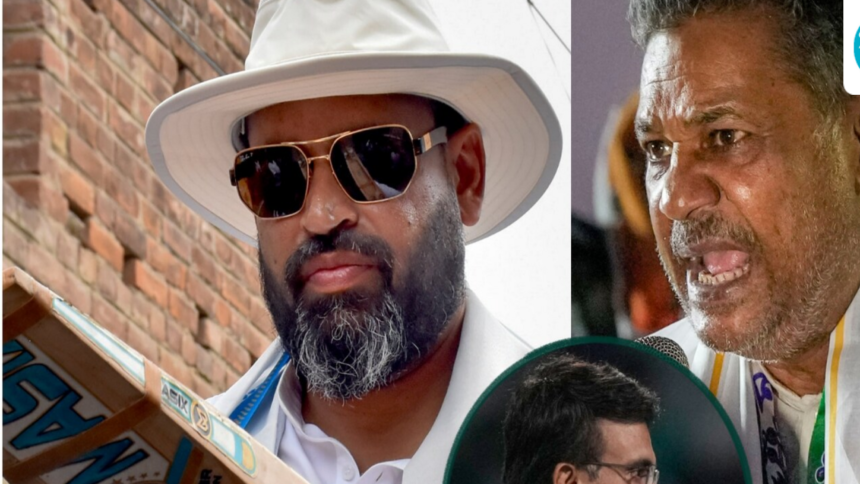
Pathan and Ganguly were teammates in Kolkata. Azad and Pathan are both World Cup winners, with Ganguly one of Team India’s most prominent captains

The Trinamool Congress crisis has an unlikely subplot. There are three familiar names from Indian cricket, each standing in a different corner.

Most vocal is Kirti Azad, a member of India’s 1983 World Cup-winning team and now TMC’s Bardhaman-Durgapur MP, who has emerged as one of Mamata Banerjee’s fiercest defenders against the rebels. Originally from Bihar but a long-time leader with political roots in many places, Azad used to be an all-rounder – a right-handed batsman and an aggressive right-arm bowler.
Kirti Azad criticizes the rebels
Azad denied the rebels’ claim that there were 20 deputies with them. Terming it the “fake and fabricated narrative of the BJP’s dirty tricks department”, he insisted that only 13 people attended the rebel meeting and “no one else signed on the dotted line”.
He was frank about their motives at a press meet in New Delhi on Tuesday: “If you want to go to the BJP, say it openly.” Regarding Kakoli Ghosh Dastidar, who is leading the revolution: “Kakoli lost five elections, yet Mamata Banerjee appointed her as an MP.”
Azad said he and other loyalists were “born of struggle.” The son of former Bihar CM Bhagwat Guha Azad, who was a Congress stalwart and freedom fighter, Kirti Azad has had a political career that runs through three parties, the BJP and the Congress, besides the TMC at present. He was an MLA from Delhi, and then a multi-term MP from Darbhanga in Bihar, before winning his current Lok Sabha seat in West Bengal for TMC.
Yusuf Pathan, the universal other
In the opposite corner are Yusuf Pathan, of India’s 2011 World Cup-winning squad, and TMC’s Baharampur MP, who also happens to be a batsman like Kirti Azad.
Pathan, a Gujarati who became an Indian Premier League star with Kolkata Knight Riders, is now the subject of defection talk with the party’s Lok Sabha unit split and the rebel camp claiming that nearly 20 of the 28 MPs are in favor of the NDA.
Mahua Moitra publicly accused Pathan, who had remained quiet till the afternoon of June 9, of “rushing into Delhi” on the call of Union Home Minister and BJP leader Amit Shah. Shah and Prime Minister Narendra Modi also happen to be Gujarati.
Moitra asked Pathan to show “some shame and some backbone”.
Another MP loyal to Mamata, Kalyan Banerjee, said Pathan told him that Shah had summoned him. Pathan has not taken a public stance.
Dada denies having a role
The third is the biggest star of the three, Sourav Ganguly, who is not a politician at all, but was drawn regardless.
A front-page report in daily Bangla last week said the former India captain and opening batsman acted as an emissary for Mamata Banerjee, asking Pathan to vacate his seat so she could contest a by-election. Pathan said no, the report claimed.
Ganguly flatly rejected the report in a statement issued on June 6, saying he “never approached or contacted Mr. Yusuf Pathan” and “never participated in political matters at any stage.” He called on the media not to “fall prey to rumors and speculation.”

The threads go back as much to the locker room as to the numbers in Parliament House. Pathan and Ganguly were previously teammates at Kolkata Knight Riders; Azad and Pathan are both World Cup winners. Ganguly, who also bowled medium pace, led India to the 2003 World Cup final and built a powerful new Indian cricketing tradition.
The TMC has long attracted candidates from film and sports, and in 2024 sent both Azad and Pathan to Parliament from Bengal.
Ganguly, who is called “dada” (brother in Bengali) by fans, is constantly receiving offers to join politics, as he is a big cultural star in Bengal in particular; He said, but he’s not interested.

Arish Chhabra is an associate editor on the Hindustan Times online team, where he writes news reports and explanatory features, as well as overseeing the site’s coverage. His career spans nearly two decades across India’s most respected newsrooms in print, digital and broadcast. He has reported, written, and edited across formats—from breaking news and live election coverage, to analytical long-reads and cultural commentary—building a body of work that reflects editorial rigor and a deep curiosity about the community for which he writes. Areesh studied English Literature, Sociology and History along with Journalism at Punjab University in Chandigarh, and began his career in that city, eventually moving to Delhi. He is also the author of Little Big City: What Life is Like from Chandigarh, a collection of critical essays originally published as a weekly column in the Hindustan Times, which examines the culture and politics of a city that is much more than just its famous architecture – and in doing so, holds up a mirror to modern India. During his stints at BBC, The Indian Express, NDTV and Jagran New Media, he has worked across formats and languages; Mainly English, as well as Hindi and Punjabi. He was part of the crack team for the BBC Explainer project which was replicated around the world by the broadcaster. At Jagran, he developed editorial guides and trained journalists on integrity and quality content. He has also worked at the intersection of journalism and education. At the Indian School of Business (ISB) in Hyderabad, he developed a website to streamline academic research in management. At Bennett University’s Times School of Media in Noida, he taught students the craft of digital journalism: from newsgathering and writing to social media strategy and video storytelling. Having moved from small town to larger town to megalopolis for education and work, his intellectual passions lie at the intersection of society, politics, and popular culture—a perspective that guides his writing and worldview. When he’s not working, he’s constantly reading long-form journalism or watching cerebral content, sometimes both at the same time.Read more