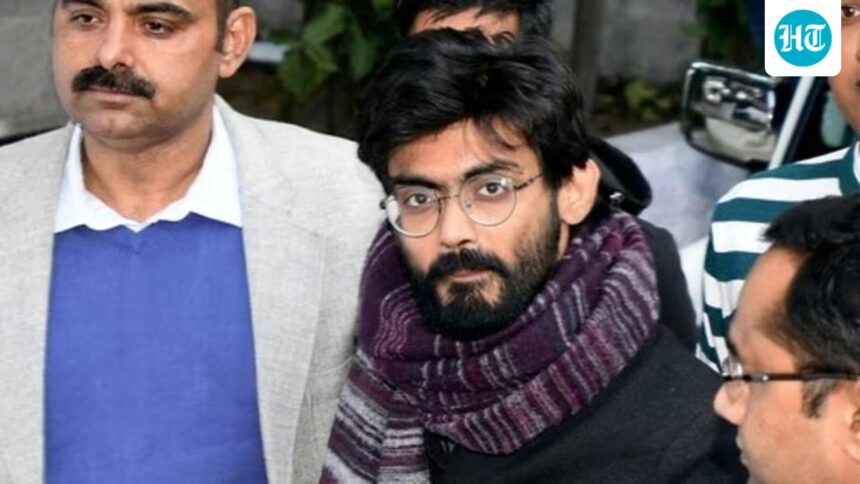
The Delhi High Court on Friday issued notice on the bail application filed by student activist Sharjeel Imam in the larger conspiracy case linked to the February 2020 Delhi riots.
A bench of Justices Prathibha M Singh and Vikas Mahagen sought the Delhi Police’s response and fixed August 27 as the next hearing date.
“They issued notification of the list on August 27,” the court said in its order.
Sharjeel, through his lawyer Ibrahim and Taleb Mustafa, moved the Supreme Court against the court’s July 4 order.
On July 4, the court of first instance refused to release Sharjeel and Omar Khalid on bail, saying that there were no grounds to “accept” the new petition, because it could not even examine whether the circumstances had changed since the Supreme Court rejected their petition in January.
Additional Sessions Judge (ASJ) Sameer Bajpai of Karkardooma Courts observed that the difference of opinion between the Supreme Court’s January 5 judgment in the Gulfisha Fatima case and the subsequent judgment in the case involving Syed Iftikhar Andrabi had already been referred to a larger bench of the Supreme Court. The court of first instance said that until the matter was settled, it could not consider new applications for any reason.
Read also: Delhi court grants 10-day interim bail to Sharjeel Imam in 2020 Delhi riots case to attend his brother’s wedding
In that case, the Supreme Court expressed “serious reservations” about the reasoning adopted in the January 5 judgment, and observed that it may not have properly applied the principles laid down in the 2021 judgment in Union of India v. K. A. Najib, who acknowledged that prolonged imprisonment and delayed trial could exceed the legal restrictions on bail contained in Section 43D(5) of the Unlawful Activities (Prevention) Act.
The court issued notice after Sharjeel’s lawyer argued that the trial court had erred in holding that there were no grounds to entertain a fresh bail application. They stressed that the result was wrong because the trial had not made any progress, and charges had not yet been brought. The lawyer noted that the stage of the proceedings has remained unchanged since January, when the Supreme Court rejected Sharjeel’s bail application.
Opposing the bail application, Additional Solicitor General (ASG) SV Raju, representing the Delhi Police, contended that the trial court, in its January order, had already considered the issue of delaying the trial while denying bail. He further said that a significant amount of time was spent listening to the arguments regarding the framing of the charges. Raju added that the police will provide a detailed response to the bail application.
The Delhi Police arrested Sharjeel on 28 January 2020. They detained them under the stringent Unlawful Activities Prevention Act (UAPA), alleging that the two were the architects of the entire conspiracy, working alongside other conspirators, which escalated into large-scale communal violence during the Delhi riots in February 2020. The riots erupted into violence on 23 February 2020, following protests against the then proposed Citizenship Amendment Act (CAA), which It left 53 dead and hundreds injured.