For years, Keith Olbermann, former ESPN Sports Center And MSNBC the countdown Anchor, one of the holy grails of baseball cards was used…as a paperweight.
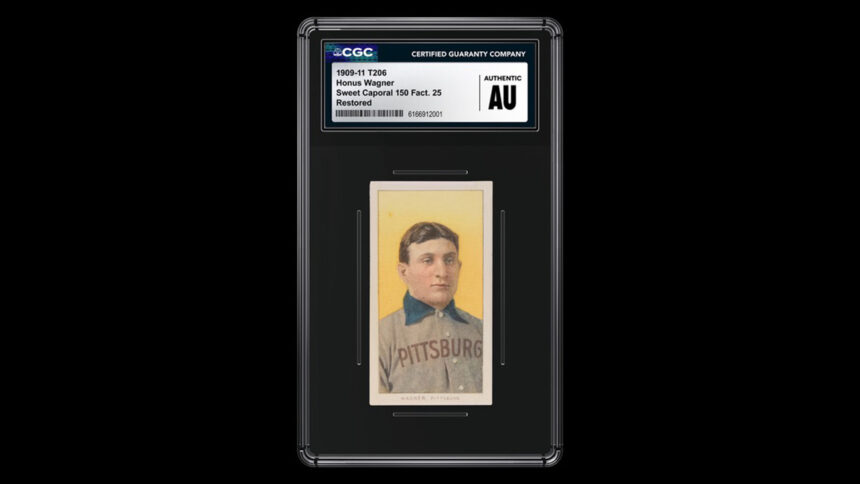
Now, says the TV veteran Hollywood Reporter The card in question has been authenticated and cut by the CGC, and will go up for auction later this summer at Love of the Game Auctions, after making its debut at Fanatics Fest in New York next week, alongside rare Wayne Gretzky and Mickey Mantle cards.
The card in question is a T206 Honus Wagner card. Specifically, it was a card known as the “Die-Cut Wagner,” which disappeared in the mid-1990s, only to find its way into Olbermann’s vast card collection in one of the most bizarre stories of rare collector’s items.
“You’ve heard the phrase an abundance of caution,” says Olbermann. “This is what happens when you have too much caution.” “I’m the guy who had the Mona Lisa sitting in the closet, or in this case in the office, and it was literally in a Lucite holder like a paperweight, and sometimes I would carry stacks of 1995 spring training baseball programs, and I think that my stupidity just adds to the story a little bit.”
So, what happened? In the late 1990s, Olbermann read an article about someone who restored baseball cards. He sent him a “small project,” and he did so well that the idea of a larger business came to his mind.
“He said, ‘I have a really unconditional option to buy a Wagner, and it’s barely even a card, but I think it’s a perfect candidate for the type of restoration I’m doing,’ and so he set me a price, and I think we worked out a two-year installation plan for me to pay him, and by the time I got it, which was early 1999 and he delivered it to me in person, and I met him, and this card is what you see now, it’s not perfect, but it’s the next best thing.”
It was then that things went off the rails.
“I went on a trip for Fox to anchor the Super Bowl for two weeks, and then I came back and took the card out of my safe in Southern California, looked at it, and said, ‘This is unbelievable, literally, almost unbelievable,’” Olbermann recalls. “I needed to know how he did it. I need to see his studio, which is something we talked about while we were restoring it, and he said, yeah, you can come over and I’ll show you the tools and what I did with them, and what’s left of the donor card, and everything else.
“So I called him, his phone went off, I emailed him, the email came back, I wrote a letter, it came back in the mail, ‘Not at this address,’ and if you had any doubt about what was in front of you, that would be amplified by that kind of response,” he added. “The man, as far as I knew, had disappeared into the ether, so I didn’t know what I had. I wasn’t sure, and I didn’t want to go and find out.”
Olbermann ended up taping the card into a glass holder and keeping it on his desk, until last spring, when “I bought a card from someone on eBay, who then messaged me and said, ‘By the way, I think you have my old Wagner. I’ve always been told my old Wagner was bought and restored, and you bought it, and I said, ‘Well, that’s an interesting coincidence.'”
So Olbermann brought it to CGC to help verify that it was in fact Wagner’s long-lost piece.
“We treated it like any other card, in this case, we knew there were restorations we were looking for, which made it a little easier, but we’re trying to make sure that the core, or the part that represents the original Wagner, is actually what it’s supposed to be, so we reviewed it with the grading team,” says CGC’s Andy Broome. “We also used some of the technology we have, different things like video spectral comparator, which is a fancy way of saying, you know, I’m using different wavelengths of infrared and ultraviolet and other types of lighting.
“As you can imagine, the image of Honos was cut out around his head and shoulders, and it’s a die cut, and we can see where that was put together, and we can see some of the adhesive that was used, and we can see where the color was re-matched in the panel to make it essentially seamless, and we were able to discover that the card parts were from a donor T206 card and matched them beautifully, and so we’ve just confirmed what Keith found out many, many years later, that this was in fact what’s known as a Wagner die cut that was made Restoration.
While restorations are common in fine art, fine watches, and other parts of the big collectible business, they are still somewhat scorned in the world of baseball cards, where trimmed and modified classics (including a T206 Wagner or two!) have left buyers burned. Olbermann and CGC are betting that by being completely open about the restoration process, these concerns can be alleviated.
“If you had the Mona Lisa, or you had a copy of the original Declaration of Independence, you wouldn’t throw it away or leave it behind because it was contaminated with coffee,” Olbermann jokes. “I mean, actually, you’d try to fix it, and it seemed to me that as long as it was legitimate and recognized it was an art form in and of itself, and allowed the possibility of having people enjoy high-end cards without necessarily bankrupting themselves, and also, simply, you know, it’s a shame to see a great collectible or collectible sports set of any kind damaged, and in a way, it’s a wonderful, if that’s not a very silly word, everyone is withholding. This.”
“You can’t put your hands on the Venus de Milo, you don’t do it on every occasion, you don’t have to do it on every card, but I think it would be better if the restoration work done on the cards in this hobby was at the forefront,” he adds.
However, it begs the question…why would we sell one of the holy grails of baseball cards? A card that disappeared 30 years ago only to return today?
“I’m 67, and I’m a little older, not quite, but a little more mature,” says Olbermann, noting that he already owns another T206 Wagner with the white border cut out, as well as proof of the iconic card in question. “This card should have its own home. It should be on display somewhere, at least in someone’s home, rather than, as I said, my lax oversight of this card, because it’s not just a Wagner, and it’s not just a Wagner that had its own past before anyone restored it, but the restoration itself is incredible in some ways.”
“The decision to auction them depends largely on one thing, which is how many Wagner pieces does one person need?” He says. “It turns out I have three right now. I thought I had two.”
Olbermann’s T206 Wagner will be on display at the Fanatics Festival next week.