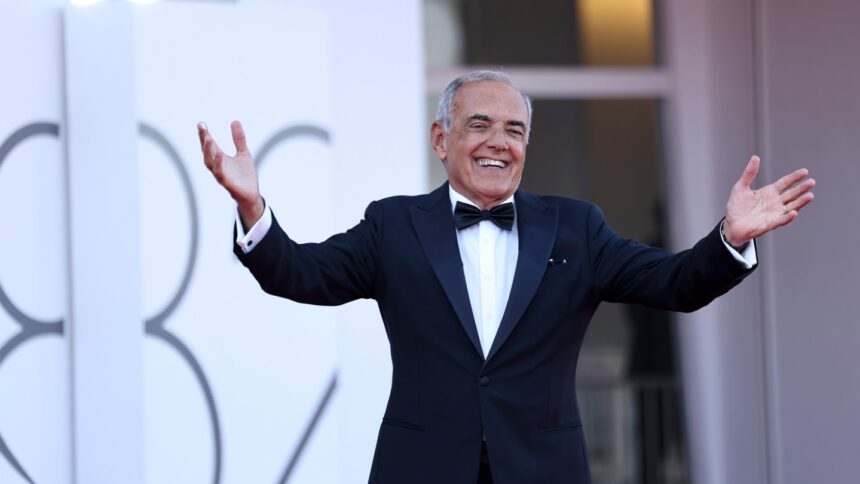
Artistic director Alberto Barbera revealed the lineup for the 83rd Venice International Film Festival on Thursday, and as always, there’s no shortage of firepower from the auteurs heading to the Lido.
The competition list includes: Peak timeStarring and produced by Robert Pattinson; BunkerWith Penelope Cruz and Javier Bardem; inkfeaturing Jack O’Connell, Guy Pearce, and Claire Foy; and Echo chamberLed by Alicia Vikander. There are also highly anticipated new features from Martin McDonagh (Nine wild horses), Li Chang Dong (Potential love(and Werner Herzog)Baking Fastard).
But compared to last year — when Jacob Elordi, Dwayne Johnson, Emma Stone, George Clooney, and Julia Roberts helped turn Venice into a red carpet supernova — the wattage is noticeably lackluster. Film lineups are also negligible at Hollywood studios, continuing a worrying pattern seen this year in Berlin and Cannes: major companies are increasingly ignoring major festivals.
Equally evident is the gender imbalance. Of the twenty films participating in the competition, there is only one film, which is the Danish drama directed by Mai Al-Toukhi Unknown woman – It has a female director. Nearly a decade after Barbera signed a 50/50 by 2020 pledge to improve representation of women filmmakers in Venice, the numbers offer little evidence of progress.
In a wide-ranging dialogue with Hollywood ReporterBarbera addressed the studio’s slowdown, the gender equality setback in Venice, and whether AI-made films have a future on the festival circuit.
How are you?
very good. In fact, I’m already exhausted. Now I have to work on the examination schedule. Everyone wants to play on the first weekend, which is impossible. Then we have actors who have commitments and commitments because they are on set and can only be there for 20 to 24 hours. It is very complex and difficult. Just endless discussion. Over the next two weeks, we will reschedule several times. It’s a nightmare. The worst part of my job.
Well, congratulations on at least finalizing the lineup. What are you most proud of about being selected this year?
The truth is that the mix of films combines big names with young talent. We have new arrivals from all over the world. This is of course part of our mission, which is to reflect world cinema. But this year is much more diverse than previous years. There are a lot of discoveries, and a lot of newcomers. In the main competition we have only nine films from directors who have been to Venice before. Others are completely new to the main competition. Some of them are very young and very talented.
We also have a lot of documentaries, very strong documentaries, more than usual, this year. It’s very powerful and very relevant and I think it will have an impact. We abandoned the idea of showing many TV series this year, and that too, from a quality point of view, were not interesting. We prefer to show more documentaries.
One thing I noticed is that, as at other big festivals this year, there aren’t a lot of big studio films.
No, no big studio films. Because it is not available. only [studio movie] We were hoping to land in Venice [Alejandro G.] Inarritu movie with Tom Cruise[[digger]. But Warner Brothers decided not to do any festivals and released the film at the beginning of October, skipping all festivals. That their marketing strategy. There was no room to discuss the matter with them.
But no other major studio films were available at the right time. The films that deals were speculating over the past two-three months were not ready. Alan Sorkin movie[[Social account]Not ready. They decided to reshoot some scenes in August, so the film wouldn’t be ready in time for its screening in Venice. David Fincher movie[starringBradPitt[BradPitt-starrerThe Adventures of Cliff Booth]which was highly anticipated, also for us, is not ready because Fincher had to pause for personal reasons. It’s been delayed a bit and will probably be ready in October, but not in time for Venice.
But there were no other major disappointments because the films were not ready. Can you name one movie from a studio that was ready that isn’t in Venice? naturally Sand dunes 3 Not ready. It will be released around Christmas.
The problem is not that studios have chosen not to bring their films to Venice, the films are simply not finished yet. I can’t say it’s common for studios to skip festivals. It’s a temporary situation, the result of a film production schedule that major festivals like Cannes and Venice can’t reach.
Next year we’ll see. Maybe the studio will return to the festival. Or maybe not. Because we know that all studios are rethinking their marketing strategies, because marketing films is becoming more complex and difficult. If you have a blockbuster, or a Tom Cruise movie, it’s easy. You release the film and people come. With other films it’s more difficult because the traditional marketing tools don’t work anymore and they’re still building new ones. So we’ll see what happens.
As marketing strategies change, does that change the role a festival like Venice plays in the industry?
I don’t see any big changes in the near future. The future, by definition, is unpredictable. But I can’t see a big revolutionary change in festival houses. If major Hollywood films decide to skip festivals, we will improve our role in promoting independent films, new talent, and new filmmakers – auteur cinema from around the world. It is part of our mission and something we have always done. Maybe we’ll do more of that.
One movie I was surprised not to see in the lineup was Luca Guadagnino industrial. Was that ready? Have you checked it?
Yes. I saw the movie. I love the movie. I think it’s a great, great movie. The only problem is that Neon only bought it a few weeks ago [after Amazon MGM dropped the film]. I had a long discussion with [Neon boss] Tom Quinn. He said he was very sorry. He believes that the film is a strong contender for next year’s Oscar. But they won’t be ready to release the movie until early 2027. They will release it in December to qualify for an Oscar but they’re not ready yet. I think the movie was probably too expensive for them. They spent a lot of money to buy the movie. Now they need to sell it all over the world and they don’t want to [to premiere] The film was sold out everywhere. So they decided to skip the fall festivals [for] Direct commercial release. It’s a shame because the movie is really good.
You and the Venice Festival tend to stay out of the fray when it comes to political discussions, but in his comments today, Biennale president Pietrangelo Buttafuoco made a very political statement, criticizing the European Commission’s decision to withdraw a €2 million ($2.3 million) grant to the Biennale’s art gallery. Mr. Buttafuoco noted that the loss of the grant could impact the Venice Festival, particularly on the funding of the Biennale College and the Venice Production Bridge programmes. Is this the case?
Fortunately, no. The European Community’s decision will not affect the production bridge in Venice or the Biennale College. It was supposed to be €2 million over three years, meaning less than €700,000 [$796,211] A year, which we can cover with our own budget. I won’t say we’re not worried. we. We are saddened and frustrated by the decision which is merely a political matter and is unacceptable.
It is known that you and Mr. Buttafuoco do not share the same policy. [Buttafuoco is a right-wing writer and journalist.] But you two seem to work well together. How do you manage this despite the political differences that I assume exist?
Of course they are. Everyone knows it, it’s no secret. But it’s actually very simple. He is very respectful of my independence as artistic director of the festival. He never interferes in my choices. He is one of the most respectful men I have ever worked with. It’s very easy to Work with him. This is the opinion of all those working in the biennale. He has succeeded in creating a space where everyone feels free to support the artists we support, where there is freedom of expression and a space for confrontation and discussion between people who do not necessarily share the same political views.
Another political question. In 2018, I signed the 50/50 by 2020 pledge to try to increase gender equality at the Venice Film Festival, and increase the number of female directors in competition. How do you evaluate your progress, knowing that out of the twenty participating directors this year, you have only one woman?
I’m so sorry about that. I’m actually desperate. I would love to be able to find more films, more films directed by women, to put into competition. But it simply wasn’t possible. For many reasons. The number of films made by women has decreased, which is very strange and difficult to understand.
From 2018, 2019 and 2020, we have seen numbers improve year over year. From female directors, who constitute 18-19% of film production, to more than 30%. But for feature films [this year] There was less than 24 percent of women directing. The quality of the ones we saw were not so good that we could put them in competition. The only one was from Danish director May Al-Toukhi [Mayel-Toukhy’sUnknown woman].
I don’t know why that is, but I know that other departments, independent departments in Venice, had the same problem. I think it is a temporary negative state. Hopefully next year it will improve again, we will get more films made by women and the quality will improve. It is difficult for us to understand. But we are at the end of a chain that we do not know how to control. There are choices made by producers and financiers. It’s a matter of budgets [being given to female directors]. I’m so sorry about this situation but there was nothing we could do. We don’t want to choose to compete based on gender, but rather on the quality of films. Of course, quality is a subjective category, but we bear responsibility that our choices are made based on the quality of the films and not any other criteria.
Speaking of selection criteria, it is clear that there is a huge debate about the use of artificial intelligence in cinema. You have an out-of-competition documentary presentation[[Be brave]Made almost entirely using artificial intelligence. What is Venice’s position on the use of artificial intelligence in films? Will you choose a film for the competition that was produced using artificial intelligence?
I am very interested in AI because it is an amazing and powerful tool that will undoubtedly have a huge impact on humanity. It will completely change the world of production. Not only in cinema, but in all areas of human activity.
The problem is that so far most of what we read about AI is centered around negative impact. And it’s true, these are very dangerous tools. But I think it’s time to discuss the possibility of using this incredibly powerful tool in the service of a director’s creativity. We know that most movies already use AI in some form, even if they don’t talk about it. It is interesting to understand how you can use AI differently in film production and in filmmaking. This documentary is a kind of experiment conducted by an Italian production company to show how you can use artificial intelligence under the complete control of the director, to create something that you cannot do without the technology, or it would be very difficult.
It’s a way to open up discussion about the potential uses of AI in filmmaking. We know that AI is here to stay and will become more important in film production. The thing we need to understand is how we can use AI to suit the goals of the artist or creator. This is why we are open to films made by artificial intelligence. But only those made under the complete control of the artist.