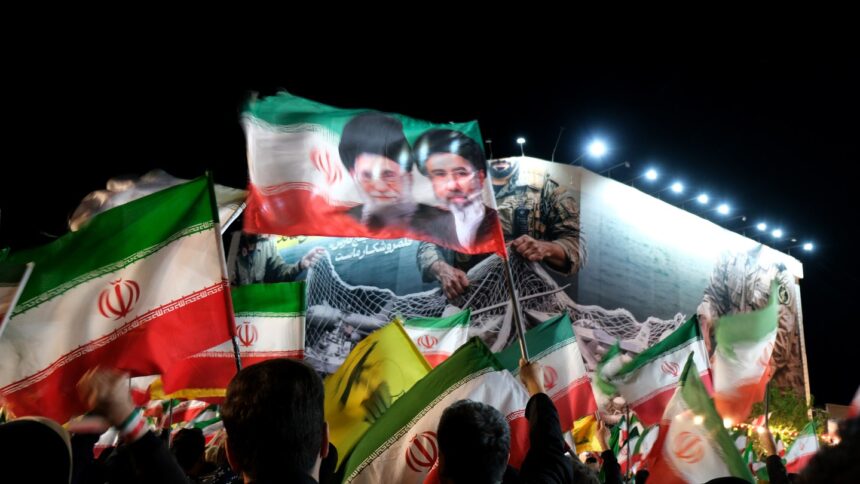
With no end in sight to the ongoing war in Iran — with both Iran and the United States this week seizing ships trying to move through the Strait of Hormuz — the country’s filmmakers say they feel “attacked” — by US and Israeli bombing attacks that have caused widespread damage to civilian infrastructure — and “abandoned” by the international community.
Nearly two months after the killing of Ali Khamenei on February 28, there is little evidence that the conflict has weakened hardliners within the Islamic Republic. Instead, power appears to have been centered around a more hard-line leadership linked to the Islamic Revolutionary Guard Corps, with figures such as Mohammad Baqir Qalibaf, a former IRGC general, playing a central role in negotiations with the United States.
Two weeks after a fragile and uncertain ceasefire, some semblance of normalcy has returned to the streets of Tehran. “compared to [first] During war days, there are crowds and noise [again]Says Iranian film journalist Mansour Jahani Hollywood Reporter. “People are busy with their daily work [but] In meetings and conversations they talk to each other [about] The latest events and developments of this destructive and illegal war.”
The disruption in the film industry was immediate. Cinemas across the country closed their doors for 18 days at the beginning of the war. While many have since reopened and shown a limited number of films, the New Year period on Nowruz, a 13-day holiday starting March 20 and usually the most important season for the domestic box office, was severely affected. Jahani points out that there was a “serious slump at the box office.”
The air strikes also directly hit Iran’s industrial infrastructure. The headquarters of the Iranian Cinema House, the largest independent film industry guild in Iran, was bombed and partially destroyed. Tehran’s historic Shekoveh Cinema was bombed twice and remains closed. As Jehani first reported, the home of the late Iranian director Abbas Kiarostami (Cherry taste, Certified copy) were also involved in air raids, along with training centres, documentary film facilities and film offices across the country.
Beyond cinema, Jahani points to the broader toll on the Iranian people as a result of the ongoing war. “The homes of a number of actors and directors and 90,063 housing units for ordinary Iranians and civilians were also targeted and damaged,” he claims.
Earlier this month, two-time Oscar-winning Iranian director Asghar Farhadi directed (separation, Seller), which new feature, Parallel storieswhich will premiere in competition at Cannes, urged international filmmakers to take a stand against the destruction of civilian infrastructure in Iran, calling on “artists and filmmakers everywhere in the world to be a voice in these critical days and hours, in any way possible, to stop the devastating aggression” of the US-Israeli bombing, which he said was “not just the destruction of buildings, but an assault on human life and dignity.” Iranian actress Golshifteh Farahani (Patterson, About Lily) issued similar calls.
Early in the war, some in the Iranian film diaspora outside the country expressed support for US-Israeli military action, hoping that the war would lead to regime change. The Iranian Independent Filmmakers Association (IIFMA), a group founded in 2022 in the wake of the Women, Life, and Freedom movement, which claims to speak on behalf of Iran’s dissident filmmaking community, issued a statement supporting “targeted actions against repressive government officials and agents.” The filmmakers’ group also called for the protection of Iran’s civilian population.
But as the war continued, “repression inside the country intensified,” says IIFMA board member Mehshed Zamani. She believes that the conflict strengthened the same forces that it was supposed to weaken. “The government is no longer accountable to anyone. As the war continues, it is to their advantage.”
The association says that the Iranian authorities are launching a crackdown on its members. They claim to have confiscated the assets of at least 11 directors and actors, including Shirin Neshat, Niki Karimi and Hamid Farrokhnezad. They say dozens more have been arrested or are still missing.
Zamani says she feels betrayed by Washington’s efforts to end the conflict without changing the regime in Tehran. “Everyone feels abandoned,” she says.
Inside Iran, Jahani says he sees no indication that the conflict is driving internal political change. “Regardless of their dissatisfaction [with the regime]The Iranian people [have] “They did not welcome foreign intervention as an opportunity to overthrow the government in their country,” he says. “Wars have always united the Iranian people.”