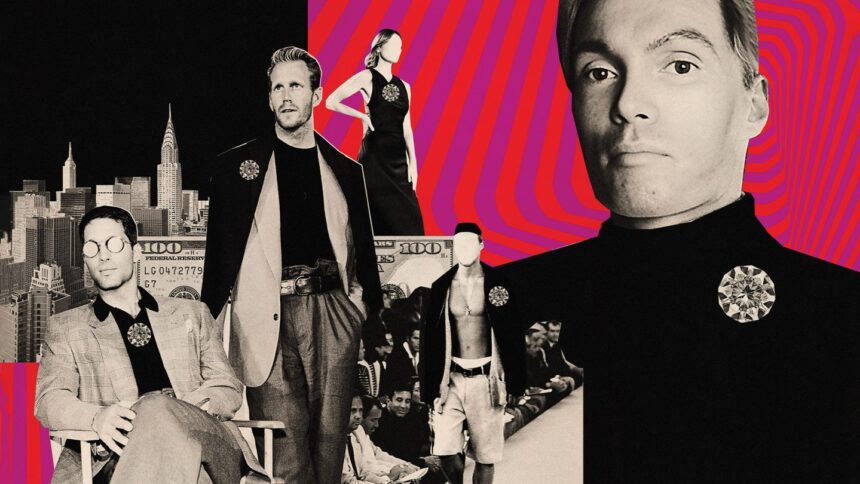
For a long period in the late 1980s, Hoyt Richards was the world’s most successful supermodel—Bruce Weber’s golden boy, the face of luxury menswear, the man who moved through the upper reaches of fashion alongside Cindy Crawford and Naomi Campbell with aristocratic ease. What no one knew was that every night, from hotel rooms across Europe and America, Hoyt would call the Manhattan cult leader to report his behavior. The man on the other end of the line claimed to be an alien consciousness from the star Arcturus inhabiting a human body.
His name was Friedrich von Merers. Born the son of a Brooklyn dry cleaner, Frederick Myers reinvented himself through charisma, social climbing, and a special genius for identifying lonely or ambitious people and making them feel chosen. He listed himself on the Social Register, showed implicit ties to the Vanderbilt family and claimed to have inherited millions through a godmother in the Chris family fortune. None of it was true. Those who knew his true background would sometimes shout “Freddie Meyers!” He crossed the floor at Studio 54 only to watch it retreat.
Frederick told his followers—mostly men but women as well, all of them attractive, often cherry-picked from the fashion world—that he was “coming,” meaning that an extraterrestrial being had taken over his body to prepare humanity for the apocalypse and usher the spiritually sophisticated elite into the next age. He preached separation from worldly concerns while selling gemstones at high prices, claiming that God’s thoughts were condensed into crystalline form. He held seminars at the Park Avenue Church. He broadcast his teachings on Manhattan Public Television in the early hours of the morning, after Robin Byrd and before dawn.
By the time journalist Mary Brenner profiled him Vanity gallery In March 1990, Manhattan prosecutors were already investigating his operation. (“How could an obvious fake like this convince so many smart, attractive young men in New York that he was real?” the article quoted an investigator asking a model who had recently fled the group.) Brenner estimates that Frederick sold approximately $2 million worth of gemstones using fraudulent appraisals from jewelers on West 47th Street. He died the same month the story appeared, having concealed his AIDS diagnosis while continuing to see male prostitutes near his apartment on East 54th Street. The group, which called itself the Eternal Values, survived him, transforming from the spiritual theater of the Upper East Side into something harsher and more paranoid after his death.

On June 1, it premiered on HBO Bring me beautya documentary by director Chris Smith about Hoyt’s journey through the fashion industry and into Frederick’s orbit. What the film depicts is the double life Hoyt lived for more than a decade, where he was an international supermodel by day and an obedient member of a religious cult by night.
What the documentary only hints at is how long Frederick had been doing this and to whom. His operation began in the late 1970s. By the time he meets the 16-year-old Hoyt on Nantucket in 1981, Frederick has already spent several years moving through New York society, rounding up beautiful and vulnerable young people who arrive in Manhattan and hope to become someone greater than themselves.
Frederick, who was said to have been born in 1946 but was also a well-known fabulist, was truly handsome in the clean-cut American way. He looked like Robert Redford, before facial plastic surgery and self-mythologization turned him into something grotesque. He was impeccably dressed, had authority and seemed to have an endless supply of aristocrats, decorators, socialites and semi-famous New Yorkers. Billy Baldwin, the dean of American interior design, became one of the key figures legitimizing Frederick’s orbit. He constantly dropped Baldwin’s name.
People entering Frederick’s world were always confronted with two versions of him simultaneously: the ridiculous cosmic figure who claimed extraterrestrial origins and the highly convincing Upper East Side sophisticate who seemed perfectly plausible in rooms full of wealth and magic. The strange legends were almost a test. If someone accepts this, they have already given in to their doubts and are ready to enlist.
“He was the scariest person I’ve ever met, and I’ve met some very dangerous people,” says Richard DuPont, one of the DuPont twins, who worked at Studio 54 and Andy Warhol’s Factory.

Richard was 16 years old in 1977 when he met Frederick in the men’s clothing department at Bloomingdale’s. He had come to town from Connecticut with his mother for a weekend of shopping and theater. While she was at Kenneth’s hair salon, Richard was walking around uptown alone. A very handsome, dark-skinned older man casually approached him in the department store and introduced himself as Frederick von Merers. He said he was a Ford model, interior designer, and New York society member. Richard remembers him looking charming, worldly, and completely at ease within the adult world of the city. Richard called him the following weekend and was invited to stay at Frederick’s apartment on East 54th Street. Richard told his mother that he was visiting colleges.
“Take off your shoes,” Frederick said as soon as he opened the door, telling Richard that the marble floors had just been cleaned. He then asked the teen to take off his jeans as well because the oils in the fabric could damage the silk sofas. Richard stood there wearing Brooks Brothers boxer shorts inside Frederick Billy Baldwin’s designer apartment while Frederick served tea and sandwiches from William Bull.
Two days later, Richard woke up alone. A note orders him to leave before Frederick returns. On the train back to Connecticut, Richard replayed the weekend in his mind, wondering if he had been raped, if it was even possible to rape a boy. By the time he got to Southport, he had decided not to think about it anymore. He says that years later, after moving to New York, he met Frederick again at Studio 54. Frederick began pursuing him aggressively. Richard warned people about it. No one listened.

His twin brother Robert didn’t listen either. Richard had no idea at the time that Robert had actually met Frederick himself. The brothers never discussed their sexual history. Robert moved into Frederick’s apartment for several months in 1979. He says Frederick gave him acid and subjected him to repeated sexual assaults. He eventually ran away after becoming jealous of another young man Frederick was involved with, a soap opera actor One life to live.
“Freddie was evil,” Robert says now. “Everyone knows that. I saw it in his eyes.”
Fifty years later, both brothers — neither of whom appear in the HBO documentary — still remember Frederick’s phone number by heart. “Yard 53530,” Robert says, instinctively listing the number. “Awesome. Maybe he gave us an orgasm.”
***
Hoyt met Frederick when he was sixteen on Nantucket Beach. Frederick drew a yin-yang symbol in the sand and told the teenager that he possessed a higher destiny. Now the experience is less a persuasion than an emotional immersion, Hoyt recalls. “Instead of asking, ‘Who is this person who acts like they know me when I just met them?'” “That’s the big question. I was lost in it,” Hoyt says. “We all like to be told we’re special.”
A few years later, Frederick accompanied Hoyt to the office of Ford Models president Joey Hunter, who signed him on the spot. Hewitt became one of the iconic faces of fashion in the late 1980s: Weber, Richard Avedon and Helmut Newton all photographed him. A sprawling 58-page magazine spread in the Italian magazine Mundo omo Helped establish it internationally. Designers and photographers loved him because he could exude softness and authority at the same time.

He moved through a world inhabited by the likes of Linda Evangelista, Crawford and Campbell, a world of private facilities, hotel suites, European nightclubs and endless flights between New York, Milan and Paris. What no one around him understood was that he lived most of this enchanting world behind glass. After photo shoots, after parties, after dinner, while everyone else disappeared into the nightlife and romance and cocaine and celebrities, Hoyt returned to Frederick.
He returned home to a Manhattan apartment, where several members were sleeping side by side on mats, turned over their earnings to the group and telephoned with detailed reports of their daily thoughts and behavior. Romantic relationships were discouraged. The independent identity itself gradually came into question. “I fell in love with the narrative so much that I began to self-censor to preserve it,” Hoyt says now, describing the mythology Frederick built around him.
Because Frederick instilled this in their consciousness, the group believed that the world would end in the year 1999. The spacecraft would land before the global devastation and airlift the Chosen to the rejuvenation chambers, as he promised them. Hoyt who grew up star wars And Spielberg, they found the mythology exciting at first.
After Frederick’s death in 1990, the group lost the charismatic center that held the legends together. The surviving members were transported to North Carolina near Asheville, where Frederick began building a pink marble estate because he believed the Blue Ridge Mountains would survive the apocalypse. The house was built with money provided by Hoyt’s salary. He was allowed to keep very little of it for himself.

The days and months were drawing closer to Frederick’s expected doomsday. The remaining members, only men at this point, stocked up on food, guns and gold while waiting for civilization to collapse. Hoyt had spent enough time traveling internationally by then, and this reality itself was increasingly at odds with the prophecies.
“I was still bouncing around Europe, Paris, Milan, Stockholm, wherever,” Hoyt recalls. “And I was looking around and saying, ‘Well, all the signs we were told would lead to this thing, the storms, the earthquakes, the tidal waves – none of that is happening, and certainly economies are not collapsing, governments are not collapsing.’ So I mustered up the courage to come back and say, ‘If nothing else, I think the timeline is off.'” That’s when I was attacked.
The new self-proclaimed leader of the group responded by systematically humiliating him. “He would say, ‘I wish you had the guts to kill yourself,'” Hoyt recalled. “It’ll put me out of my misery.” Hoyt began contemplating suicide. He was convinced that he was heavy, weak, and spiritually defective. Ultimately, leaving the group seemed less rebellious than compassionate. “It’s like a battered partner who keeps thinking, ‘They have to spend all this time yelling at me because of what I’m doing to them,'” he says.

On July 3, 1999, Hoyt made the call that changed his life – to Fabio. The two men worked together at Ford Models. Fabio bought him a plane ticket to Los Angeles on the spot, allowed him to stay in his house for 18 months and handed him the keys to a Porsche, the world’s most famous romantic model who had quietly become a safe haven for the world’s most successful male model. The friendship became one of the first truly unconditional relationships Hoyt had experienced in decades.
But not everyone emerged from the wreckage so lucky. Jackie Adams was a Ford model who escaped eternal values and later became a major whistleblower in… Vanity gallery Expose. “the Vanity gallery “The article more or less killed Jackie’s career,” Hoyt says. “And for me, it catapulted my career.” Somehow, the industry’s fascination with his participation in the cult led to more bookings. His career and fame grew.
Learn that victimhood and complicity are not mutually exclusive. He did not recruit himself into the sect, but he ignored the warning signs, rationalized the contradictions, and benefited professionally while others paid the price for telling the truth. “It’s like being a drunk driver running someone off the road,” he says. “You can say: ‘I was drunk’ – but you are still responsible.”
Bring me beauty Director Smith (Executive Producer of Tiger King) says the aspect of the story that affected him most was the contrast between a man who publicly embodies beauty, status, and ambition while privately abandoning almost every element of personal independence. “I’ve never found stories about cults so interesting,” Smith says. “But this person seemed different because of the double life – the split between public image and private reality.”
Frederick instinctively understood that proximity to beauty and status legitimized him. Fashion models became a tool for recruitment, and fashion itself became evidence of cosmic particularity. The more successful Hoyt became publicly, the harder it became psychologically to admit that something was wrong in private. Success became proof that Frederick must be right somehow. “If you met any of them, you would never think they had that experience in their past,” Smith says of the former cult members.

Today, Hoyt works as an exit counselor helping families reclaim their loved ones from highly controlling groups. He is engaged to Donna Flagg, a dancer and choreographer whom the cult has pressured him to give up for decades.
When he talks about manipulation now, he speaks with the specificity of someone mapping the territory he once lived in: the love bombing, the isolation, the teaching of self-doubt. “But the empirical light never goes out,” he says of the critical-thinking sects that try to extinguish it. “It’s turned down so low, you can’t see it. But it never turns off.”
This story appeared in the June 3 issue of The Hollywood Reporter magazine. Click here to subscribe.