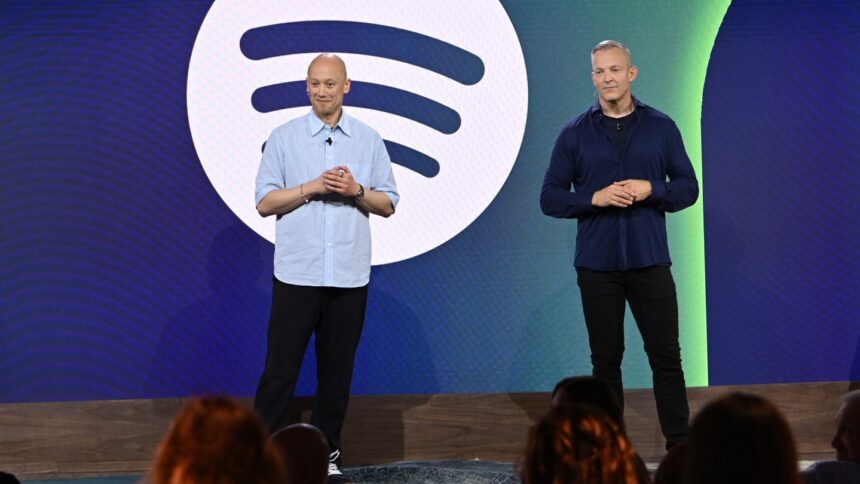
Spotify is leaning more heavily into AI as it delivers on its promise to reach 1 billion active users by 2030.
At the company’s investor day in New York on Thursday, executives laid out the planned path to reaching that number, as well as $100 billion in annual revenue, with new features including the ability to create personal AI-generated podcasts, user-generated covers and remixes using AI and more. Spotify also plans to continue creating more add-on services or paid subscriptions, alongside audiobook offerings, which they say has been one of the most engaged verticals on the platform.
As co-CEO Gustav Soderström explains, in the beginning, the company’s motto was access. Spotify then moved into personalization, with curated playlists and more. The next step is “generation,” relying on AI tools to help create content on the platform.
“We are entering the generational era, where the experience is not just chosen from a catalog. Rather, it is shaped by each of our users, in real time, according to their taste, context and intentions,” said Spotify co-CEO Gustav Soderström. “Today, there is no media player for both public and private content – or in other words – no media player for the generative era. We believe Spotify will become that.”
The custom podcasts, covers, and user-generated remixes join Spotify’s existing personalization products, including AI DJ, which creates curated playlists for the user, and guided playlists. Spotify also unveiled a desktop app that can create a daily audio summary or podcast based on a user’s emails and schedule.
The idea of leaning into AI and offering more personalized products is to help improve member retention, conversion to paid memberships and time spent on the platform, as Spotify gains a deeper understanding of the individual. AI can also be used to add more content in each market’s language, and get it translated faster.

Currently, the company last reported 761 million monthly active users globally, of which 293 million are subscribers. Annual revenue was approximately $18.5 billion in 2025. Spotify highlighted potential future user growth in Brazil, India and the Philippines among other markets.
Amid the AI talk, the company also announced that its audiobook business is on track to reach $100 million in annual recurring revenue from audiobook+ subscriptions in July. Paid users already have access to 15 free hours of audiobook content, with an additional Audiobooks+ subscription giving them an additional 15 hours. In less than a year, more than 1 million users have already paid for audiobooks, according to Spotify.
It’s also seen some of the deepest sustained engagements on Spotify, a metric the company tends to get ahead of.
“The number of times you come back to us in a month, and the number of devices you use, may be some of the most important metrics we monitor,” Nordstrom said.
On Thursday, the company also announced the creation of additional tiers for offering audiobooks, which offer more hours at a higher price. This comes as part of a plan to increase the amount of revenue generated by users who are already subscribed. The company recently introduced fitness by partnering with Peloton to stream videos on the platform. Which executives said they believe has “the potential to become a meaningful sector in its own right.” Executives also said they are looking at many other future sectors.
Podcasting has also made “significant progress,” according to CFO Cristian Luiga, who described the segment’s gross margin as “very negative” in 2021 and growing to 20 percent in 2026. He added that the company sees “a path to 40 percent” of gross margin, which will be driven by first- and third-party content.
With additional additions and new features, there will be more price increases in the future, but executives noted that there has been little change with previous increases.
“You can expect us to continue on this journey,” Nordstrom said of the price increases. “But we always want the user to win.”
For the second and third quarters, the company said it will increase its spending on marketing and R&D as it adapts to these new realities and may allocate capital to mergers and acquisitions, Luiga said, while maintaining a “build-first strategy.”
But overall, Spotify, which has previously undergone a number of cost-cutting measures, said it would rely on greater efficiency through artificial intelligence. “We no longer expand by increasing headcount, we expand by increasing the impact of the people we already have,” one executive said.