With his first two features, Girl and ClosesLukas Daunt has earned a reputation for insightful examinations of the minefield of children and adolescents with sexual and gender identity, both internally and in relation to the outside world. Both films won acclaim, but also critics who were angered by the Belgian director’s exploitation of sensitive topics such as gender dysphoria, self-harm, and suicide for the purposes of emotional manipulation. I landed somewhere in the middle of those two poles, even cowardwhich reeks of affectation and falsehood.
One of the indisputable strengths of Dhont’s films is his skillful handling of actors, especially young newcomers to the screen. That virtue is undermined here by two main characters with minimal chemistry, one inexpressive and the other archly theatrical, by design if not to rewarding effect. But what really sinks in? coward It is the greatness of self-awareness with which the director strives to reach sublime emotional heights in moments that instead feel hollow and artificial.
coward
Bottom line War is hell, especially when you’re there.
place: Cannes Film Festival (Competition)
He slanders: Emmanuel Macchia, Valentin Campani
exit: Lucas Dont
Screenwriters: Lukas Dhont, Angelo Tessens
2 hours and 5 minutes
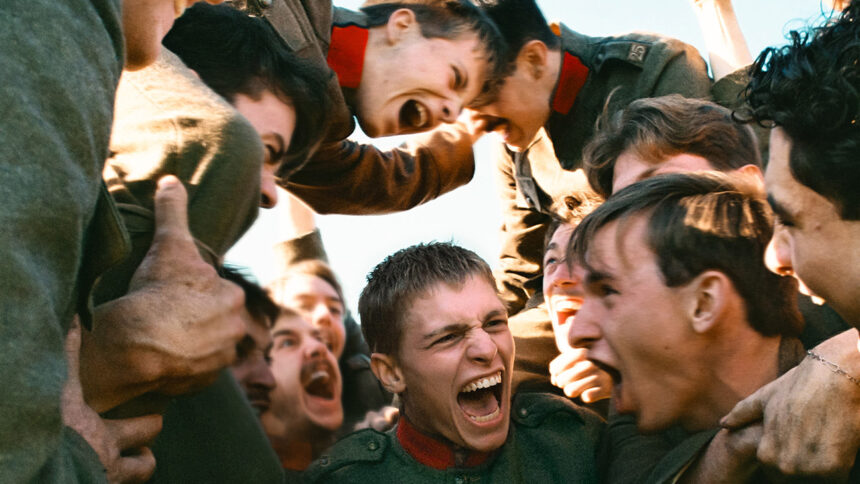
The film opens with a train loaded with rookie Belgian soldiers headed to the front, eager to dive into battle and prove their bravery in a full-length ode (in French) to “Pack up your troubles in your old kit-bag, and smile, smile, smile.” The certain enthusiasm of the soldiers’ singing, and the length of time Dont lets it go on, cultivates a vague notion that the director could almost be aiming for the heightened sentimentality of the musical.
This impression is reinforced when a group of soldiers calling themselves the Untouchables are introduced, performing light entertainment in makeshift women’s uniforms to entertain the boys behind the trenches and maintain morale. Every anthem they perform is packed with maximum intensity.
Among the highlights is the anthem at the end, full of fiery indictment, as bandleader Francis (Valentin Campani) waves a banner as if concluding the first act of Les Misérables is gay. Full disclosure, so no one gets the wrong idea: I’m into the club and into musicals, but it’s gotten to the point where I find myself muttering, “Oh no; last “F**King song?”
The history of soldiers entertaining their comrades in cross-dressing performance groups is well documented, representing a special form of bravery and fighting spirit in macho military settings. One of Donut’s main themes is that courage can be defined in countless ways, whether it’s crawling through muddy fields near enemy lines, choosing life at great personal cost or applying makeup and wearing dresses made from burlap sacks and parachute cloth.
At eighteen years old, Pierre (Emmanuel Macchia) has barely left the farm where he grew up before being drafted to serve in the Belgian army. On arriving at the front, he told Pierre that the rookies needed to prove themselves, and he threw himself into his duties, carrying heavy shells into the trenches and loading bodies from the battlefield onto carts. DP Frank van den Eeden’s camera gets close to his face – as it does with the main characters throughout the film – showing the effort and determination he puts into his tasks.
He is generally calm and reactive compared to most soldiers who are filled with loud bravado and loud sarcasm. But he forms the beginnings of a bond with a vulnerable young man who has recently become a father for the first time, and whose son is born after he left the country.
Pierre’s first taste of Francis’ indifferent glow comes when the latter is brought into the dining tent on a stretcher, a sheet covering his swollen, pregnant belly. Francis embarks on a pantomime of childbirth that culminates in the new father being urged to cut the umbilical cord. Loud guffaws follow, though the antics are more insensitive than amusing.
Although he is tall and physically strong, Pierre seems unsettled amidst all this bubbling testosterone. He appears to have moral qualms about soldiers gathering to urinate in soup buckets being served to a truckload of German prisoners. But he participates anyway, and is clearly eager to belong.
Meanwhile, the brash, self-confident, feminine Francis continues to catch his eye and he soon talks Pierre into helping build a stage in a barn, where Francis and his fellow strangers intend to put on shows for the boys. The attraction between them is subtly suggested at the beginning, when Francis and the rest of the costumed troupe lead the cheerful “Ladies’ Choice” dance. But even Pierre’s embarrassment couldn’t hide the reason behind the intense eye contact.
And so it goes, moving back and forth between repetitive trench warfare with lots of tense hand-camming and gentle interludes like Francis leading his chorus girls in a tremulous voice on the aria “Plaisir d’Amour,” which seals the deal for the infatuated Pierre and brings tears to the eyes of the soldiers in the audience. (I bought this less than I bought the central love story.) The first kiss follows shortly after on the roof above the stage.
When one of the soldiers is shot during his second attempt to escape, Pierre’s desire to keep returning to the line of fire weakens, and he intentionally injures his hand so that he can get away from the fighting. He becomes more involved with the performers, first backstage, blowing snow from the roof, and eventually joining them on stage. But instead of full drag like the rest, his costumes are more like variations on Pierrot’s theme.
Neither Pierre nor Frances has any actual experience with sex, and even when they enjoy the privacy of the bedroom as they travel to perform at the hospital, the physical aspect of the relationship barely goes beyond kissing. Hot competitionThis is not so.
Dhont works hard at injecting the tragic dimensions of a love story forced to exist in secret, but I found this film completely unmoving. Francis wants the war to never end so he can cling to whatever freedom they find together, while Pierre becomes a romantic man who dreams of escaping to live in a cabin in the mountains. Brokeback, maybe?
Although it was the “Great War”, more than 20 or 30 people rarely participated; Production volume seems tight. Even with the depiction of bloodshed and death, the conflicts of the drama are somewhat subdued.
There’s a whiff of homophobia in one soldier taunting Pierre, saying: “Go dance while we die.” One of the officers reacts hostilely, calling them “a bunch of degenerates” when his caretaking of Francis during the parade causes Pierre to intervene. But those and other threats of dramatic warming tend to fade before they go anywhere. Even the semi-open, potentially happy ending feels hackneyed because neither the director nor the actors convince us to invest much in the outcome.
Macchia mostly sticks to the same tone of lunar adoration while Campagne seems to be in conflict with himself over whether he can make Francis more annoying in or out of the clouds.
There have been poignant and much more detailed films about the fears and risks involved in being a gay man in the army in recent years, such as Oliver’s Hermanus. iMovie Or Elegance Bratton Inspection. And World War I serves as the poignant force that caps off last year’s resonant strange love story History of soundalso directed by Hermanus.
in coward (BTW, is Dhont going to upgrade to a two-word title?), the war is mostly the backdrop for thinking about the bravery out there, without building much dramatic heft. Everything about the film is interesting, from the direction to the lighting and camera to the soundtrack. It’s so completely overstudied and toothless that it devolves into melodrama.