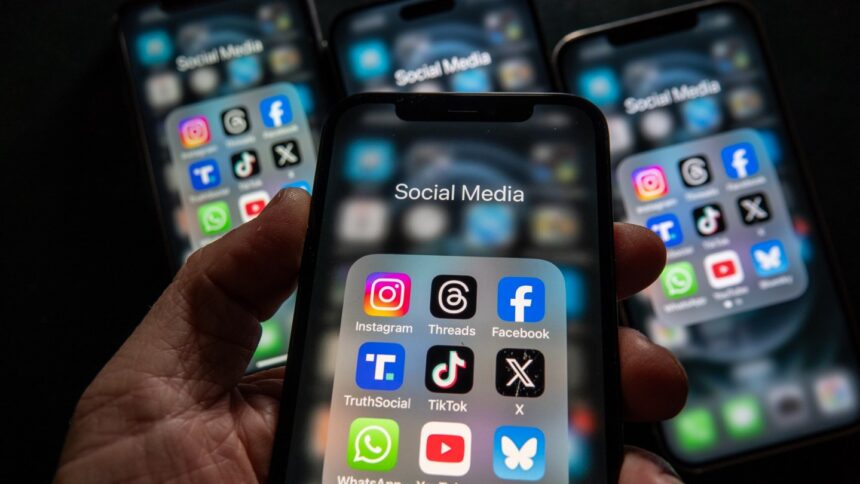
It’s been a busy week with the social media ban. The UK on Monday unveiled plans to impose sweeping restrictions on children under 16 using TikTok, Facebook and similar platforms, and Canada is following suit, pushing its own legislation through Parliament.
Both the British and Canadian proposals are modeled on Australia’s ban on under-16 teams, the first of its kind in the world, which came into effect in December. Half a year after the experiment, the rest of the world is watching closely. From Paris to Ankara, from Brussels to Jakarta, governments around the world agree on the same idea: to keep children safe from the harms of social media, they must be kept away from it.
Whether this approach actually works is another matter.
Australia remains a test case. The online safety amendment forces online platforms to block accounts for those under 16 or face fines of up to A$49.5 million ($34.7 million) per offense. It has been sold as the toughest child safety law in the world.
Governments supporting such measures point to a growing body of research linking certain patterns of social media use to mental health problems, body image concerns, cyberbullying, and sleep disturbance among young people. But six months after Australia’s experience, questions remain about whether a blanket ban is the most effective response.
The country’s e-safety commissioner has admitted that some young people are already finding ways around the restrictions. Researchers tracking the rollout have documented teens accessing VPNs, borrowed devices, and a growing constellation of unregulated platforms that don’t care about age verification at all.
Canada is watching Australia’s experience closely and is moving forward anyway. Bill C-34, the proposed Safe and Secure Digital Services Act, would limit the risks and harm to children under 16 from social platforms, chatbots and other online services, impose direct safety duties on operators of regulated services, and create a new digital safety commission to enforce the framework once it becomes law.
The bill has already drawn skepticism from Internet and e-commerce law experts who have weighed what it can and cannot achieve.
Michael Guest, a law professor at the University of Ottawa, tells The Hollywood Reporter that he expects Canada’s proposed ban on social media to fail and lead to unintended consequences.
“Experience so far elsewhere suggests that bans can be easily circumvented and that children are drawn to riskier, less regulated platforms,” says Guest. “Because verifying the identity of under-16s means verifying everyone, this is a population-wide identity verification mandate.” “The real solution is to address the harms caused by social media for all users. The bill provides this with a duty to act responsibly, but bans suck up headlines and cause more harm than good.”
Guest is equally uneasy about the bill’s plan to hand enforcement over to an entirely new regulatory body rather than Canada’s current Communications and Broadcasting Regulatory Authority.
“I am deeply concerned about the regulatory body, which appears to me to be overstepping its bounds, not oversight,” he says. “The Digital Safety Commission is a super regulatory body [that] It will have even more direct access to the daily lives of ordinary Canadians [broadcast watchdog] CRTC. It writes the rules, enforces them, and is supposed to defend the users it monitors, all in one body that is not bound by rules of evidence and can hold hearings in secret.
Catherine Warren, head of digital consultancy group Fan Trust, takes a different angle, saying the goal should be to set limits on platforms rather than impose strict rules that tech-savvy kids can bypass.
“Let’s be clear: children are being harmed online, and families are grieving,” Warren says. “This is exactly why the Canadian response must work, not just feel decisive.”
For Warren, the fundamental problem is not that children are using the Internet, but that the platforms are designed to be addictive, built on endless scrolling and AI-powered chatbots whose dangers to young users have proven difficult to curb.
“When we wanted children to be safe in the water, we didn’t drain the pool,” she says. “We fenced it off, taught them how to swim, and sent lifeguards.”
It also warns that a blanket Canadian ban could deepen inequality, as wealthier families can easily purchase VPNs to hide their children’s location and bypass restrictions.
“Blocking that some kids can trick themselves with a VPN isn’t child safety, it’s a classroom filter, where families with the most outperform the system, while kids with the least — and perhaps the most need — need for online connection, community, and education — are isolated,” Warren says.
These skepticism towards a comprehensive ban are shared on the other side of the Atlantic.
“Legally, [blanket bans] “It carries more risks than benefits,” says Stefan Dreyer, a senior researcher at the Leibniz Institute for Media Studies. “We still don’t have studies that actually prove that blocking social media improves mental health.”
When young people are asked what worries them most, Dreyer says: “It’s not the content on social media – it’s crises, the environment, migration, fear of getting sick in the family. Social media can certainly present these things, and maybe even amplify them, but it’s not the cause.”
He warns that restricting access could push children towards other, less regulated and potentially more dangerous online services.
These concerns have not stopped European parliaments from pushing for their own version of an Australian-style ban. Several EU countries have legislation on the way. But the continent is not moving at pace: France has settled at a maximum of 15 points, Austria at 14 points, and Greece and Spain at 16 points.
More important than the different age limits, Dreyer says, is the legal complexity that is largely missing from public debate. EU digital services law already governs how platforms protect minors, and under EU law it takes precedence over conflicting national rules.
“The Endurance Act actually prevents national rules from member states, and most member states have not taken that into account in their plans yet,” he says.
He points to France and Greece as two countries that have tried to overcome this problem. For example, the French rule banning children under 15 from using social media does not specify who is actually obligated to enforce it, since naming the platforms as the responsible party would result in a direct conflict with EU law.
The European Commission is trying to prove that the DSA has teeth. It has targeted TikTok for allegedly violating DSA safety rules with “addictive” design features, including infinite scrolling, and Facebook’s parent company Meta for not adequately protecting children from online bullying and grooming on its platform.
If found to have consistently violated the DSA, platforms face severe penalties, including fines of up to 6 percent of their total global annual sales. But many European parents and politicians are frustrated by the pace of implementation.
“Member states have run out of patience with how to implement the daily residency law,” says Dreyer. He believes that the new ban is an attempt by member states to put political pressure on Brussels to pursue the maximum age at the European Union level.
Dreyer believes that the lesson learned from Australia and Europe is not that governments should abandon regulation, but rather that they may be focusing on the wrong goal.
Instead of imposing a blanket ban, he says, A Regulators need to identify and restrict specific harmful features – infinite scrolling, recommendation algorithms, and systems that push age-inappropriate content to minors.
“We know that the risks come from the platforms, not from the children,” he says. “And I find it remarkable that we are having a conversation, in country after country, about excluding children from these services – because this is not the way we normally approach this. When we know that someone is responsible for a risk, we go to that person and say: address the risk, remove the risk.”
The challenge for lawmakers is to find the right balance between reducing risks to children and preserving privacy, independence and freedom of choice. Few Western democracies are willing to adopt the kind of highly restrictive model that would make circumvention almost impossible. However, the more limited and targeted the intervention, the more difficult it is to ensure meaningful protection.
China lies at the extreme end of this spectrum. The country has built the world’s most comprehensive system of age-based digital regulation, requiring “secondary mode” on devices used by people under 18. Children can only visit approved sites, access social media platforms with severely restricted features, and limit their online gaming to three hours per week, in a one-hour window from 8 to 9 p.m. on Fridays, weekends and holidays.
However, Dreyer expressed cautious optimism. He points to ongoing US lawsuits against major platforms as a potential source of pressure that could push companies to modify their products globally, even without new legislation forcing them to do so.
He also points to an unexpected trend: usage time among young people appears to be decreasing on some platforms, which he attributes in part to growing wariness of AI-generated content.
“The more mediocre AI-generated content on these platforms, the more young people will say: ‘This is not original. I want original content’ – and so they will turn to other things instead,” he says.