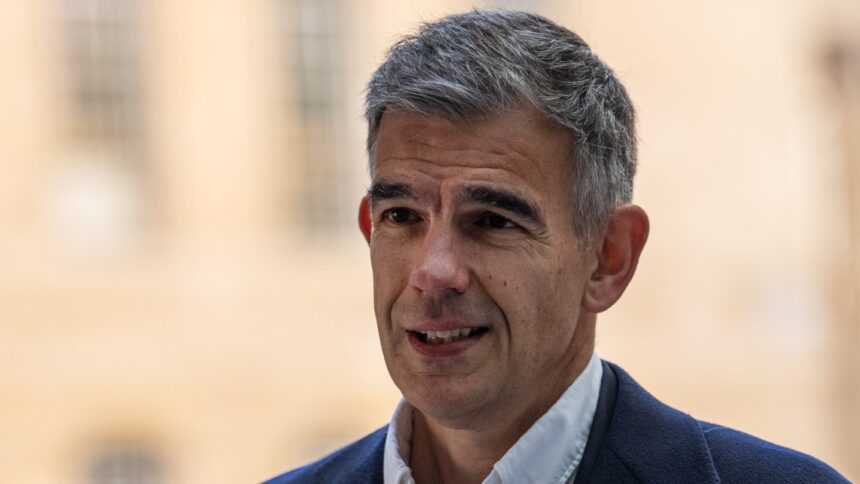
In the wake of Sky’s takeover of rival public broadcaster ITV, the BBC’s new boss has revealed that the company is in conversation with Channel 4 about the possibility of merging its streaming services.
Matt Brittain, who took over from former BBC director-general Tim Davie in May this year, took on politicians at the UK Parliament’s Culture Committee on Wednesday, detailing the necessity of a British “sovereign platform” that can compete with US tech giants such as YouTube and Netflix.
It comes just two days after news that Sky will buy ITV for £1.6bn. A combined Comcast-owned Sky and ITV would create a formidable British media conglomerate in the face of a major audience shift to digital platforms and streaming devices, but would certainly also put PSB’s cash-strapped colleagues on their toes.
“We have had an approach and have had a discussion with Channel 4,” Brittain, the former Google executive, told MPs. “In the world of the ITV-Sky merger, Channel 4 seems very sub-scale. All these mergers are driven by the need to expand. One opportunity for them would be to partner with the BBC, and have content on iPlayer, while continuing to fund advertising.”
He continued: “There are a range of commercial, public, public service and technical issues, but what we will do is explore that as quickly as we can, because I think this is something that will be important to the public media… This is a moment of real danger,” Brittain added, “because of the scale and because of the influence of a handful of American and Chinese technology players.” [which] It will dominate content creation and distribution.”
Just last month, the BBC, the UK’s largest public broadcaster, announced it would cut its content spending by $107 million and cut 550 jobs. Brittain, who appears keen to confront the company’s financial uncertainty head-on, broke the news in a memo to BBC staff. Since taking the BBC’s top job, he has spoken clearly about the need for “real risk, and at the same time real opportunity”, so that the BBC can “thrive as a public service fit for the future”.
Channel 4 is a smaller operation than the Beeb, and news of the Sky-ITV deal will only fuel further speculation about its future and ability to compete in an already saturated market. While a live broadcast team-up with the BBC may be on the table, Priya Dogra, CEO of Channel 4, shut down the possibility last May while speaking at the Creative Cities conference. “I’ve been involved in mergers and acquisitions for a long time,” she said. And the thing you learn is that there is no fusion. There are only acquisitions. Someone is always buying someone else out, and from my seat, that’s the wrong answer for Channel 4, because it just means that Channel 4 falls into another organisation.
PSBs have long complained about streaming services like Netflix, Prime Video and Disney+ that dominate the industry. A live-streaming tax was introduced by the government in a bid to save British domestic production of high-end television and films, allowing public broadcasters such as the BBC and ITV to reclaim some of the funding that streamers had taken away, but was denied in July last year.
Julianne Althoff, a film and TV lawyer and partner at London-based media and entertainment law firm Simkins LLP, said the partnership between the BBC and Channel 4 would bring another “shock” to the UK broadcasting landscape.
“The challenge will not just be to build a bigger broadcast service,” she said. “The BBC and Channel 4 have distinct public service remits, and any joint platform will need to maintain these commitments rather than dilute them in the pursuit of commercial growth. For public broadcasters, the collaboration is less about beating the likes of Netflix than ensuring British content doesn’t get lost in an increasingly crowded global market. ”
She added that companies face obstacles such as software rights, renegotiating licensing deals, conflicting management structures and regulatory obligations. Even ITV’s chief executive, Caroline McColl, admitted she did not expect it would be easy to convince regulators to approve the Sky-ITV merger, and said antitrust scrutiny would be tough. “We expect a very thorough and comprehensive review [of the deal]. “We expect it to move to the second phase,” McCall said, noting that approval could take between 12 to 18 months.
Hollywood Reporter I contacted Channel 4 for comment.