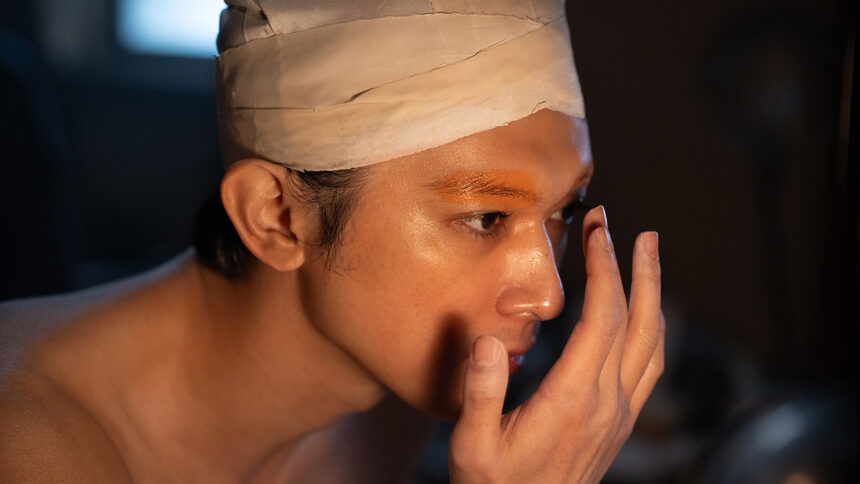
Naomi Hibino says her initial reaction was “numbness” when she learned that she and her fellow hair and makeup artists had been nominated for an Oscar for their work on Cocohoa breakout period drama set in Japan.
Hibino has spent the past 30 years working in the quiet, secluded world of traditional Japanese dance, studying and training as a dancer. KaushiOr a traditional Japanese stage makeup artist. Cocoho It was her first film, and the prospect of attending the Oscars stunned and puzzled her.
“After a while, when I realized our work had already been nominated, I kept feeling like it wasn’t really for me,” Hibino says. “This was a tribute to a traditional performing art form that has survived for several hundred years in my country – and it was a tribute to the countless people who have inherited and nurtured our art, including my teacher who taught me everything to get here. The fact that so many people are celebrating it, including people abroad, is something I can now take great joy in.”
Directed by Lee Sang Il, Cocoho It tells the story of 50 years of complex friendship and rivalry between two Kabuki theater artists – both orphans. Onnagata A prodigy (a male actor who specializes in female roles) and heir to a great theatrical dynasty. like THR’Lee’s review noted that Lee crafts “a transference and operatic epic that blends backstage melodrama, succession drama, and artist-making narrative into a sweeping meditation on ambition, beauty, and sacrifice.”
Cocoho The film competed closely in the Academy Awards’ Best International Feature Film category, where it made the shortlist but ultimately received no nomination in what was a particularly competitive year for world cinema. But the film’s three-person hair and makeup team — Toyokawa Kyoko, Hibino Naomi, and Nishimatsu Tadashi — were a surprise by receiving a nomination in the Best Makeup and Hairstyling category.
A 15-year passion project brought to life through nearly two years of rigorous kabuki training by young stars Ryo Yoshizawa and Ryusei Yokohama. CocohoImmersive kabuki theater sequences – captured in mesmerizing close-ups by cinematographer Sofiane El Fani (Blue is the warmest color) – not only reviving the theatrical box office in Japan but also reigniting audience fascination with this centuries-old art form. After a quiet start in the midnight section of the Cannes Film Festival in May, Cocoho It defied the odds — with a running time of nearly three and a half hours — and became a commercial sensation in Japan, where it grossed $130 million and became the country’s highest-grossing live-action film of all time. It also led to renewed public interest in kabuki theatre, with major traditional theater houses across the country reporting a significant increase in attendance, even among younger demographics.
The film was widely hailed for the stunning sweep of its generational saga—but equally important to its success in Japan was its faithful and brilliant recreation of Kabuki theater’s unique aesthetic.
A 400-year-old popular theatrical tradition that emerged in early 17th-century Japan and evolved into a strictly codified art form, kabuki combines acting and dance with vocal and musical performance. A collection of about 300 classic plays are still performed in Japan today with the same visual rules that audiences were familiar with dozens of generations ago – defined by stylized, exaggerated movement; an orchestral combination of shamisen, percussion, and chanting; And a very specific aesthetic of transformation, of Onnagata The tradition of men performing female parts in elaborate wigs, white painted faces, and the graphic lines of stage makeup denoted age, status, temperament, and moral strength.
Cocoho It is an adaptation of an 800-page, two-volume novel by the famous Japanese writer Shoichi Yoshida, who spent several years behind the scenes as a Kabuki theater worker researching the tradition from the inside. Nakamura Janjirō IV, one of the most respected contemporary kabuki theater masters, served as chief consultant, guiding the actors during their arduous kabuki training, as well as advising the film’s craft team to ensure that the stage designs, costumes, hair, and makeup were accurate and respectful of tradition.

Director Lee Sang-il, previously known for crime thrillers such as The villain (2010) and released on Apple TV+ Pachinkobrought in Japanese film industry veteran Kyoko Toyokawa (Sonatine, Midnight dinner) to serve as the film’s main hair and makeup artist. Cocoho It uses subtle costumes and design cues to indicate the passage of time over 50 years, and the film’s two leads, Yoshizawa (32) and Yokohama (29), play men both much younger and much older than themselves during different parts of the story – so Toyokawa’s task was indeed difficult. But Lee also hoped that Toyokawa – under the guidance of consulting kabuki actor and teacher Kyozo Nakamura – would be able to acquire sufficient ability with traditional make-up to handle many of the scenes set within a kabuki theatre. Real kabuki actors apply their own makeup — one of many aspects of this art form that has been perfected over countless years of arduous practice — but the production never expected its stars to go to this degree of preparation for the method.
“I was asked to handle all the kabuki makeup, but kabuki makeup is something else entirely,” Toyokawa says. “I actually trained, but the more I trained, the more I realized that this would be an insult to Kabuki actors. It’s not the kind of art that can be acquired overnight,” she adds.
With the support of the project’s kabuki consultants, Toyokawa eventually convinced the film’s producers that they needed to hire an expert in traditional Japanese stage makeup, which led to the hiring of Hibino. Nishimatsu was appointed to undertake the making of all the traditional Kabuki wigs worn by the actors – a rich and extensive craft tradition of his own.
For Hibino, stepping onto a film set meant adapting a centuries-old craft designed for the theater to the technical demands of cinema. In the traditional dance world where she has spent her career, makeup is only supposed to last a few hours and is usually viewed from a distance by the audience seated farther away from the stage.
“What I do day in and day out is apply white face paste to Japanese classical dance parties during stage performances,” Hibino explains. “Normally, if that makeup can be maintained for two or three hours, that’s enough. But for filmmaking, makeup has to look good for about 10 hours — and that’s what I struggled with.”
Kabuki makeup begins with a thick white base known as bintsukeIt is a paste derived from wood wax oils and comes in different levels of hardness. The stiffer the mixture, the harder it is to apply, but it is more resistant to sweat and other elements under hot stage or studio lights. For the film, Hibino worked with the very assertive Bentsuki.
Even more complex was the challenge of translating kabuki makeup—much like Western theater makeup, traditionally designed to be read clearly across the stage—to the unforgiving scrutiny of cinematic close-ups. While preparing for the film, Hibino found herself recalling a lesson from her own training years earlier. Even in theatre, her teacher emphasized that performers would closely study their appearance before they went on stage.
“My teachers always told me that when performers are doing their makeup, they always look at themselves in the mirror closely,” she says. “So, even if the audience sees them from a distance, the makeup has to look beautiful on the performer themselves – otherwise it might take them out of character. I was reminded of this while trying to make kabuki makeup beautiful for all those close-ups.”

because Cocoho Over the course of the characters’ half-century of life, Hibino has also transgressed The style and tone of kabuki makeup to reflect the performers’ evolving maturity, social standing, and emotional journeys—all while remaining faithful to the logic of makeup that the characters themselves would apply within the world of the story.
“When they were little, I made the makeup a little more youthful and vibrant — a little bit more modern,” she explains. “I also tried to match the characters’ personality and circumstances. Shunsuke comes from a very prestigious Kabuki family, so his makeup is more lively and sophisticated. Keiko starts out as an outsider, so his makeup starts out simpler.”
As Kikuo rose through the ranks of kabuki and eventually achieved Japan’s rare status of living national treasure, Hibino gradually reshaped the look.
“By the time he becomes a living national treasure, he will be a true veteran who has gained a lot of experience, on stage and in life,” she says. “So I tried to give his makeup a refined simplicity — almost a purity — where everything is where it should be.”
If Hibino was responsible for translating the visual language of Kabuki onto the faces of the film’s actors, veteran craftsman Tadashi Nishimatsu had the equally difficult task of recreating the elaborate wigs that complemented and brought to life the iconic stage aesthetic.
Nishimatsu has spent nearly 45 years perfecting the art of traditional Japanese wig making. After graduating from high school, he entered commerce as a uchi-deshior resident apprentice, resides in his master’s home while training in workshops and theaters each day.
“My career spans about 45 years,” he says. “Traditional Japanese wigs involve very sophisticated craftsmanship – something that has to be practiced day after day, from morning to evening. Only after many years could anyone participate in actual kabuki production.”
Nishimatsu adds that this craft is as psychologically expressive as it is technical. Over the centuries of Kabuki tradition, wigs have come to help embody a character’s deeper meaning.
“My teacher used to tell me that the wig expresses the entire mentality of the role,” he says. “Circumstances, social status – everything is embodied in the character through the wig. This has been true for 400 years of kabuki.”
Recreating this tradition of cinema came with significant practical challenges – especially because of it CocohoStars who were not trained Kabuki artists.

“Kabuki wigs used on stage are very heavy,” Nishimatsu explains. “And the actors in this movie were not kabuki actors. They had to wear these wigs for very long periods of time, so the challenge was whether they could hold that weight on their heads for so many hours.”
Production days often start around 6 a.m., when makeup preparations begin. The actors may then spend the entire day—sometimes even the night—donning and removing the elaborate wigs dozens of times between takes.
“We customize each wig for the actor, but because they are not used to it, the fittings can sometimes be painful,” says Nishimatsu. “Unlike most Western wigs, which are made of lightweight nets, Kabuki wigs have a copper plate at the base,” he explains. “In the foreground there is a piece called A habutae A hood with hair built into it, and there are many other separate items bundled together. Then you add the so-called decorative hair pins KanzashiAnd it’s also very heavy.
In some cases, a full head set can weigh more than 10 pounds, putting significant physical strain on performers—especially during active dance sequences.
Lee, trusting his hair, makeup, and costumes, to get the aesthetics of kabuki exactly right, freed him to focus on the drama — and on the film’s central question of what an artist is willing to sacrifice in his perpetual pursuit of beauty.
“I wanted the audience to feel like they were almost taking a bath in this film. I did my best to make them feel that way while filming – so the audience could feel the emotion directly underneath the makeup and the costumes and these ancient epics,” he adds.