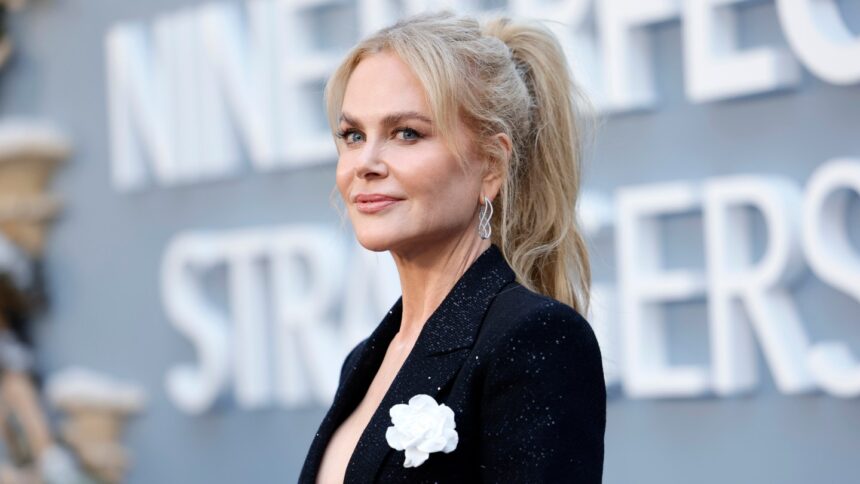
Nicole Kidman says she has noticed the public response to her training to become a “death doula”, but finds supporting people and their families in their final moments together “beautiful” and “very important to me”.
“I recently had this talk where I said I was expanding on learning to be a death doula, which seemed to have people confused or curious,” the actress and producer told a Philadelphia audience in the Kimmel Center’s Marian Anderson Auditorium on Saturday as part of HISTORYTalks 2026, a live speaker series produced by the History Channel.
After describing her desire to help people and families be present and navigate their final moments together, she described death doula work as “really wonderful. It’s so beautiful, and you have to be a certain person to be able to do that. But I’ve discovered that I’m actually that person. It’s very important to me. There’s always suffering, but if there are people who can help with that, help those final stages be less painful — if you feel the connection in your heart, that’s beautiful. So that’s what I’m exploring.”
Kidman shared her thoughts on the practice after discussing the experience of learning of her mother’s death in September 2024 while honoring the actress at a film festival. “I won Best Actress at the Venice Film Festival. This seems to be a common theme throughout my life. I was about to go on stage, and I found out my mother had died. I went straight back to the room in Venice, went to bed and was completely devastated,” she recalls. Kidman said she found herself not knowing how to function or move forward because her mother “was such a big part of my existence, so the idea of being there at that particular moment was horrific.”
She continued: “I remember getting on a boat in the canal, and literally at night trying to find my way to the airport, and then I turned around and went, and I couldn’t even do it. Then I went back to bed, and I was alone. My husband wasn’t there. My kids weren’t there. I went to win an award. What should have been a beautiful thing, ended up being that.” “But there is a paradox in life, and that’s what I always tell people. I say that when I know I’m resilient. That’s when I know I can survive almost anything.”
the Scarpetta and Nine perfect strangers The star and producer noted that in her relationship to life and art, “I don’t think I’ve ever sought peace. I’ve sought to explore the human condition,” and that she also considers herself not a celebrity but a worker. “I’m a worker bee, I like to be out in the world working, I like to provide work if possible to others, and I like to do that work.”
Kidman was just one of the speakers during the annual daylong series of talks that explored the connections between politics, comedy, entertainment, sports and American history through the lens of leadership and legacy. The event was hosted as part of a larger year-round celebration of the 250th anniversary of the founding of the United States of America and in association with Comcast NBCUniversal. As such, Kidman also addressed her historical connection to the country.
“I came here and [have] “I’ve lived in a lot of different places, and my work has been very transient, so I’ve seen a lot of the United States,” said the actress, who was born in Hawaii, lived in D.C. for several years while growing up, and has lived in California and Nashville, where she raised her children with Keith Urban. “I love that I saw it in a very specific way. I saw all the elements of the movie as it was being filmed in different states, as I lived in California, but my ex-husband also traveled on a tour bus all over America. It’s actually extraordinary because of the people. You meet the people. I feel like I’m a part of this country, not just by birth, but by actually being here.”
As part of that larger conversation, Kidman talked about her journey not only with death or with working and living in America, but with becoming a producer later in her career. While chatting with Hoda Kotb, Kidman recalled moving to Nashville while pregnant, becoming a mother, and wondered if she would officially retire from acting. She pointed to her mother, who encouraged her not to “completely give up” on what she had been doing since she was 14 years old. Kidman said it made her wonder, “Well, what can I do that won’t stress me out so I can have my baby? And production suddenly became a much more interesting avenue.” That would lead her to Rabbit hole.
“I read a review of a play called Rabbit hole“, which was about losing a child, and I thought, what a wonderful thing to do after I’d just given birth — that’s how strange it was for me to go and make a movie about the thing I’m most afraid of — to go and connect with people who I now feel such deep empathy for and want to understand and want to help,” she spoke to the Philadelphia crowd. No one wanted to give us money. It was a $3.5 million movie. We had to beg for every cent. But we got it done. It was a passion, and that was the beginning of my producing career.
It will also be the first step toward a future focused on women in film and artistic contributors on and off screen. “There’s a lot of opportunity. I have a couple of shows now that are primarily about women in the director’s seat, the writer’s seat, the showrunner’s seat, and stories about women. That wasn’t the case 20 years ago. So this is a huge change,” she told Kotb. “The percentages are still incredibly low, relatively speaking. I think we’re still looking at 14 percent output. Maybe it’s 16 percent now. It’s good to say those numbers because I think people think everything is fine now. No, there’s still a huge gap. But I’m making changes.” [with] Women who have a position that allows me to go, “I can greenlight this, I can make it happen, and I want to put a woman at the helm.” How do I do that? I can say this is what I want, and this is actually popular change.