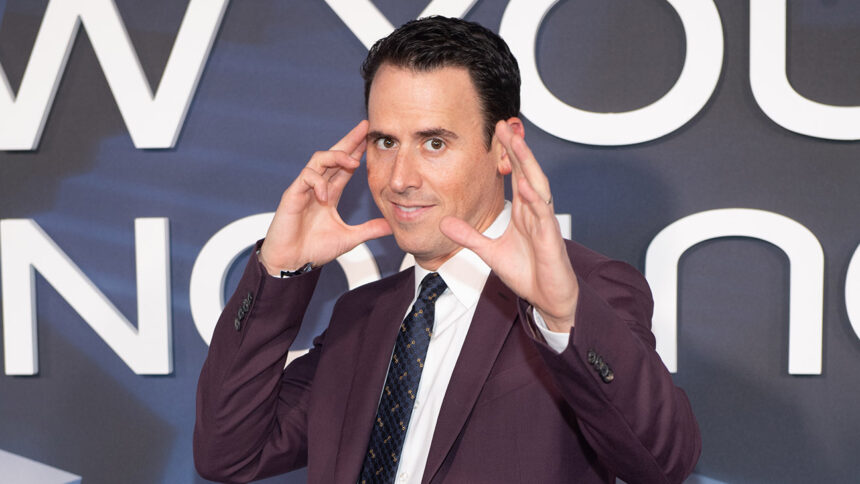
For many years, Oz Perlman – known as Oz the Mentalist – was inescapable. It’s been popping up everywhere: March Madness coverage, HBO Hard hitsJoe Rogan’s podcast, and most recently the White House Correspondents’ Dinner, where he was scheduled to perform for President Trump. (Perelman was just moments away from the set when gunshots in an adjacent hallway led to the diner being evacuated; the suspected shooter was charged with attempted assassination of the president.) America’s got talent alum (came in third place in 2015) is the most televised psychiatrist in the world and the most followed on social media. His work—guessing names, PINs, memories, and private details seemingly plucked from nothing—has made him a fixture on talk shows, in locker rooms, and in celebrity culture. Now this act is under serious scrutiny.
Last week on Pablo Torre finds outESPN’s Pulitzer Prize-winning Pablo Torre finds out how Perlman pulls off his most shocking tricks. Stevie Baskin’s findings are a real problem for anyone who still believes in a little magic.
On January 15, the Aussie Baskin published a five-hour and 11-minute exposé on Perelman’s apparent use of “meta-deception” in the process of “mind reading.” At its simplest (none of this is basic, hence the time to remove Baskin), meta-deception is the practice of deceiving the sign As for how to deceive them – In some cases, when You are deceiving them. Oz admits that he is not a true fortune-teller (because those don’t exist) and states that he is instead skilled at reading non-verbal clues such as micro-expressions. That’s not entirely true, Baskin says.
If Baskin’s detailed interpretations of The Wonders of Oz are to be believed, Perelman’s widespread intellectual reading relies on a combination of undivided pre-show work, expensive technology, a degree of surveillance, and even, in some cases, an alleged final amendment clause in his appearance agreement. Perelman, by his own admission, doesn’t actually read your mind — but he does sometimes read your (limited) search history, Baskin asserts.
Perelman did not respond Hollywood ReporterRequested for comment on Baskin’s findings.
The high-tech techniques supposedly used in the Oz act include controlling an audience member’s cell phone through various methods (demonstrated by Baskin in the video below). Perelman is also said to use “gimmick” notebooks that save information as written (sometimes by an assistant, sometimes by the unwitting mark itself) on a sticky note. These digital solutions are not part of the submitted act — they usually are not even at the time of the submitted act — and even magicians believe that ethical lines are being crossed here.
It gets a bit worse when you consider Perelman’s TED talk, in which Oz analyzes what he called “reverse engineering the human mind.” TED talks are expected to be educational, and Perlman asserts that anyone can do what they do, but he overlooks what they actually do (and certainly how they do it). Instead, Perelman appears to have used the brand reputation of TED Talks to validate an invalid work. Not only does he use this moment to teach one of his actual big skills — Perelman’s sleight of hand, conversational control, and other typical “tricks” are impressive in their own right — Oz continues to push his famous “I don’t read minds, I read people” narrative.
Perlman has also written a best-selling book, Read Your Mind: Proven Habits for Success from the World’s Greatest Mindset. Read your mind It’s pitched as an educational book that has practical, real-world uses, such as how to “read” your spouse or boss, but Baskin says it taps into an ability that doesn’t actually exist.
It’s a Baskin video that should have been put together as a TED talk. Watch it below.