Perhaps the defining paradox of British film director David Lean’s life is the contrast between his professional life, in which he shepherded huge productions, often in remote locations with no infrastructure, and his chaotic personal affairs, hopping from one marriage or relationship to another in a futile search for lasting happiness. “I am able to live through film as I cannot in everyday life,” says the subject in one of several archival interviews excerpted in the book. Maverick: Epic Adventures by David Lean.
Barnaby Thompson’s exhaustively researched film was produced in full cooperation with Lean’s Estate. But even as you rise to a state of amazement over the unparalleled greatness of classics like… The bridge on the River Kwai and Lawrence of ArabiaHe avoids hackneyed hagiography. While the assembled speakers include many of the world’s great contemporary directors – all of whom are keen to acknowledge Lean’s profound influence on their work and cinema in general – there is no attempt to gloss over the tyrannical perfectionism he can be during grueling filming sessions.
Maverick: Epic Adventures by David Lean
Bottom line A brilliant artist, a complex man.
place: Cannes Film Festival (Cannes Classics)
with: Wes Anderson, Autumn Dorald Arkapaw, Francis Ford Coppola, Brady Corbett, Alfonso Cuaron, Nia DaCosta, Paul Greengrass, Steven Soderbergh, Celine Song, Steven Spielberg, Denis Villeneuve, Joe Wright, Cate Blanchett, Kenneth Branagh.
Director and screenwriter: Barnaby Thompson
1 hour and 45 minutes
Robert Mitchum describes him as “a monomaniac” after working with Lean on the critical failure that threw the director’s career into oblivion. Ryan’s daughter. In the same film, he insisted that the cameras keep rolling as veteran actor Leo McKern nearly drowned, tossing and turning near the rocky shores of Ireland’s west coast during a ferocious, once-a-year Atlantic storm.
Then there’s Omar Sharif’s frank assessment of Lane after he made it Doctor Zhivagoa 1965 epic that was a massive commercial success despite being widely rejected for crushing the spirit of Boris Pasternak’s novel, trivializing the Russian Revolution and reducing the complex story to a subdued romance.
Sharif describes Lin as a selfish man who is difficult to work with, who strongly pushes people to go after what he wants from the scene. “He didn’t spare anyone, including himself,” says the actor, whose fame grew exponentially thanks to his work with Lean on. Doctor Zhivago and Lawrence of Arabia.
Returning from 14 years “in the wilderness” after a disaster Ryan’s daughter His self-confidence shaken, Lin directed his final film, Passage to Indiain 1984, where his dogmatic approach caused open rebellion among the actors. Narrator Cate Blanchett recounts that Judy Davis was the sharpest of them all, hurling a slur at the director and flatly telling him he had no idea what he was doing. (Davis received an Academy Award nomination for Best Actress, while her co-star, British actress Peggy Ashcroft, won the supporting award.)
Lin comments on the dissatisfaction of dealing with “this personal hatred” from actors whom he does not trust. But his words seem to confirm the recurring charge that he cares more about images than performances. Reflecting on the role of the actors in the shoot, he says: “They are – and I say this in the best possible way – puppets.” Is there really a “best possible way” to suggest that actors are merely tools to be operated by pulling their strings?
Although there is no evidence that he subjected the cast to the kind of psychological torture for which his unruly contemporaries Hitchcock and Kubrick were known, he was clearly moody and impatient. Nigel Havers recalls with good humor telling Len that he couldn’t sleep the night before filming began Passage to India. “Neither did I, I was very nervous,” Lane told the actor, adding: “It took a few hours before he got back into the groove and yelled at people.”
Despite these impressions of Lean as a prickly character, this is by no means a reductive portrait of the great director as an unfeeling tyrant, and Thompson has assembled an impressive lineup of accomplished directors to acknowledge the many ways in which Lean constructed the model of the modern blockbuster. Revisiting the stunning location footage from his most ambitious projects makes you realize how much film fakery we’ve now come to accept.
Steven Spielberg reveals he’s rewatching The bridge on the River Kwai Every time he is about to start filming an adventure movie. Francis Ford Coppola and Denis Villeneuve talk about how Lean’s fearless sense of scale, never at the expense of story or character, influenced their work. Paul Greengrass credits him as one of the few directors who invented the language of filmmaking. Steven Soderbergh recounts how Lin, who started out as an editor, would typically draft the first cut without dialogue or sound, letting the images alone tell the story — a technique Soderbergh stole and still uses to this day.
Weaving an abundance of archival material and clever passage selections, Thompson and his editor Paul van Dyke follow chronologically through Lane’s professional and private life, beginning with his childhood in the drab South London neighborhood of Croydon with a strict Quaker family. He was dyslexic and failing at school, leading his emotionally cold accountant father to view him as a stupid person who would never amount to much.
His father abandoned the family when Lean was fifteen, and while they kept in touch, the casual harshness of his father’s letters and his complete lack of interest in his son’s work speak volumes about the admiration, even respect, for which David Lean spent his entire life searching in vain. He sent an official invitation to attend the royal screening of the film Lawrence of Arabia To his father, who replied that it was too far. It is believed that he died without having watched any of his son’s films.
Maverick It illustrates Lean’s entry into the British film industry in a fast-paced, entertaining way. After taking up photography as a hobby, he knew films were where he wanted to be. He took an entry-level ‘tea boy’ job at Gaumont Studios and within three years had risen through the ranks to the newsroom. He went from cutting newsreels to feature films, most notably Powell’s and Pressburger’s Parallel 49 and One of our planes is missing. Alfonso Cuaron notes that this was when he began to understand the importance of scale and spectacle in films.
Noel Coward, already a big name in England, chose Lean to direct his first feature film, the 1942 war drama. In which we serve – despite Lin’s insistence that they share co-director credit. It was nominated for an Academy Award for Best Picture, the first of many Lean films. Coward (theme of Thompson’s 2023 film, Mad about the boy) Len was then offered his choice of scripts to direct, resulting in the production of one of British cinema’s most beloved classics, Short meeting. Even out of context, the first encounter at the train station between Celia Johnson and Trevor Howard is indescribably poignant, a model of restrained desire.
Fans of Lane’s wonderful adaptations of Dickens in the 1940s, Great expectations and Oliver TwistPerhaps he wished Thompson had stayed longer on them. But it correctly points to the pivotal moment in the director’s career in 1955 summerthe Katharine Hepburn vehicle that was the first British film shot entirely on an international location and one of the best cinematic depictions of Venice ever made.
The experience confirmed Lin’s boredom with studio shoots and his desire to work outside in inspiring locations. He found a powerful producer to help facilitate this transformation in Sam Spiegel, the collaboration that produced the first ultimate Lean saga, The bridge on the River KwaiIt was filmed entirely in the jungles of Sri Lanka, then known as Ceylon. The detailed analysis of the climactic scene in which the bridge is blown up as the various plot threads come together is exciting. The film won seven Academy Awards, including Best Picture and Best Director.
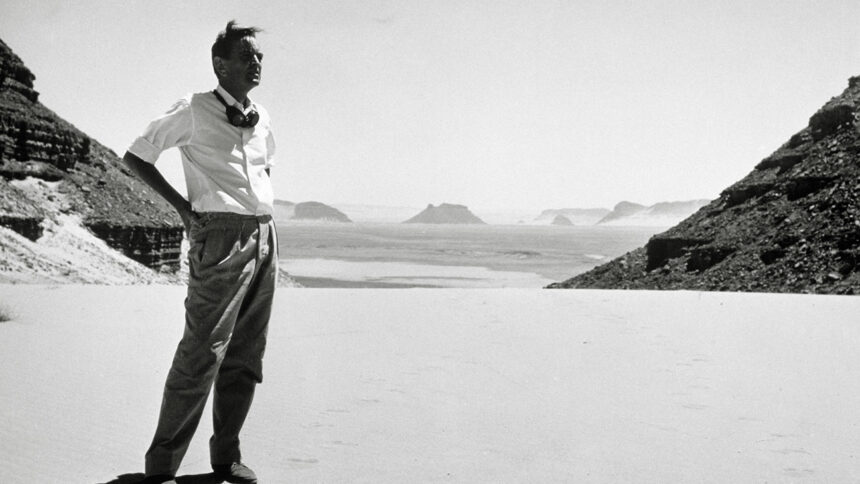
Lin stuck with Spiegel on his next assignment, Lawrence of ArabiaIt was filmed mainly in the deserts of Jordan. When the original writer left, Spiegel connected Lane with playwright Robert Bolt, an important collaborator who, like the director, was the product of a puritanical childhood, during which he was considered the family idiot.
It’s refreshing to hear famous directors marvel at the film’s sheer greatness, remembering how it opened their eyes to the limitless possibilities of cinema. There’s also a breathless appreciation for the fact that everything in the film (e.g summer and Kwai) was real, giving movies an immersive quality rarely equaled in the digital age.
The sprawling life and conflicting loyalties of the film’s subject, British army officer T. E. Lawrence, had long been considered impossible to adapt to the screen. But Bolt and Lin found a key to it that evolved into one of the undisputed landmarks in cinema history. The film won seven more Oscars, including Best Picture and second Best Director for Lean.
Joe Wright—who was also written off as a lost cause early on due to dyslexia—expresses his affinity for Lean while also outlining the ways in which Lean saw himself in Lawrence. “I think the connection between pain and pleasure, self-invention, and loneliness are all things that Lin felt and expressed through Lawrence.” It’s a sharp observation that underscores how the film was both epic and personal at the same time.
Anyone interested in the physical side of large-scale filmmaking before the computer age will be fascinated by the up-close glimpses of movie magic, such as the transformation of the Spanish landscape into snow-covered Russia. Doctor Zhivago Or build an entire Irish seaside village Ryan’s daughter.
The latter film and its brutal reviews fuel an episode that shows Lane at his most vulnerable. He remembers being summoned to a meeting of the National Society of Film Critics at New York’s Algonquin Hotel, where critics like Richard Schickel and Pauline Kael dragged him over the coals for two hours, wondering what the man who made the movie was like. Short meeting It can produce such garbage. Lin says the experience had a terrible effect on him, filling him with shame and reluctance to direct again.
As a counterweight to the headmaster’s arrogance, Thompson makes a fair point with a brilliant split-screen montage showing how the radical new wave of independent filmmaking emerging from America in 1970 created Ryan’s daughter It looks hopelessly old.
Through this dense and always interesting survey of Lean’s film career, Thompson chronicles the vicissitudes of the director’s personal life, which spans six wives and various other affairs and relationships. It is a sad irony that he reversed his father’s history by leaving behind his first wife, Isabel Lane, and his only son, Peter, with whom he then had only minimal involvement.
While many of his films were primarily about love or its elusiveness – summer, Short meeting, Doctor Zhivago, Ryan’s daughter -Lane appears in archival interviews as a contemplative man whose belief in love was stymied by the constant certainty of love. And something better is just around the corner. There are echoes of his father’s strictness in his thoughts about the end of a relationship: “Everything is over. It’s over. You just have to pretend people aren’t there. Once you make up your mind, you have to cut them out of your life.”
Oddly enough, this extreme lack of emotion is part of what makes… Maverick Very satisfactory. With rousing orchestral emphasis from Ryle Jones and elegant contributions from Kenneth Branagh reading Lane’s letters, Thompson paints a multi-layered portrait of a man driven to conjure grace, splendor, and soaring emotion in his art but prone to trudge through life leaving wreckage in his wake.