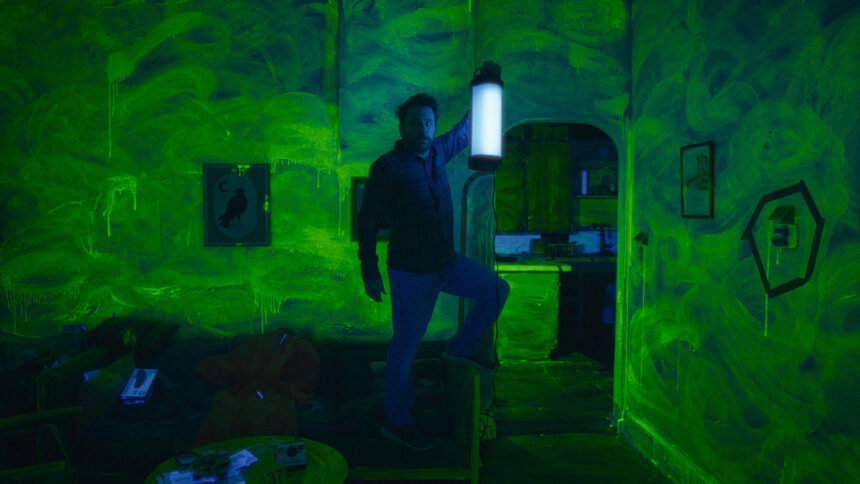
While talking to the cops he called to report that someone had tried to kill him, Jimmy (Charlie Day) suddenly panicked. He wants to plead with the fifth; He wants to contact a lawyer. He is terrified that they are accusing him of “trying to kill himself.”
The police are understandably confused. The normal term for this is “suicide,” and in any case, it’s not something they arrest you for. But Jamie’s choice of wording is key to Peter Warren’s directorial debut Kill mepremiering at SXSW.
Kill me
Bottom line Dark and twisted.
place: SXSW Film Festival (Feature Spotlight)
ejaculate: Charlie Day, Allison Williams, Giancarlo Esposito, Aya Cash, Jessica Harper, David Krumholtz, Tony Cavaleiro
Director and screenwriter: Peter Warren
1 hour and 45 minutes
To the rest of the world, it might seem obvious that Jimmy cut his wrists. However, Jimmy can only understand what happened to him as a possible murder, even if it means eventually reluctantly admitting himself as a suspect.
It’s an interesting frame for what could have been a bleak, serious drama, portraying depression as a killer deadlier than any serial killer, and portraying one’s own psychology as a more unsolvable mystery than any cold case – with a morbid sense of humour, for example. If his exploration of these ideas is ultimately too patchy to feel completely satisfying, his performance is strong enough to hold attention throughout.
In fairness to everyone who isn’t Jimmy, the evidence against him seems pretty clear. The film begins with Jimmy in his bathtub, expelling the last bits of energy to make a 911 call. (The bathroom looks so dirty that it’s almost… opinion The film is one of many clever production design choices from Ashley Cook.) From his family—which includes his sister Alice (Aya Cash), his mother (Jessica Harper) and his stepfather (Michael Flynn)—we learn that he has a long history of mental illness—particularly a very similar incident that occurred four years ago. We heard from the cops that there was no sign of anyone else in his apartment, which they noticed was locked from the inside. Not even Jimmy, once he starts frantically searching his location for forensic evidence, is able to prove otherwise.
But Jimmy is adamant that he doesn’t remember doing it. And anyway, why would he do that? He can’t think of a reason — even when his family points out that he’s been particularly depressed lately, even when he admits to his therapist (Giancarlo Esposito’s Dr. Singer) that he’s off his medication, and even when he’s quick to come up with ordinary, heartbreaking justifications for why others might want him dead. (Among them: his ex-girlfriend Sarah, played by Sam Rothermell, because she didn’t run enough, because she embarrassed herself at her work party, and because she couldn’t lift his penis that time.)
Kill meThe film’s tone veers between black comedy and darker drama, and in its darker moments it benefits from Day’s talent for playing men in the midst of intense, wide-eyed panic. The script, also written by Warren, includes some sharp, funny, and unforgettable lines — I laugh at Jimmy, on his initial 911 call, worrying that his blood might stain his bathtub (“Yes, I think it might,” the dispatcher, Allison Williams, Margot, answers shortly), and his insistence that his filthy apartment doesn’t mean he’s living in filth; certificate.
But the role also allows Day to go in sadder and more serious directions, as Jimmy oscillates between his constant certainty that he’s being targeted and his intense fear that the only person he really should be afraid of is himself. Margot follows him through those many mood swings, a pale, numb soul who has her own reasons for refusing to give up on him. The romantic spark that ignites between them is unexpectedly sweet, even hopeful, even if we never lose the nagging sense that they are clinging to each other the way shipwreck survivors cling to driftwood.
Kill me It does a good job of keeping the viewer guessing whether Jimmy is really thinking about something (he eventually comes up with some clues that can back up his theories) or whether he is, as Alice says, living “in a Sherlock Holmes fantasy where you’re just sailing on an ocean of delusion.” But even though it understands Jimmy’s pain on a deep level, the film sometimes feels as hard on Jimmy as it is on itself.
Time and again, Jimmy faces suggestions that he may not be the only one who suspects that he might be better off dead. There’s the son of a suicide victim (David Krumholtz), who spits, “This is the most selfless act… [my dad] He killed himself so my mother and I could move on. The father of another suicide victim talks about how his daughter has finally “found peace,” which is something Jimmy complains about. The deep concern that Jimmy’s loved ones feel for him is palpable. The affection they feel for him is even less so.
These are arguably honest and brutal reflections of the way Jimmy sees his place in the real world, and a sharp turn to sentimentality wouldn’t suit a film as prickly as this. Kill me anyway. But without any real emotional resolution, the film ends up feeling incomplete, perhaps more like a successful mission that leaves the victim still gasping for air.