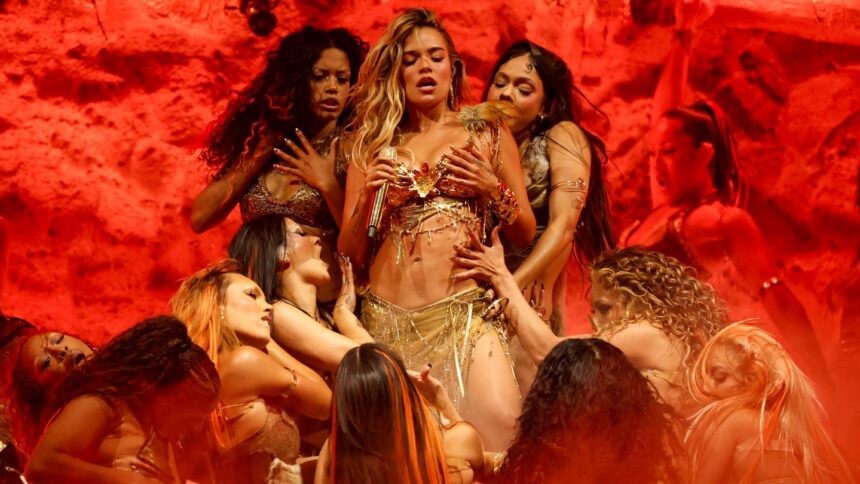
Coachella’s headline set has long been one of the most sought-after in the entire concert scene, an affirmation of star power and a sign of the most culturally relevant music in the world. But since it’s also become one of YouTube’s signature live streams of the spring, the millions of people watching at home have pulled top billing to a world-class production on par with the likes of the Super Bowl.
Sabrina Carpenter and Karol G’s headline sets in particular this year exhibit a level of scale far beyond what might be expected from a typical live concert broadcast, featuring lavish productions with numerous set changes, dozens of supporting dancers, and perhaps most especially for those watching from the screen, next-level cinematography.
Ambitious Coachella sets aren’t new per se — just look at Daft Punk’s famous pyramid from 2006 or Beyoncé’s iconic “Beychella” from 2018 — though with a larger global audience, what was once considered absolute excellence is starting to become standard expectations.
“I think there’s now equal, if not greater, interest in how it translates on camera and how the cinematography will actually reflect the scale and detail of the production,” says Ian Simon, CEO of Strangeloop Studios, which helped with the visuals and creative direction of Coachella headlining groups like Blackpink and Kendrick Lamar. “Having a live performance that translates well to live has probably become a non-negotiable at this point. If you have something that sounds great at Coachella but is disappointing live, you risk disappointing the fan base that expects it at this point, especially after this year with the quality we’ve seen.”
“No one takes the size of this for granted,” says JBeau Lewis, a partner agent at UTA whose clients include Karol G as well as 2023 headliner Bad Bunny.
“Each artist and their team have to define the value to them,” says Lewis. “Strategic, smart artists and their teams see the big picture of how Coachella in the live and streaming experience fits into the larger landscape of what they are trying to achieve.”
Considering the massive global audience plus the thousands on site, Lewis says Karol G spent three times what Coachella paid her on her production costs alone, which included months of preparation and three weeks of rehearsals in Las Vegas. Lewis didn’t specify what Karol G was paid this year, but given that the typical Coachella headliner is paid in the mid-seven figures (Justin Bieber set the record this year with an estimated $10 million payday), that suggests Carole could have been paid in the eight figures.
When asked whether the wider live-streaming audience played a significant role in these calculations, he called it a “fair assessment.”
“Carroll doesn’t see this as a one-time offer, like, ‘I did this and I’m going home now,’” Lewis says. “She is someone who deserves and seeks world domination as one of the biggest artists on the planet. The show is part of a bigger plan. Performing her best in front of over 100,000 people there and for tens of millions on live will benefit that long-term plan.”
The focus was certainly justified, as Karol G’s global Spotify streams jumped 15 percent the day after her show. Rolling Stone Reported this, while US flows jumped more than 35 percent.
Of course, not every outfit needs the same level of glow. Justin Bieber’s show stood in stark contrast to Carpenter and Carroll’s, which was relatively stripped-down featuring nothing more than Bieber with a laptop, a half-pipe-like stage setup and a few guests. The show, although divisive online, was the most watched of the entire weekend and was by all accounts a successful comeback show that affirmed Bieber’s image as one of the biggest entertainers in the world.
Neither Coachella nor YouTube share specific numbers about the festival’s streaming numbers, though it has undoubtedly become a behemoth drawing millions of views. Coachella and YouTube have doubled down on their streaming efforts for 2026, streaming the main stage, outdoor stage and desert tent in 4K for the first time and introducing a multi-stream feature to show four different sets simultaneously.
Given the number of viewers tuning in to the broadcast, Simon likened the development of Coachella’s lineup to shows like award shows and other TV commercials, where the focus can’t be on the thousands watching in person, but the millions watching from a screen.
“At every Grammys I’ve worked at, you’re sitting with the director to watch the performance, and it’s always a process of redirecting attention from the stage to the screen, reminding them that there may be 5,000 here, but there are a million more,” Simon says. With Coachella live, it’s a similar process, where in rehearsing the costumes, thinking about the stage pieces, and the choreography, it’s pretty much designed to work backwards from what it’s going to look like on camera.
However, this does not mean that in-person viewers are not prioritized just because live streaming is popular. There are hundreds of thousands of people in attendance, but festivals are held in parks and fields, not in arenas and stadiums that were designed to accommodate line of sight for that many people, so most festival-goers won’t get much of a view of the larger groups in attendance regardless, making a good camera shot equally important to them, too.
“There were people running through the open doors, settling at the Pepper Barrier and sitting there for 11 hours without going to the bathroom all day so they could get a good view,” Simon says. “If you’re not willing to make that kind of commitment, the chances of getting good visibility even if you have a VIP or artist pass are low, and you’ll have to look at the screen.”
Coachella has offered live streaming for more than a decade, though Simon attributes at least some of the growth in popularity to the COVID-19 pandemic, which has transformed live streaming from an afterthought to the only way fans can consume live content from their favorite artists. Live streaming shows in the age of COVID-19 started out random and cheap, but as they become more widespread, the demand for high-quality live streaming shows has soared. Technology hasn’t gone away, and live streaming is becoming a more regular part of the live experience for those who can’t attend in person.
Simon adds that live streaming in the pandemic era has given way to many of the technological and skill upgrades that still exist in live streaming now, and coupled with the ever-increasing demand for better shows, the floor has risen.
“With everything we do with these cameras, you’re basically trying to produce a live concert film for a live audience,” he says. “The contrast between the live broadcast format and the format of a well-produced, post-edited concert film is beginning to converge, with expectations for the former looking like the latter.”
Simon said Blackpink was his company’s first show on the Coachella main stage since the pandemic ended, adding that “the conversation about live streaming was something we were thinking about from the moment we entered rehearsals, versus previous main stage work we’ve done in the past, where we were aware of that, but we weren’t necessarily looking at blocking the camera early in the process.”
As these high-profile shows continue to grow in ambition, and as Coachella continues to improve, it’s hard to imagine this trend slowing down in the coming year.
“If you perform on stage in Indio, there are people watching the show in India,” Lewis says. “People are watching it everywhere. This has a direct impact on artists’ ability to attract fans, connect, broadcast and tour in all places around the world that may have been difficult to reach before.”