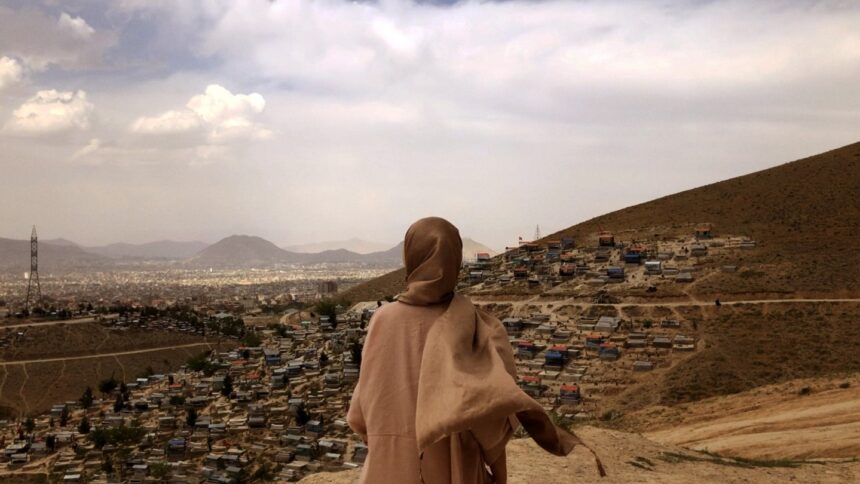
In Taliban-controlled Afghanistan, where women are denied the right to study, work or speak freely, a group of young women risk their lives to form an underground reading circle. Inspired by Anne Frank’s experiences in Amsterdam in the 1940s, they began writing their own memoirs. For these women, the harsh reality is reality. Now, they’re sharing it with the world Secret Reading Club in KabulIt is a documentary directed by Shakiba Adel and Elina Hirvonen and partly filmed by the women themselves.
The film, described as “an intimate testament…to the power of art to keep hope and humanity alive,” will have its world premiere on Monday, March 16, in the Nordic:DOX competition program of the 23rd Copenhagen International Documentary Film Festival, CPH:DOX.
“We experience with shocking clarity what is at stake when the Taliban storm a hidden school or arrest young girls for practicing martial arts,” the festival website highlights of the document. The story is intertwined with an insight into director Adel’s journey. She grew up as a girl under the first Taliban regime, and after the fall of the Taliban she became the first woman to appear on Afghan television. “Having had to flee her homeland twice, she now dedicates her film to a new generation facing the same oppression she suffered,” the festival notes.
Secret Reading Club in Kabul Produced by Marco Talli, Joanna Raita and Paulina Piponen. Cinematography was handled by Jarkko Virtanen, while the editor was Anouka Lilja. Yellow Film & TV is handling sales.
Adil and Hirvonen spoke to THR About the journey to make the film, the protection they put in place for the young women, and their hopes for it Secret Reading Club in Kabul It will give Afghan women a chance to be heard and seen all over the world.
How did you first meet?
fair We met here in Finland when I was working on another project in Afghanistan with young people, funded by the Finnish Ministry of Foreign Affairs. Elena was working on the same project. I was producing this workshop, and you helped me prepare the content.
Hirvonen I’m also an author, so I’ve been creating some writing exercises and things like that.
fair I was in Kabul ahead of the workshop that was scheduled to take place in August. There were rumors of the Taliban taking control of the cities. I never thought that Taliban control of Kabul would become a reality again. Their time has passed, a lot has been invested, and there is now a proper government, I think.
Suddenly, I saw my phone full of text messages and WhatsApp messages. They were all my colleagues and people I knew, especially the women I worked with, the female journalists in Afghanistan. They were all in a state of panic. At the moment he was [clear] The Taliban were spread everywhere, and everyone was trying to return to their homes as quickly as possible. Of course, I was in shock. I didn’t want to believe it.
When my niece returned from school, I saw her crying, so I asked her why. “We had to say goodbye to our classmates because the principal said we couldn’t go back to school,” she said. I was numb. I felt anxious because I had gone through the first period of Taliban rule, and [had that same experience]. I remember what they did, and how I felt.

Hirvonen I remember texting Shakiba asking, “Do you know how to get out?” She had no idea. We knew that the Taliban were going door to door and killing people, especially if you were collaborating with foreigners. We knew that Shakiba would be a target because of her work and history as a journalist, the first woman on television, and a women’s rights activist.
So we started summoning all the politicians, all the ministries from our side. We were finally able to get her listed, and she was evacuated.
How did you find the young women we will be following? Secret Reading Club in Kabul?
fair I knew the main girl who started the book club, and she wanted to be part of the movie. In the book club, there were many girls willing to participate, but we chose the girls who were the most outspoken and had something to say.
What security measures did you use during filming to protect the young women and their identities, other than using names in the film that are not their real names?
Hirvonen Security-wise, we had a security specialist helping us, because our main priority was making sure the film didn’t become like that [too much of a] Danger for girls. Of course, you can never be 100% sure, but we wanted to take every possible measure not to put them at risk.
Our security consultant helped create a system for them to submit material to us and for us to delete it immediately. He came up with tips on what to photograph and how to photograph them so as not to be recognized. And then we also blurred the images. Our consultant is very experienced, has helped people in similar situations, knows Afghanistan well and also knows how the Taliban operates.
fair No matter how careful you are, the danger still exists. But these girls wanted to participate and knew the risks from the beginning. The first tip that we shared with the help of the security consultant is that they should cover their faces and not shoot from near the window.
When we started editing, there was a lot [scenes] Which we loved but couldn’t use due to security concerns. A security consultant would sometimes say that someone can be identified and discovered. So we had to cut a lot of shots, blur them out, or cut out beautiful shots and get rid of them. The girls filmed really cool material, secretly with their mobile phones.
How did you do early? Diary of a young girlalso known as Diary of Anne FrankWhat comes into play during filming?
Hirvonen He’s been there from the beginning. It was something I remember Shakiba recommending to them as something that might resonate with them.

fair Long ago, when I came to Finland, a Finnish friend gave me the book. When I was a young girl in Afghanistan, I always wondered, “Does the world know what we’re going through?” I thought we were alone. I thought we were the only ones going through this and no one would understand. But when I read the book, I was surprised. I felt like Anne Frank, I really did. I just felt like someone else had gone through the same thing as me and knew what it felt like to be inside your own home, unable to do the things you wanted to do as a little girl.
So when I came back from Afghanistan, that book came to mind. I sent it to a lot of women in Afghanistan. So I asked them to please read it. I tried searching on Google and finding a PDF or something like that. I said: Read this and write what you feel. and [one girl who] I read it and then decided to start a book club.
What I found so horrifying about your film, beyond the Taliban beatings and other forms of violence, is how much the horror you create affects the identity of young women. We hear one of them mention how she doesn’t want to be a woman anymore, that she doesn’t want to live in Afghanistan anymore, and how she’s starting to doubt her religion, all because of the Taliban. Did this surprise you too?
Hirvonen I was so impressed by how open and brave they were. I was incredibly impressed by the way they opened up their whole world, from the outside, but also in terms of what happened to them on the inside. To me, it was even more surprising how elegant their language was. All these talented women wanted to be in the film. They want to be heard, and they want to be seen. They want to be seen as human beings, not as something the Taliban is trying to make of them.
Sometimes, people’s attitude toward women in Afghanistan is that they are somehow different, and that in their culture, it is somewhat acceptable to be treated that way. But when these women show the world what’s inside and out, you can relate to them because they’re human, and they’re not that different.

fair I was also amazed by their courage. There’s a shot in the movie where… [one of the women] He walks among all these men. That was one of the first shots we got, and when I saw that, I was shaking. I was like: “How do you do that? “A gunshot also appeared with a Taliban member and a pistol next to it.
That’s when I realized they were not my generation. They are different. They have been taught. They know what their right is, and they are not afraid to fight for it. They are not afraid to confront the Taliban. Their attitude is that they never give up. In the film, you see several times how their courses or classes are closed down by two students, but they find another way to continue.
Hirvonen They also support each other. They have this brotherly attitude. They use art as a form of resistance. At least for these women, this is tangible, photographing and writing as a form of resistance. After watching this movie, even the most pro-Taliban people cannot agree with the Taliban.
What is your hope for Secret Reading Club in Kabul?
Hirvonen Our hope is that the film can bring the international community together to put pressure on the Taliban, similar to what happened with apartheid in South Africa. We want the international community to come together and say you cannot treat people this way. Fundamentally, our hope is that the voices of Afghan women will no longer be ignored. Our dream is for the film to bring together the international community to say this must stop.
fair There are popular women’s movements in Afghanistan, even under the severe restrictions imposed by the Taliban. So, yes, our hope is to bring the international community together to put pressure on the Taliban and recognize them as well [what they are doing] As a crime against humanity. We look forward to bringing the wise voices of these women to the world and including Afghan women on the world’s agenda. After all, human rights are universal.