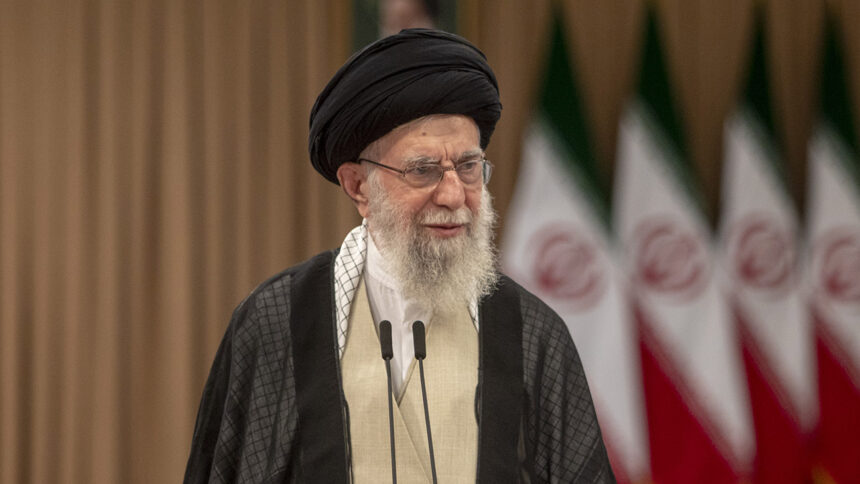
Iran’s large community of diaspora filmmakers expressed widespread support for the US-led attacks that killed Iran’s Supreme Leader, Ayatollah Ali Khamenei, on Saturday.
In public statements and across social media, Iranian filmmakers are celebrating Khamenei’s death and the international intervention they see as a blow against the theocracy in Tehran.
“Everyone is very happy that the dictator is dead,” said Mehshid Zamani, a film critic and member of the Los Angeles-based Independent Iranian Filmmakers Association. “This overshadows all other reactions at this point, even though people are worried about what will happen next.”
Iranian director Mohammad Rasoulof, nominated for an Oscar (Holy fig seed(, who now lives in Germany, posted a photo of Khamenei on his Instagram account on Sunday with the text (in English): “He is without a doubt the most hated figure in contemporary Iranian history.” In a later post, he expressed hope for political change in Iran. He wrote that the Iranian people want “the right to self-determination,” and noted that this desire for political change “can no longer be suppressed.”
Nima Sarvestani, a Swedish-Iranian documentary director, posted on Instagram her latest film, Death Corridor Survivorswho examines the legacy of political executions in Iran, wrote that “the Iranian regime’s 47-year nightmare” is “not quite over yet, but light is slowly entering the frame.” With the dismissal of Khamenei and the dismantling of part of his inner circle, a dark chapter is approaching its final form.”
In the wake of news of Khamenei’s death, anti-regime expatriates in cities across Europe and North America organized marches and celebrations, waved pre-1979 Iranian flags, and expressed hope that Khamenei’s death would accelerate political change in Tehran. Meanwhile, smaller pro-government demonstrations have emerged in parts of the United States and elsewhere, condemning the military strikes and expressing solidarity with the Iranian leadership.
talking to Hollywood ReporterZamani said that the Iranian diaspora has long been demanding international intervention to help overthrow the Iranian regime. She refers to an open letter dated January 10 from Shirin Ebadi, the Iranian human rights activist and Nobel Peace Prize laureate, signed by the famous Iranian director Mohsen Makhmalbaf (A moment of innocence), calling on President Trump to “help the Iranian people. It is time to act against the machines of oppression and prevent the continued killing of a people seeking dignity, justice, and freedom.”
About 200 Iranian filmmakers have put their names in another open letter condemning the recent violent suppression of popular protests in Tehran, and criticizing the regime’s “systematic corruption and plunder of public wealth,” which has “pushed people’s lives into the abyss of poverty, oppression and despair.”
Zamani said that even amid the state of jubilation, fear hangs over expatriates. She said: “Every Iranian outside the country is worried about our families in Iran… Everyone is worried every minute this war continues.”
This concern is confirmed by the rapidly expanding military campaign on the ground.
The US-Israel-led offensive on Iran continued on Monday, with Pentagon officials warning that the campaign is only in its early stages. At the same time, conflicts are showing signs of spreading across the region. Iran responded by launching explosive drones across the Persian Gulf, and the Iranian-backed Hezbollah group fired missiles from Lebanon at Israel, triggering retaliatory air strikes on Beirut. Three American planes were shot down in what the Pentagon described as an apparent friendly fire incident involving Kuwaiti air defenses, although the pilots escaped safely.
There have also been Iranian-led strikes on oil and gas infrastructure in Saudi Arabia and Qatar, missile attacks near US bases in Kuwait and the United Arab Emirates, and the closure of shipping through the Strait of Hormuz, all of which have rattled global energy markets and raised concerns about the economic fallout and broader regional conflagration.
Ali Larijani, Iran’s top security official, struck a defiant tone on Monday, criticizing President Trump for what he described as “delusional illusions” of regime change that have “plunged the region into chaos.” “Iran, unlike the United States, has prepared itself for a long war,” Larijani wrote on X.
talking to New York TimesUS President Donald Trump said that military action against Iran may continue for four to five weeks. Gen. Dan Keane, chairman of the Joint Chiefs of Staff, declined to give a timeline for the conflict while acknowledging the possibility of more American casualties.