
“Jabin” Courtesy of Lightdocs
Maxence Voiseux’s debut feature, which has its world premiere at Directors’ Fortnight in Cannes, follows the titular young man in northern France from the ages of 8 to 18.
French documentary filmmaker Maxence Voiseux clearly has the patience, stamina, and desire to immerse audiences in a world they are likely unfamiliar with. In his first novel, GabinHe photographed a young man for a decade, following him and his feelings of being caught between continuing his family’s farming life, as envisioned by his father, and a slowly developing desire to follow his dreams from the ages of 8 to 18. The documentary makes its world premiere on the Directors’ Half Night line-up at Cannes 2026 on Thursday 14 May.
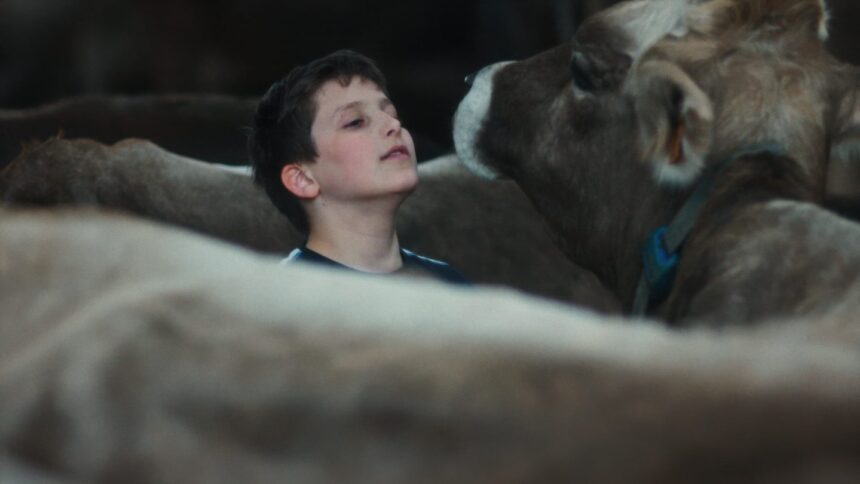
Gabin is the youngest son of a Gourdel family in the rural area of Artois, a region in northern France, “where leaving feels like betrayal, and staying has a price,” press notes note. Set to take over his father’s butcher shop, he feels torn between loyalty to family, a desire to save the farm from financial ruin and dreams of liberation.
Gabin The film’s events take place in a neglected countryside, far from the eyes of the world and affected by globalization. “I turn my camera toward what remains of this legacy: the men whom life rarely rewards,” Voiseux explains in a statement to the director. “When I was a child I saw [Artois] As gloomy and austere. It was only much later that I began to see it as a real film set, with its inhabitants as living fictional characters. The Artois region is where I first envisioned becoming a filmmaker, and I pay special attention to its working-class roots.
In 2014, for his graduation film. Of men and beastsIn fact, Voiseux made a short film about the cattle market in Arras, Artois, where he met Gabin’s grandfather. Then he met his three sons, whom he shot Heirshis first medium-length document.
GabinThe film is written and directed by Voisaux, with cinematography by François Champy and Martin Roux, and editing by Pascal Hanauer and Nathalie Barry. Produced by Cécile Lestrade and Elise Hogue of Alter Ego Production, and co-produced by Ola Lehmann of Ama Film and Palmir Badinaire of Rita Productions, in a co-production with SWR/ARTE and RTS Radio Télévision Suisse. French distributor for Gabin It is an Arizona distribution. Lightdox handles sales.
Before the film’s premiere at the Directors’ Fortnight in Cannes, THR I wanted to hear from the director about the challenges and joys involved in filming a documentary over the course of a decade.
Voiseux says he spent about 100-115 days filming. “But actually, the most important thing was the time I spent with Gabin,” he says. THR. “You might feel some of these exchanges in the film, but you won’t see them. I spent a lot of time between shoots preparing and talking to them.”
On each visit, the director said he felt like a family cousin, and Gabin even introduced him as his cousin at times to simplify interactions with others. “But at the same time, I was also a film director, and they knew that,” Voiseux highlights. “So they knew after a while that I was thinking about what they were sharing with me and how I could put it in the movie or not. And I would ask them for their ideas.”

By the time filming was done, “Gabin had spent more time shooting with me than not shooting with me,” notes the director. “So, it’s been a crazy ride for me, but also for him. The movie is a part of life for him and for me.”
At times, the film created space for intimate conversations, including about Gabin’s future. At times, it was stressful for all involved, but they remained committed to preparing the document.
However, Voiseux admits that sometimes it becomes difficult to know where life and film blend together or influence one another. “They used film as a process, as a molecule, to make their lives a little better and to make things happen,” he says. THR. “Sometimes, I or we didn’t know whether they were doing things for themselves, for the film, for everyone or for everyone.” [of those]. So, sometimes it’s a big mix of life and film.
After years of dealing and calling each other cousins. At some point, he visited Gabin Voiseux in Paris, and opened up his life to the young man in a way he had never done before. “That was when we went from cousins to brothers,” says the director.
How is their relationship now that the film is complete? “It’s a bit strange,” he says. “Now, it’s just me and him, without the camera, without the process of cinema. So, now we don’t talk about cinema. We only talk about life.”

Voiseux showed the film to Jabin before sending the final version to Cannes. “I went to Canada to show him the film because I wanted to make sure it was okay for him in terms of integrity. We rented a small cinema and watched the film together. It was very moving. At the end of the film, Gabin was crying.”
To the director’s delight, Gabin felt seen, heard, and accurately presented. “He told me right away that the film was accurate and very close to his heart,” Voiseux recalls.
He stresses that all this was possible thanks to the “great trust” between the director and the people he photographed for a long time, and “Voiseux’s focus on the desire of my characters.”
The director strongly believes that the more local and specific a story is, the more universal it becomes. He hopes that audiences around the world will feel that Gabin’s loyalty to his family and his region, as well as his dreams of escaping the fate decided by others, speaks to them. Voiseux concludes: “Gabin is about a young man driven by a spirit of liberation and a strong devotion to the Artois region. This is a very powerful story.”
THR Newsletters
Sign up to get THR news straight to your inbox every day
Subscribe subscription