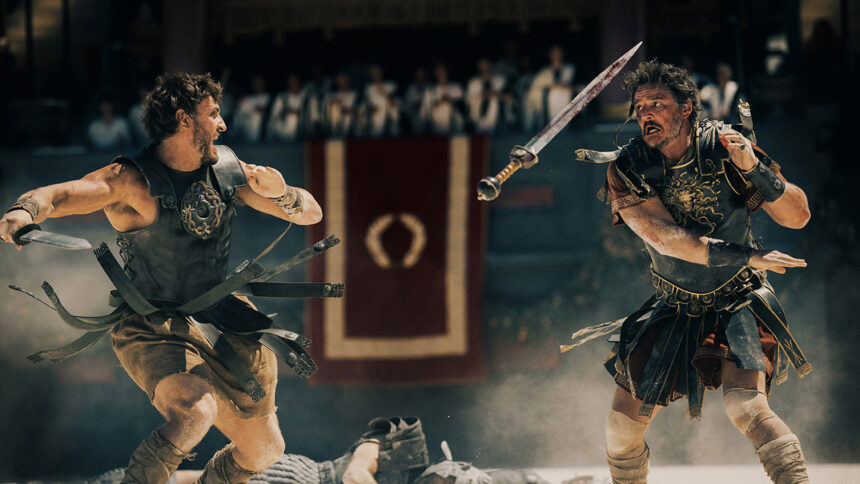
Last February, Hollywood received a message from the future: “I hate to say it, but it’s probably over for us.”
This came from Wolverine and Deadpool Screenwriter Rhett Reese responds to a clip posted on Twitter by Irish director Ruairi Robinson. The AI-generated video, as you’ve surely seen, depicts a fight between Brad Pitt and Tom Cruise over what appear to be Roman ruins that lie somewhat confusingly on the New York City skyline.
The clip appears to represent a huge leap forward in AI-generated video, with high production values and realistic facial expressions and movement. He – she It seemed Like a movie. An expensive one. While some commentators have criticized, the video quality represents a quantum leap forward from the popular early AI videos depicting Will Smith eating spaghetti.
Anyone who extrapolates this progress into the future can see that it will not be long – a year, months, or… Weeks – before anyone could create movies on their home computer that previously cost $200 million or more at no cost. For screenwriters like Mr. Rees and me, and everyone else who makes a living in our business, the diagnosis seemed clear: It’s over for us.
Or is it? Because the question, I think, is not what AI can do. The question is, will anyone watch it?
One harbinger of the paradigm shift we are experiencing — not just in the entertainment industry but across our entire culture — occurred on May 11, 1997, when chess grandmaster Garry Kasparov lost to IBM’s Deep Blue. At that point, Kasparov was the greatest chess player in human history, with an ELO rating of 2800, but after that loss, computers left humans behind and never looked back. It seemed to any observer that day that the game of chess, or the game of chess played by humans, was over. The future will be computers playing other computers.
But that’s not what happened. Competitive chess – Humans Chess – prosperous. Magnus Carlsen is an international celebrity. Chess has made him richer than any player before him, and YouTubers like Hikaru Nakamura earn as much as Carlsen. Chess is an industry that never existed in 1997. At the same time, there is a much smaller community of people designing AI chess engines and pitting them against each other as I like to imagine it. Fight club– Style competitions held in the basements. AI chess bots are now far better than any human player who has ever lived, but – and this is important – Nobody cares about them.
Humans are social animals. We care about what other humans do. We don’t care much about what machines can do. We take it for granted that they can do things we can’t – after all, that’s why we make them. But they don’t interest us the way other humans do.
Imagine that you are a tennis fan and that in the future, the Netflix algorithm will be able to create tennis matches tailored to your taste. You can watch a new, amazing and exciting match between AI Carlos Alcaraz and AI Novak Djokovic every day. Will you watch that channel? Of course not. You don’t care about Novak Djokovic’s AI. Being a sports fan means being invested not only in the spectacle of the sport, but in the human drama associated with it: the competition between a young player on his way against an older player trying to capture one last title. We feel like we know these people, and what’s important about the drama of this anti-social relationship is that they are real human beings, testing real human limits.
We care about the real Novak Djokovic because he’s a 38-year-old man who seems to do the impossible — just as we care about the real Tom Cruise who performs his own stunts because he’s a 63-year-old man who does the impossible.
Now imagine that you are a movie fan. The Netflix algorithm detects that you liked Emotional valueso it creates a channel that automatically creates a new Joachim Trier movie for you every day. Will you watch it? Maybe not. Because you are interested in what Joachim Trier says and how he chooses to say it. You have a parasocial relationship with him and his actors, even if you are entering the theater for the first time and have never seen one of his films before. It’s a human being trying to communicate something to you, and this communication is part of a broader cultural conversation taking place at tables at restaurants, at parties, and on Twitter. If humans are not involved, We don’t care.
To be sure, not all entertainment is auteur cinema, and not everyone cares whether what they watch is man-made. Does the 3 year old know or care whether Teletubbies Made by Amnesty International? Probably not, and this has implications for children’s programming. And future generations of children who grew up programming AI — “AI natives” — will likely be less discriminating about whether their entertainment is AI or human-made. There’s a whole layer of “commodity TV” where the consumer just wants something to be shown in the background, and we have to assume that there will be some kind of cultural creep as AI becomes more widespread and starts to move up the entertainment food chain.
Rhys worries that soon “someone will be able to sit down in front of a computer and create a movie that’s indistinguishable from what Hollywood puts out.” But this medium has been around as long as cinema itself has existed, and it is called animation. We may be on the verge of the age of photorealistic animation, but that won’t necessarily crowd out the live-action film industry any more than Pixar did. It’s notable that the anime never tries to perfectly replicate what live action can do: instead, it does what live action can’t do. And in all great anime, from Chuck Jones to Hayao Miyazaki WALL-EThe human touch is evident in every frame, because the human audience demands it.
The AI filmmaker of the future will have to come up with something very original and special to rise above the ocean of no-cost AI that will soon be available. If anything, the bar will be higher for AI filmmakers than for live-action filmmakers in terms of sound and authenticity. The “Chris Nolan AI” that Rees predicts would have to be very special to avoid being instantly duplicated by hordes of roving AI agents cloning whatever movie just came out.
The future of AI video may not be to create realistic “fake” Hollywood movies with fake stars, but rather movies that Hollywood can’t make, or hasn’t even dreamed of making yet. The real limits of the medium may be the point at which the merging of “real” live performance and artificial intelligence suddenly makes films that were once uneconomical suddenly possible.
The real significance of the Brad Pitt vs. Tom Cruise video is that we are rapidly approaching the point where the cost of producing a blank scene becomes zero. Visual images that previously cost $250,000 per shot and thousands of CGI man-hours to produce will now be as plentiful as air or water. We will soon be swimming in it, and its cultural and economic value will decline accordingly. But human dramas, written by real writers and performed by real actors, will remain as rare and valuable as ever.
David Scarpa has been a leading voice in film and television for more than 20 years. He recently wrote for Verve The second wrestler and NapoleonBoth by Ridley Scott.
This story appears in The Hollywood Reporter’s Artificial Intelligence issue. Click here to read more.