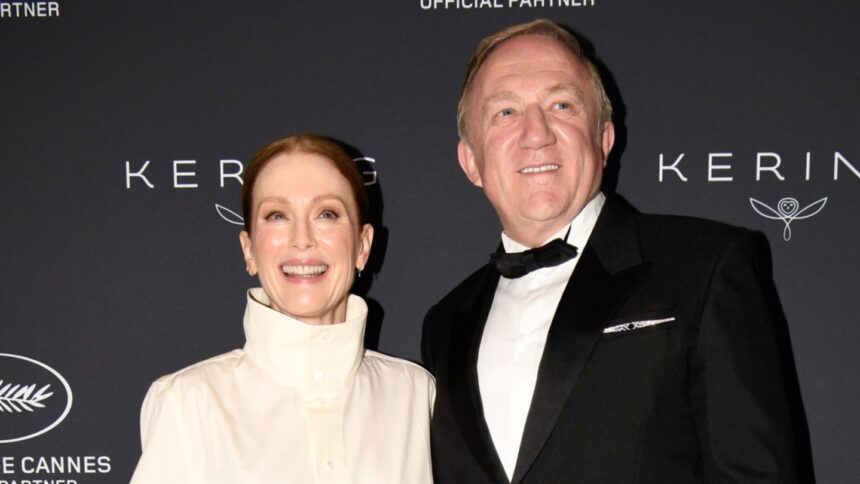
Feminism was always going to be the main course at Kering’s Women in Motion dinner, but no one would have expected Julianne Moore to unleash a battle cry in a speech during what is usually a glamorous but subdued annual event at the Cannes Film Festival.
“This is something that drives me crazy: There’s a cultural assumption, especially in the United States, that women’s stories are less interesting or smaller, or that if we’re at the center of the narrative, we need to be stronger or accomplish something great or do something male-specific if we want men to watch us,” Moore said while accepting an award for her career and advocacy for gender representation in film.
She continued: “And I think this is not true, because I think: What about the female audience? What do they want to watch?”
Moore was wearing a white silk turtleneck jumpsuit and carrying a briefcase-sized handbag also covered in white feathers, making her look like a very posh astronaut visiting this tent in a castle overlooking the French Riviera to dispense invaluable advice on how to be an inclusive advocate for female artists.
“I love actresses,” said Moore, who was on a roll. “I like to look at them. I like to identify with them. I choose a lot of what I watch based on who I’m going to look at for two hours.” Then, she seemed to make eye contact with her red-haired roommate: “Looking at you, Isabelle Huppert.”
She said that in her daily life she always looks at women. She looks to women for advice. I’ve noticed them on the subway in the elevators. She reads books about women. Everyone who represents her—manager, agent, etc.—is a woman, as is everyone in her yoga group. “When my kids were little, I told them, ‘If you get lost or in trouble, find a lady. She’ll help you,'” Moore said.
She went on to say that this doesn’t mean she has anything against men, but simply wants to celebrate the female point of view.
She also wanted to expose the idea that women feel invisible after a certain age. It seemed like a self-fulfilling myth. Maybe someone said it once and then others started repeating it, to the point where it felt real. “I’m always curious about this novel,” she said. “I want to know where they feel invisible, why they feel invisible, and are we raised to only be seen by a certain audience, or to only value that view?” Moore said.
“We need more female voices in our industry, more writers, more directors, more actresses to carry this vision of what we see,” she concluded.
Once Moore finished, the entire hall erupted in applause.
She was in good company. Salma Hayek, who founded the event ten years ago with the support of her husband, Kering chairman François-Henri Pinault, was acting as the night’s flight director, with a huge plume of white feathers emerging from the left shoulder of her form-fitting white dress.
She posed with Demi Moore, Chloe Zhao, and Ruth Negga in the photos, then walked around the room speaking with allies like Stellan Skarsgård, Rami Malek, and Jordan Firstman’s love interest, Diego Calfa. Kid Clubthe festival’s runaway hit that was snapped up worldwide by A24 in an 8-figure deal. Meanwhile, Firstman was sitting next to Odessa A’zion, his HBO costar I love Los Angeleswhere the two were dancing in their seats every time the DJ played banger music.
Meanwhile, Colman Domingo wore an ornate Boucheron octopus in white gold, diamonds and mother-of-pearl, on his right ear, as well as a shimmering embroidered jacket and a Boucheron ring, nicknamed the “Address” because it is so large that it needs its own zip code.
The whole outfit was so sparkly and adorable that guests kept coming in to take pictures of the octopus on the side of his head, which was exactly the point.
“I mean, if we can get more attention to supporting women in films, that’s great!” “That’s why I feel so stunted tonight,” he said.