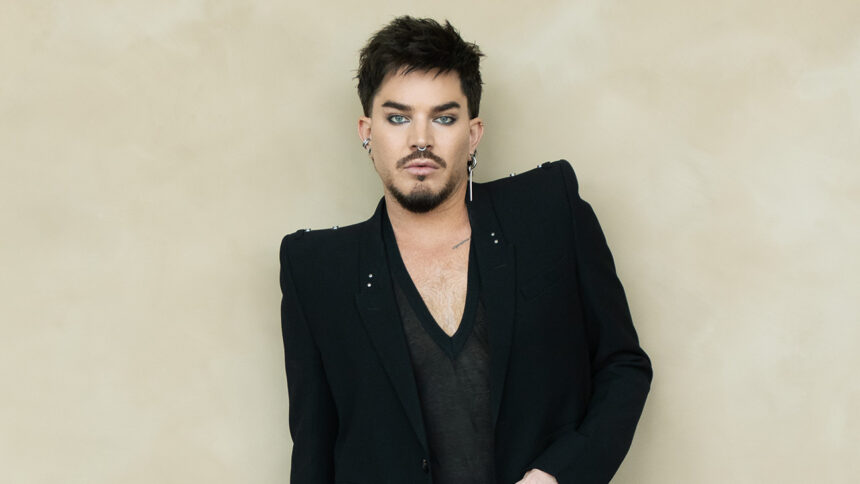
When Adam Lambert finished second American Idol In 2009, he emerged as one of the contest’s most memorable contestants: an openly gay rock singer (he came out to… Rolling Stone Two weeks after idol Conclusion) with a powerful voice and theatrical line that defies the show’s usual pop star schema.
Today, 44, Lambert has built a diverse career, releasing several solo albums, spending more than a decade fronting Queen alongside Brian May and Roger Taylor, and returning to his musical theater roots in productions including nightclub and Jesus Christ Superstar.
Now he is entering another new chapter with him Adamhis most personal album to date and the first to be released completely independently on his own label. Shaped by a move to New York, the end of a long-term relationship and the influence of industrial rock, the album finds Lambert taking stock of where he’s been and where he’s headed next.
In conversation with Hollywood Reporter From London, where he was wrapping up a small promotional tour, Lambert reflects on a career that almost took him to Broadway instead of American Idolgained the trust of Queen’s fiercely protective fan base, wrote his own music, and why, after 17 years in the spotlight, he’s still discovering new sides of himself.
Let’s talk about your journey, because it started in 2009 on the biggest stage in the world, you could say — American Idol. Is this where you expect to be in 17 years?
I don’t know what I expected, to be honest with you. When I auditioned for the show, my hope was, “Hey, I’d love the opportunity to make a really great album, and then hopefully more after that.” So my expectations were actually kind of practical. I started imagining what it would be like to be in the recording industry and make original music, but I didn’t really do much of that. I kept telling anyone who would listen, “I really want a chance to work with some of my favorite producers,” because I was convinced that if I could work with some of them, I would make something happen. That’s what idol He gave me.
You have reached the end of the competition. I was signed to RCA. I worked with Max Martin and Shellback, among other great producers, and I got to make my first album, which was helped by some of the best in the business. So I got my wish. Then we got to the next album, and it was like, “Okay, we’re doing it again. Now what?” And I’ve kept moving forward. I continue to release music, and it’s been an interesting adventure. Some were full of triumph and joy. Some of it was difficult, frustrating, and a setback in the music business.
You were very unique, both in your brilliant presentation, which was not common at the time, and in your exit [as gay]more or less, from the beginning. How did that clash with what the industry expected of you?
When I got to the end of the show, there was all this noise. I don’t think the industry knew what they expected from me. Some people in the industry saw something exciting happening – “This is something different. This is something we haven’t seen a lot of lately.” They obviously didn’t release an idol who was open about their sexuality, or even an idol who was left of center in general. It was kind of a cookie-cutter formula at that point. From my impressions, the industry was guessing at the same time I was guessing. We were all just trying to figure it out. But everyone realized that there was a lot of interest, which is great – that’s half the battle, getting people’s attention.
There was a lot of guessing that went along with it: “Well, we don’t know if this is going to work or not. Let’s try this. Let’s try that.” Looking back at where I am today, I’m grateful that I still have the opportunity to make music and have people listen to it. It’s shocking to me that it still works.
I went to see The Phantom of the Opera Last night at Pantages. I can’t get enough of this show, it never gets old for me. It’s over the top and awesome.
My 10 year old was obsessed with it too.
You started out in musical theatre, right?
I did.
Were you reaching Broadway level at that point?
More or less. Right before that American IdolI spent about six months on the road on my first national tour evil. Then I was in a Los Angeles company evil For approximately two years prior to testing idol. So I wasn’t actually, officially on Broadway, but I was working in a Broadway company, but I was at that level. By the time I auditioned idolI was at a crossroads where I was strongly considering moving from Los Angeles to New York, knowing that there would be a lot of opportunities there for theater. But I kept putting it off. It was stressful financially, and I had a lot of friends and family [in L.A.]And I was waiting for the moment when it would make sense.
It’s funny – now idol It doesn’t have the impact it had at the time. At the time, all eyes were on him, and he could have launched something really big.
It has definitely changed. Streaming has changed those TV shows in the same way it has changed music. You no longer have the captive audience you used to.
What’s interesting to me is that you had great success in musicals very quickly, but that wasn’t your passion – you were looking for something else. It’s the opposite of what happened to Nicole Scherzinger, who felt trapped by the pop machine and had a rebirth as a star on Broadway and the West End in… Sunset Street. I know you were in nightclub.
I had a great time doing this nightclub. What I loved most was that it was a complete moment, returning to my roots, returning to the theater people. Theater people have a lot of meaning to me – I feel at home in this community. One of the things that initially turned me away from theater was that I felt like it was limited in the types of parts and the number of parts that I found compelling. One item was my sex life. Another was that I liked more alternative stuff. I wanted to explore themes and musical styles that were not common in theatre.
But in the 20 years since I’ve been gone, there’s been a lot of new material, a lot of new exploration. There has been a complete awakening on Broadway to diversity and different walks of life, and there is so much more to offer an actor now. So, back on stage, it was like, “Oh, it’s a different world now — there’s a lot more of an open playing field.” And even with Emcee, who was always a weird, alternative little character, I felt more like you could achieve whatever you wanted.
You must contact[[sunset Director]Jamie Lloyd. He’s really talented.
It’s great. I’ve talked to him before.
you have? I think you can do something great together.
My big question is I don’t know what the show will be. It’s definitely been a conversation I’ve had with a couple of people, but I can’t seem to find a proposal that makes sense. Maybe it hasn’t been written yet. And I personally am writing a musical – I’ve been writing one since the pandemic. It’s late, but it’s something I’m working on. So we’ll see.
Regarding the Queen, how has that changed your life? Suddenly you were playing in stadiums.
I think the more interesting question is: How did this not change my life? It’s been a huge career. Not only did it give me a lot of credibility within the industry, it kind of validated it. The house has been a great fit for me – their catalog really suits my strengths as a performer. I learned a lot from Brian May and Roger Taylor. They don’t believe it. We’ve been touring for over 10 years, so it’s really become a big extended family. And honoring Freddie Mercury — someone I really look up to as an actor, as a writer, and from what we know about him, as a human being — I loved the opportunity to celebrate him.
Were the fans resistant to you at first?
There were some fans at first who were resistant, which is normal, and I was kind of expecting that. Look, this is sacred ground, you can’t replace the man. There will be people who were protective and territorial. But somehow, it encouraged me to work harder. He gave me a hill to climb. Fortunately, it was Brian and Roger are very supportive, telling me from day one: “You don’t need to imitate what Freddie did on the record. You can find your own way.” That was all I needed to hear.
Early on, I took a lot of liberties. What’s interesting is that over the years, I’ve taken less liberties and stuck more to the melody. At first, I felt like I had a lot to prove. As I became more confident and comfortable in my role with them, it allowed me to trust what was written a little more and find more precise ways to make it my own.
Your voice has always been undeniable – I remember the first time I heard you sing American Idol. Technically, how many octaves can you sing?
It’s so funny – people ask me this, and I don’t really know. I think it’s four, five? I’m technically trained, but stopped taking lessons many years ago. I go by ear now. I’m doing some warm-ups, and I think taking opera for a year as a teenager was a really good foundation. When it comes to vocal technique, I have good instincts, but I’m not really obsessed with it.
Your new album Adam He has a new voice. I was thinking of Nine Inch Nails while listening to it.
That was definitely one of our reference points, for sure. This type of electronic rock music is very interesting to me.
I understand it’s partly inspired by a breakup or something personal. Do you want to talk about that?
There is a song on the album inspired by a breakup. “Am I Okay” was written a week after the end of a five-year relationship, so it was very raw and very fresh. But even more broadly than that, moving to New York involved this major life change. One chapter in Los Angeles was coming to an end, the chapter in New York was beginning, and everything was in sync with that separation. So it’s really about re-establishing my individuality, my identity, my desires and needs, my hopes and fears, and re-contextualizing them in a completely new environment in this new phase of my life.
I wanted the album to live in a darker world than some of my previous work. We’re living through political and social unrest, anxiety, fear, and uncertainty, and I wanted that to be the undercurrent. Sometimes we don’t realize how much the world around us seeps into our personal lives.
Are you happier now? Has the pain subsided?
That’s the beautiful thing about making music. It becomes a kind of therapy. You put all your thoughts and fears into a song, and turn them into something positive. I’ve always been a communicator, so writing songs is my way of understanding my experiences and sharing them with anyone who wants to listen.