[Thisstorycontainsspoilersfor[ThisstorycontainsspoilersforGirls like girls.]
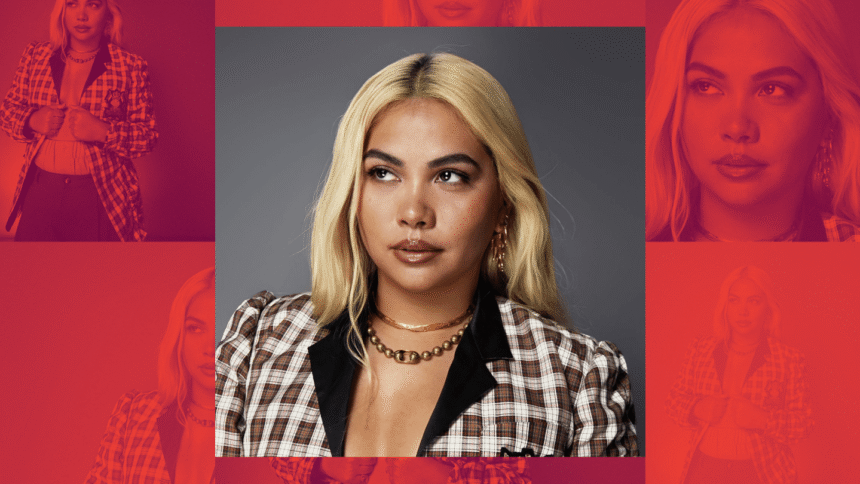
Hayley Kiyoko has accomplished something very unique. She took her 2015 hit “Girls Like Girls” and turned it into an expanded universe that includes a music video, a novel, and now a feature film.
Although the 35-year-old started out with roles on the Disney Channel lemonade mouth and Scooby-Doo! live-action films, she didn’t wait long before turning her full attention to music. She used her lyrics as a tool for self-expression and healing, resulting in her personal anthem “Girls Like Girls,” which established her as a major force in the music industry.
She quickly continued sharing her revolutionary story across multiple mediums to reach as many people as possible. Although the long journey has seen many obstacles, it has also been very rewarding for Kiyoko. “I’m not religious, but there was something in my body pushing me forward. And every time I wanted to give up and every time I said, ‘I don’t think this is going to happen or come to fruition,’ my body said, ‘But you have to do this.'” Hollywood Reporter. “It was like, ‘If not you, then who?’
The Focus Features movie Girls like girls is a coming-of-age story that follows Collie (Maya Da Costa), a grieving teenager who moves to a small town in Oregon to live with her estranged father, Curtis (Zach Braff). There she sparks romantic feelings with an attractive girl named Sonia (Meera Moloy).
“I really thought this movie — I’m sure I have more to share — but I think this movie is a big part of my purpose and a big part of just helping others on their journey of self-love and self-discovery,” Kyoko adds.
Below, she opens up about the 10-year journey Girls like girls to the big screen, why more LGBTQ coming-of-age stories are needed, the film casting process, writing an album for the film, her other directorial ambitions and more.
After you started acting and then moved to music, where did the spark for the arts start?
I knew I was different from a lot of people in terms of hiding my sexuality at a very young age. We’re talking like 6 years. So my whole upbringing was hiding and carrying this huge weight and secret. So I found music, and music was my way of being able to communicate my truth even if I wasn’t being true to myself. I still wrote he/him pronouns in my journal, but it was an outlet for me to express myself. I think that’s where the beginning came from. I started on the drums. I started writing music at a very young age and I remember seeing NSYNC in concert and them performing on stage. So I said how do I do that? I want to do something like this.
You’ve directed several of your own music videos before, so what prompted you to direct your first feature film?
When I co-directed Girls like girls In 2015, I said, “Oh my God, I’ve always been a director. This is what I want to do forever.” I directed the next 11 music videos for myself and initially started out of necessity because I wanted to create hopeful queer content. Then I said, “Oh my God, how can I do it? Girls like girls In the movie? Because I would die to see a movie like this. And so I began this ten-year journey of trying to figure it out, writing the script, trying to find financing for it, a distributor, all that stuff. And here we are in 2026, a few weeks away from the movie premiering in theaters, and it’s so baffling to me that we even did that.

This film has actually been 10 years in the making, first with the song and music video, then with your 2023 novel and now the film. What does that mean to you as the mind and creator behind the story?
It was really moving and also difficult because you always want to outdo yourself and are constantly trying to get closer to the truth. In the song, I was showing my confidence in my identity. And then the music video, I wasn’t in it. After that book, I made the introduction semi-Japanese and delved a lot deeper into the story. And then in the film, I was able to cast two Asian leads in the film and have that represent a lot of people who deserve it. So I’m really looking forward to this journey of getting closer and celebrating my true self and not trying to change who I am and embracing who I am. …And this is a very unique situation where I have my hand in every single medium, and it’s been very rewarding because every time I open a door to a new medium.
Talk to me about casting Kohli and Sonia, and when did you know that Maya and Mira were right for the roles? Also, how were you able to sign Zach Braff to the project?
We received over 4,000 submissions for this film, and Maya was actually the first audition tape I saw. And there was a moment at the end of the tape where she was sitting in Sonia’s bedroom and she was taking up the space she liked, and it took me right back to that moment where you’re in someone else’s room and she’s so vulnerable and you don’t know what to do with your body. I thought to myself, “Oh my God, this is going to be the girl to beat.”
And then Meera actually auditioned for Kohli, and on her audition tape, she turned around and took a look and said, “Oh my God, it’s not Kohli. It’s Sonia.” We prepared her to read to Sonia about chemistry. Sonia’s character is a difficult character to deal with because she says hurtful things verbally, but she’s not a terrible person. So I think Mariah did a really beautiful job of taking the complexities of that character of being messy and small and figuring that out.
And Zach, talk about transfiguration. I’ve had a lot of really interesting stories on this whole journey, but I had Garden State On my mood board for a very long time because I was inspired by the soundtrack and the influence it had on me when I was younger. So when we were looking for Father, we sent the script to Zach Braff and he was obsessed with it. He met with me. He’s a fellow Aries. It was his directorial debut Garden StateSo he understands the pressure and hardship of being a first-time director. And I was very grateful to him.

You also played a small role in the film, was that always planned or was it a last minute decision?
It was at the end of filming, and I said to myself, “I think I’ll try to throw myself in here for a moment and see if it works.” I was literally there for a second, but I was like, “You know what? It’s been a 10-year journey. I better say hello.” (He laughs.)
This movie reminds me how much I love all the coming-of-age shows and movies, and how important that time is in our lives. But then you realize that there aren’t a lot of LGBTQ movies that young people can connect with, especially with two women. Do you feel proud to be one of the first to show this story on the big screen?
I feel like we should have more, but I feel very proud. This story was pioneered by fans and I felt very lonely before it was released Girls like girls Music video. So having everyone raise their hand and say, “I also feel the same way,” or “I also had this similar experience,” brought me a lot of community and support that I didn’t really have growing up. So I’m very thankful and grateful that I was able to bring this story to the big screen and try to make a difference and try to break the glass ceiling in this medium, and then hopefully it will be a little easier for the next story and for other people to shine as well.
But this is my dream movie. This is the movie I wish I had grown up with and even though this movie is called Girls like girlsWho do you like, everyone had to confront someone and ask them if they liked them and where this relationship was headed. There’s always that pivotal moment where you move on or break up, and I think that humanizes and brings us all together. Whether you’re 16, 45, or 60, I truly believe you’re watching this story Girls like girls It will take you back to that moment, that person you never got an answer from.

What is the reason? Behind the inclusion of that beautiful moment between Kohli and Sonia in the post-credits?
There were so many reasons for literally everything. I mean, I had over 20 scenes that were no longer in the movie, but it was very important to me to see Kohli and Sonya together and I felt like in the post-credit scene, there was a lot of discussion about how the movie was going to end, and without spoiling it too much, the ending is about the girls. I really wanted to say, “This is about them and highlight that.”
Your music is also a big part of the movie, with a full album being released with the movie. Can you talk about combining your love of music and film into one project?
It’s very rare that I have the opportunity to make my debut as a director, so when I had this opportunity, I said, “We’re not just making a movie, we’re making an album. We’re making as much of a hit as we can.” So I completed the film and then jumped into the studio and wrote a bunch of songs through the lens of the two characters. And because this is an independent film, there was a song I wanted — it’s a Mandy Moore song — that we couldn’t afford or license. So I looked through my old musical ideas and I had this idea that I started when I was 16 and decided to finish it for the movie. Then the other songs on the album were inspired by the compositions. So you can watch the movie and then listen to the album and then go, “Oh my God, Choker, this song is from this scene.”
And all the queer artists on the album — Young Miko, Tegan & Sara, Gigi Perez, and Chelsea Cutler — were all affected by it. Girls like girls At some point. And so they were 100% ready to participate and be a part of this cultural moment for our community, so I’m very grateful to them.
After directing your first film, what are your other directorial ambitions? Already have more stories to tell?
I have my second book Where there is a place for uswhich I would like to narrate as a movie or TV show. …I mean, it’s been a 10-year journey, so I have a lot of other stories and ideas that I want to share, but your first story is a first for you, and my dream in life is to continue to direct and write music for those projects and I would be very happy if I could do that for the rest of my life.
It has been several years since I stepped away from acting. Do you see yourself moving back to the front of the camera?
Not a 0.5 second cameo? (He laughs.)
Maybe a little longer?
I loved acting, but my focus is on directing and telling stories. I feel like this is the best use of my energy and time. But if the right role comes along, maybe in the future. But I’m grateful for the people who recognized me lemonade mouthIt was an interesting parallel too because that character was like, “Be heard, be strong, be proud.” She was fighting for what was right and trying to break the glass ceiling herself. So it was also interesting to take my own journey and see myself a little bit in that character.
If you had to describe what makes Hayley Kiyoko, Hayley Kiyoko, what would you say?
I love trying new things. I think my motivation is that I like to do something new. I don’t like to do the same thing twice. And here I am, books, music, movies (He laughs). I don’t know what next.