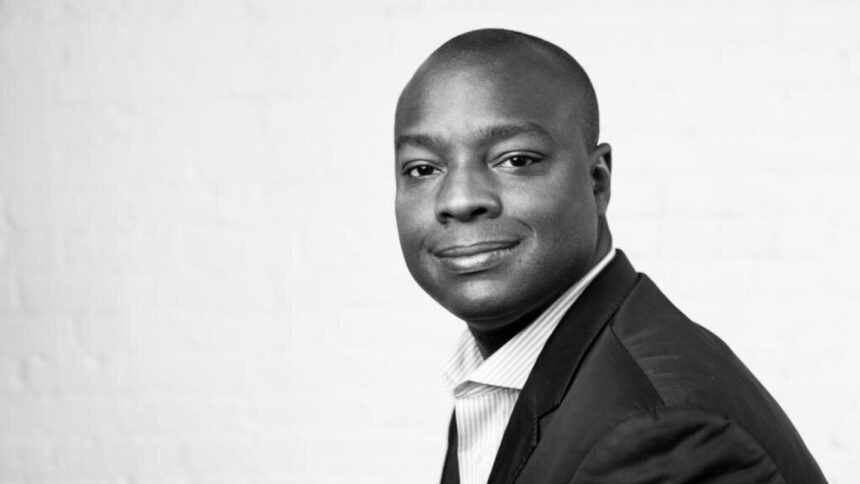
Ebs Burnough reflects on the best advice he’s ever received. This comment comes from a dizzyingly star-studded rolodex – a mountain of industry names he has amassed over decades of working in politics and film.
“Nora Ephron,” descends to: “Consider the Alternative.” Because the alternative to a lot of things, frankly, is not being here. Whenever I’m disappointed or upset about something, I say: Oh my God, think about the alternative.
Perno, who is currently president of the Sundance Institute, is a former White House adviser turned filmmaker. After serving as Michelle Obama’s senior advisor and political director in the late 2000s, he was handpicked by the then-First Lady to help chair some of the most prestigious events ever held in an American political house: state dinners and cultural affairs events that will host the world’s top politicians, artists and activists.
He admits that this job was what took away his passion for cinema and theater. In 2011, he emerged on the other side of the Obama administration unscathed, and after two years spent working with Aerin Lauder (granddaughter of the late beauty icon Estée Lauder) to expand her luxury lifestyle giant Aerin, Perno found himself pursuing a lifelong dream. Cabot tapesA deep dive into Truman Capote’s explosive, never-completed final novel. Answered prayers — told through an unheard-of audio archive and interviews with the writer’s friends and foes — and released in 2021, cementing Bernoux’s role as a remarkable documentarian.
He’s juggling his next project, a film about Dusty Springfield, with production on a new podcast series called Tea and vodkawhere Pernod invites famous guests—from British-American chef Ruth Rogers and former White House social secretary Desiree Rogers to Wu-Tang Clan leader RZA—to sip tea (or vodka) with him while they reminisce about life and lessons learned. He works from a studio in west London – Perno moved here in 2014, met his husband and never left – where a framed photo of him shaking hands with Pope Leo greets you as you enter.
talking to Hollywood Reporter Nearly five years into his position as head of the Sundance Institute. The director reflects on the “growing pains” Trump has caused in the United States, the major security breach that has overshadowed his political career and led the film festival’s much-talked-about move to Boulder, Colorado: “Bob [Robert Redford] “He was aware of that,” Pernod laughs, “and made his opinions very well known.”

Perno’s relationship with the Obamas came through mutual connections. A graduate of Northwestern University, he worked for future New York Governor Andrew Cuomo and later for Patrick Gaspard, who was working his way up the political ranks in Manhattan. When Gaspard was hired as political director for Obama’s presidential campaign, Michelle Obama needed some staff of her own.
“[They] Everyone knows me. I am the only daughter of a single-parent family. I was raised by my mother, my nanny, and my aunt. They wanted someone who was adept at working with strong women, and non-threatening,” Perno recalls.
“She recognized the creative side of me, the theatrical and film side,” he continues, explaining why the then First Lady wanted him as deputy social secretary. “Our first formal dinner was in India, and we had Balinese dancers from San Diego, Jennifer Hudson, singing with the National Symphony. [Orchestra]. All these things, you think, “There’s creativity.” [behind it]”But there’s also the politics of someone having to actually sit in the center. “Because the head of legislative affairs says we have to invite these members of Congress, and the chair of the Democratic National Committee says we have to invite these donors,” he explains of the logistical challenges that came with the job. “I think I have a natural talent for identifying what resources are needed where and when.” […] I think that’s probably what [Michelle Obama] opinion.”
When Rogers, the first black woman to serve as White House social secretary, was fired from her position, Perno took over in the meantime. “Actually, I never talked about it,” he began to say THR. “At our first state dinner, we had a crazy experience where we got the White House gate smashed.” A man and a woman who were not invited to this event – Michael and Tariq Salahi – bypassed three security rounds and shook hands with the president, in an unprecedented security breach that left the Secret Service completely baffled. “It was big national news, and Désirée was blamed,” Pernot says, adding that no one wanted to blame the Secret Service: “The president got a lot of death threats, and you can’t bite the hand that protects you.”
Rogers’ dismissal left a bitter taste in Burno’s mouth. He left politics behind in 2011, but did he discover how the Salahis managed to get through the best security measures in the world? “I mean there were congressional hearings about that!” Perno answers. “It was crazy. The night of the event, it was pouring [with] Rain, and I think the Secret Service let their guard down because they had a lot of VIPs. “You had Colin Powell, the Secretary of State, and the Clintons, all wearing black ties and gowns.”
As someone who played a key role in an administration that is now considered the glory days of 21st century American politics so far, does he regret watching what happened in the years after Obama left office? “I’m always optimistic. I’m always optimistic. President Obama always used to say, ‘Politics is in a zigzag,’ and I think that’s true,” Perno says. “America is going through growing pain — we’re a young country, we just turned 250 — and I think those are moments of identity. I think there’s fundamentally more that brings us together than divides us. I just think that, right now, we’ve been traumatized by the coronavirus, in particular, and I think we’re living in a moment where everyone feels very individual.”
The next job presented itself through three different people: fashion legend Anna Wintour, Melody Hobson, wife of George Lucas, and American businessman Aryeh Bourkoff, who all suggested to Pernod – in separate conversations – that he go work for Lauder. The next day, while having dinner at a friend’s house, he found himself sitting next to her. Regarding whether politics opened the door for him, Perno says: “Politics, in America, [whether you’re a] Democrat, Republican, Independent – it doesn’t matter. It is a unifying force in the sense that it affects everyone. Fashion, finance and movies. Over the years, the White House Correspondents’ Dinner has become another version of the Met Gala. “Everyone has skin in the game.”
At AERIN, the transition from politics was more difficult than he imagined. Perno went from working with the Ministers of Education and Agriculture, improving children’s lives and giving back to the community, to “worrying about the pattern on a tube of hand cream.” “I walked away from doing something that had such meaning and purpose, on a personal level, and,” he says [could see] And the tangible results of its impact on people’s lives. [But] The second pays better. It has given me a completely different approach to life and time with friends and family. “I was happy to leave the White House, but I missed the impact,” he adds.
This dissatisfaction did not last long: Pernod was soon reintegrated into the world of cinema and theater. One memory in particular stands out as evidence that the director in him never left. “I was on the board of Steppenwolf [Theater Company] And the Board of Directors of the Actors Fund. [EGOT-winning composer] Marvin Hamlisch died in 2012, and when he died, Marvin W [his wife] Terry did not have any children. So I planned his funeral [and] I have planned a memorial for him. Suddenly, Barbara Streisand, Liza Minnelli, Aretha Franklin and Itzhak Perlman showed up at his memorial service at Juilliard. President Clinton spoke, and Lily Safra spoke. There were moments where I was suddenly producing or directing in some way, so I think it’s always been there.
Perno remains rightfully proud of him Cabot tapesa well-reviewed work that premiered at TIFF. It came last year Kerouac’s Way: Rhythm NationBurno’s documentary about the making of Jack Kerouac’s beloved novel On the road It still resonates across America Sphincter. Both gave him the confidence to consider “dipping his toes” into a work of narrative fiction. “I’m someone who looks at these things when they’re finished, and I say, ‘Am I proud of it? Yes. Next.'” His long-standing appreciation for fellow storytellers like Capote and Kerouac made him a perfect fit for the top job at the Sundance Institute, a role to which he has been appointed in 2021.
After its veritable baptism of fire — the first installment of the Sundance Film Festival under Pernot went completely virtual due to coronavirus concerns (“We lost a lot of money, and I’m not going to change the decision”) — the festival dominated headlines last year when it was confirmed that the Robert Redford event would move from Park City, Utah, to Boulder, Colorado.
Perno, who led the move, is well aware of its importance. “It was a big decision,” he says. “The reality of the situation is that the festival’s master agreement with the state of Utah and Park City, which is held every 10 years, was about to expire. As a board of directors, with administrative and fiduciary responsibility, we had a responsibility to examine the next terms of the deal and what the festival was bringing.”

He says the core of the deliberations was about rising costs and economic impact. “last year [it generated] $195 million in economic impact and the year before $70 [million]And we were increasingly somewhere [where] We didn’t have the same level of support we needed.” “The average price of a hotel room during the festival is $800 a night, and you’re a filmmaker fighting for every dime, and you [one] Out of 18,000 applications, you’ll get accepted, and you’ll have to raise more money just to come to Sundance. This is before you go through all your other festivals.
The board ultimately chose Boulder over runners-up Cincinnati and Salt Lake City. “It’s a beautiful thing, and one of the core principles that Bob Redford instilled into the DNA of Sundance is that we should never underestimate or forget the power of an artist who has time to be and connect with nature, and that was a big thing for him,” explains the Sundance chair. It’s much more easily accessible from Park City too, with a large airport just 45 minutes away. “He just talked to us.”
Perno admits that the move was difficult for Redford: “Like any founder. But in the end, he understood what my responsibility was and what the board’s responsibility was, in terms of how we were supposed to show up for our artists, and he ultimately understood and completely blessed both the process and the end result. He was incredibly personable,” he continues, speaking of Redford, who died in September last year at the age of 89.[He asked] Difficult questions. He had a horse in the race, you know what I mean?
Pernot himself cannot talk about the Sundance family without acknowledging the influence of their laboratory and fellowship programs. This year alone, all five Oscar-nominated documentaries came through Sundance, and four of the five Best Director nominees were at Directors Labs.
“It’s not about the awards,” Bob used to say to me. [and] I would say, “No, it’s not about the awards, but yes, and…” Perno laughs.[The Oscars] It’s the only time of the year when the entire world stops and focuses on the movie. It’s big for us to have that presence there, because what it sends out to the rest of the world is what the institute does. When you see Ryan Coogler and Chloe Zhao toasting each other because they were in the same group of Directors Lab, [or] Paul Thomas Anderson [thanking founding Sundance director] Michelle Satter… It’s not about any kind of victory, it’s about getting a better applause to acknowledge nearly 50 years of work and investment [went into it]”.
He is as diplomatic and eloquent as a politician. Does he think his time under the wing of Barack and Michelle Obama might have prepared him ideally for a career at the Sundance Institute? “Fiction, documentaries, television, theater, and acting are all about listening – constantly,” answers Pernot. “Are you listening to your fellow actor? And politics, at its core, is about listening. It’s like being a doctor or a nurse.” [In politics]If you don’t listen, people will die. Children do not get school lunches. “I think I carry that into all of my work, and I try to really listen to people and try to empathize with them and understand where they’re coming from.”
It’s hard not to think of Ebs Burnough as the perfect dinner party guest: a man full of stories and wisdom, who’ll likely attend with a celebrity as well as one on his arm. Although his resume is impressive, he remains humble enough to hand over some of that well-earned power to the unpredictability of life, especially with the Dusty doc unfinished and a whole new era for Sundance on the horizon. “I feel terrified every day,” Perno admits. THR. “I don’t suffer from imposter syndrome, but I do suffer from straight-up fear. It’s hard to pour your heart and soul into something and then put it out there and see if people like it or not. You just have to take the leap.”