diamondAndy Garcia’s detective story which will be shown at the Cannes Film Festival, is a modern-day marvel – a film set in Los Angeles that was actually filmed in the city.
At a time when news headlines criticize productions fleeing the city, diamondfilmed everywhere from the Bradbury Building to the Parramore Estate, is a reminder of why the city is sorely missed on screen.
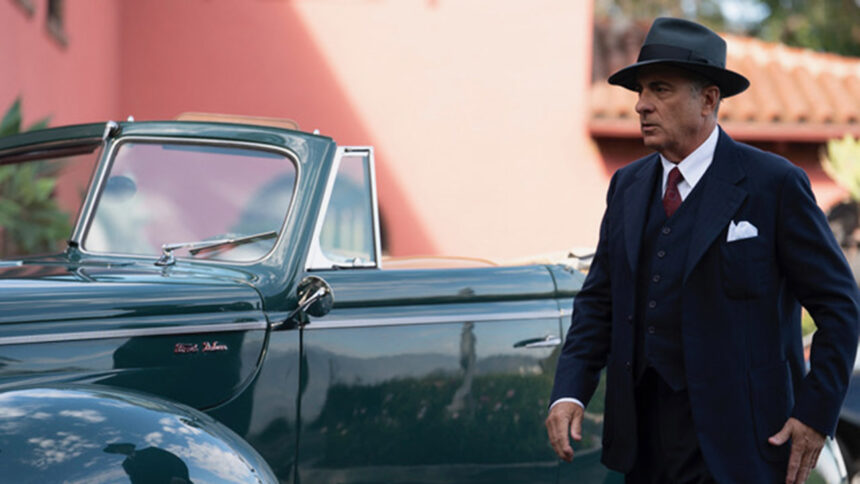
Set in contemporary Los Angeles, the film stars Garcia as Joe Diamond, a relic of another time who prefers tracksuits and leisure suits and is happy at home on a barstool. When he is hired by a wealthy woman (played by Vicki Krebs) whose husband ends up dead in their hilltop mansion, Diamond investigates the case which also leads him to truths about his mysterious past. Surrounding Diamond is a cast of supporting characters, such as a food-loving Chinese forensic doctor (Dustin Hoffman), a happy-go-lucky prosecutor (Brendan Fraser), and a sympathetic waiter (Bill Murray).
Before Cannes, Garcia spoke to THR On the making of his modern LA-set noir, Bogey’s best films, and how Ocean 11 Help him get his co-star.
Film Noirs have a long history in Hollywood, but they are less prominent now. How did the story come about?
My daughter, who appears in the film, asked me to help her with her English homework when she was a senior in high school. She said, “Dad, I have to turn in a paper tomorrow. Will you help me?” So I said, “Okay, what’s the mission?” She said it’s a bit of a short story, and you have to pick a location in Los Angeles. She chose Big Bob Boy. I said, “Ready?” Then it started. She improvised this thing while she was writing. I don’t know why he left [as a noir]. It just came out in this format. I started this internal monologue, which is still in the movie. “I woke up to a morning light that had the courage to peek into the thick gray sky. I did not wake up in a worn-out Murphy [bed]But on a bed of snow plants that will forever remain my mark. And I looked up and saw Bob, a big boy, smiling at me. She improvised this thing while she was writing and wrote a few more scenes. I handed over the paper. I think we got a B.
When did you decide it could be more than just homework?
I just sat down at my computer and it was probably around 2014 when I started home and said, “I want to explore this character.” Then I had 60 pages, so I pitched it as a pilot for a TV show. No one was interested. This is the nature of our work.
diamond It was filmed at downtown Los Angeles landmarks, such as Angels Flight, Clifton’s Cafeteria, the Bradbury Building, and The Pantry. I also photographed Cole’s, famous for its French cuisine, after it closed.
It was announced in the newspaper that it was closing when we were preparing for the movie. It is a key location in the film. I was able to speak with the man who was the owner Sayed Musa. We had lunch and he read the script. He was cooperative, and we recovered the sign. Then they were open longer, but now they are officially closed, which is unfortunate. He’s creative in Los Angeles.
Why was it important for you to film in Los Angeles?
It is the world in which he lives. At the time of the detectives, many of them resided in Los Angeles. I have been in Los Angeles since 1978 and have a love for architecture. It’s been that way my whole life. I’ve always been fascinated by Los Angeles in that time period of the ’30s and ’40s and all these iconic buildings – the California Club and City Hall. I started writing in these places. I wrote in the story that he lived above a parking garage in the downtown east side. A strange thing happened — during the coronavirus lockdown, Guy Ritchie was filming a movie with Jason Statham[[The man got angry]And they called because they had written an extra character for the movie to do two or three scenes that would tie the story together. I went to work on the movie one day with Jason and we happened to be shooting where Diamond lives in the movie. I saw it, and I said, “This is the place.” The film is a love letter to Los Angeles. Without those things, it’s not the same movie. People might say, “I love the movie. We’ll finance it. Can you shoot in Atlanta?” I’ll say, “No, I’m sorry. I can’t do that.”
How much time did you spend filming?
We had 25 days and 52 locations.
amazing.
This is independent filmmaking. It took years, then weeks to get it done, on a $20 salary.
What was the casting process like on this?
It came together fairly quickly. Relationships are great, however [actors] It must be driven by the material. Bill Murray is a friend. “Whatever the character is, I’ll do it,” he said. He is a prince in my life and Dustin was the same. But the first pivot that happened was Vicki. I sent the script to Vicki through our mutual agent. A few months passed and I didn’t hear anything. I kept checking with our agent, and he said, “She’s reading slowly. She’s distracted. She has kids.” Then suddenly she called me. Apparently, what happened was that she was watching Ocean 11 With a friend of hers. The friend said, “Oh, I love this actor. I really love him. You should work with him.” “He sent me the script,” she told her. I read it that night and then called the next day. With her blessing, everything snowballed. The role was probably difficult to play because it could have been played in a very vulgar way. When I saw Vicki in The imaginary thread Years ago I said: “This is the character.”
After spending 20 years trying to make this film, how do you feel now taking it to Cannes?
It’s as if you raised a child to the point where they are now grown and walking them to the intersection. “I love you and I’m proud of you,” she says, watching him cross the street alone. You can’t make people like that. It’s on its own.
Twenty-five years ago, I was developing one of William Saroyan’s plays as a screenplay, People of the cave. The play had a 20-page introduction in which he was interviewed about his creative process. The interviewer asked: “Do you care if your plays are successful?” “The fact that my place exists is success enough,” he said. Francis Coppola always told me that the mark of a film that resonates is how well it holds up 25 years later. I’ve seen the movie Francis Major cities. He’s been trying to make this movie for 30 years. What I took away from it is that there is no obstacle too great to overcome with a dream. To achieve this dream, you have to have discipline, commitment and a thick skin. But all great films and great art begin with a dream that a person will never give up.