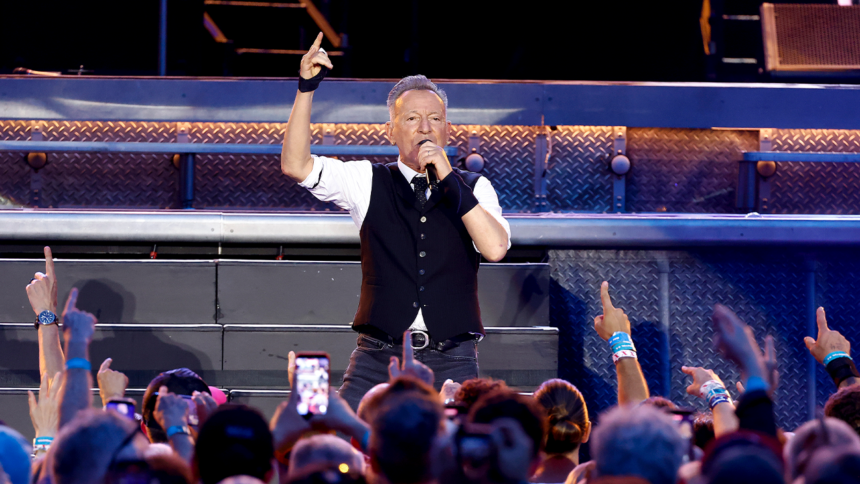
Bruce Springsteen and the E Street Band wrapped up their 20-date Land of Hope and Dreams American tour Saturday night in Philadelphia at the
What was scheduled to be a twenty-show series from Minneapolis to Washington, D.C., was slightly altered when the Philadelphia 76ers’ playoff schedule forced the Philly date (originally set for May 8) to be rescheduled.y) – Making the City of Brotherly Love the last date for the race, instead of Washington. In an almost perfect poetic irony, the tour, ostensibly about the foundations and principles of the nation, also revolves around the city in which the nation was founded.
Philadelphia marked the 11th straight show to perform the same setlist, a remarkably rare occurrence for an act synonymous with dynamic live shows night after night, though an understandable choice given how message-driven these shows are.
In the night’s opening monologue — almost verbatim most nights on the tour — Springsteen interpolates some additional context, acknowledging the foreshadowing of the evening.
“Good evening! It’s great to be in Philadelphia,” Springsteen said, before acknowledging that the city is “the home of our Declaration of Independence and the birthplace of American democracy.”
Springsteen then invited the audience to choose “Hope instead of Fear,” “Rule of Law instead of Chaos,” and “Peace is Over…” before breaking into “War,” an Edwin Starr song from 1971, a rousing rendition of the track with a bright red light shining on Springsteen’s face to highlight the urgency of the moment.
The nearly three-hour show, which began just after 7:30 p.m., was the most intense performance yet. While the tour is boldly and starkly political in nature, the underlying theme seems to be one of urgency – the urgency of the political moment and Springsteen’s acknowledgment of his own mortality – the theme of the 2023 and 2024 tour’s “Message to You” – seeming to meld together in perfect harmony to create a clear focus on the present.
The seven-song opening set is direct, powerful, and tells a story as tight as the band itself. From “War,” the band moved on to “Born in the USA” in 1984, fearing that there would be any doubt about the songs’ true meaning. “Death to My Hometown,” written as a recession anthem in early 2010, holds a unique poignancy for the current moment.
“No Surrender” came next and showcased one of the evening’s key lines: “I want to sleep under a peaceful sky in my lover’s bed,” and as drummer Max Weinberg begins to build to the final chorus, “With country wide open in my eyes and these romantic dreams in my head.”
“Darkness on the Edge of Town” followed, and the title track of Springsteen’s classic 1978 album confirmed that he had been telling these stories for nearly five decades:
After “Darkness” came “Streets of Minneapolis,” complete with video screens showing images of the heads of Alex Pretti and Rene Good, who were killed by ICE officers earlier this year.
The final song of the opening seven was “Promised Land,” and at the end of the song, each night, Springsteen would give a fan in the audience a harmonica. In Philly, he was back again, and for the first time on this tour, he pitched a second inning as well. Signs numbered by the dozens throughout the general admission pit said “Thank You for Our Lives,” and at the end of “Hungry Heart,” Springsteen said “See You” repeatedly to sign-holders. Nostalgia and a contemplative mood were in the air.
Guest guitarist Tom Morello infuses the sound on stage with a unique style, his pedalboard is a force to be reckoned with, and his famously political approach to music is a perfect fit for the tour. The tour’s finale was also Morello’s 62nd birthday, which Springsteen gleefully referred to during the band’s introductions before “Tenth Avenue Freeze Out.”
The Washington, D.C., show three days ago was the only outdoor stadium show of this tour, and the differences between the last two shows were subtle but noticeable. The stadium’s format allows for added visual grandeur — the American flag punctuating Springsteen’s “Long Walk Home” served as a stunning backdrop in the nation’s capital — and political guests, including President Barack Obama, created a poetic and powerful evening.
“You know that flag flying over the courthouse?” Springsteen sang as part of “Long Walk Home” that night, a huge American flag waving behind him. “It means that some things are set in stone. Who we are, what we will do, and what we will not do.”
Philadelphia, which has long attracted Springsteen fanatics since his first-ever show there in 1973, was a tight finale to a scripted and deliberate performance. The voice was roaring, both in the audience and on stage.
During “American Skin (41 Shots)”, saxophonist Jake Clemons stands at the back of the stage with both hands above his head in a “don’t shoot” position. It is a bold and stark reminder of what has changed in the world and what has not. The song was written in 2000 after New York City police officers fatally shot Amadou Diallo, and its refrain seemed to embody the theme of the evening. “Is it a gun? Is it a knife? Is it a wallet? This is your life,” Springsteen sings. It’s no secret. “You were only killed because you lived in…your American skin.”
Clemons, the nephew of E Street Band co-founder Clarence Clemons, portrays his uncle in a way that provides continuity, giving an impressive take on Clarence’s famous sax sounds and even wearing his uncle’s size 16 shoes on stage.
Before the final song of the night in Philadelphia, which, as on every other night on this tour, was an uplifting cover of Bob Dylan’s “Chimes of Freedom,” Springsteen got nostalgic.
“Philly, you killed it, this is the last night of our Land of Hope and Dreams tour,” he said, before thanking tour manager George Travis, as well as the band “for their commitment and courage in standing with me on this tour.”
Morello exclaimed and thanked the band’s longtime manager Jon Landau for “fifty years of partnership and friendship,” as well as his wife and E Street Band member Patti Scialfa, who was not participating in this tour.
“I first came here in 1973 at Main Point in Bryn Mawr. I was 23 years old,” Springsteen said before the organ-playing “Chimes” began. That was a while ago,” he said, laughing his trademark laugh. “So what I want to say is, thank you for life.”