Logo text
natural Featuring many of the same players from Bob Odenkirk no one films, but director Ben Wheatley never worried about any potential overlap between actors with the same names.
The British director knew that his unique sensibility would shake Odenkirk’s sensibilities no one A trust of minds that includes producing partner Mark Professero and screenwriter Derek Kolstad, as well as second unit director Greg Rementer and many more stunt performers. The only worry is on no one The Front was making sure they didn’t fire on any of the same locations in Winnipeg, the capital of Manitoba, Canada. (The image is also reminiscent of Odenkirk’s period Fargo First season.)
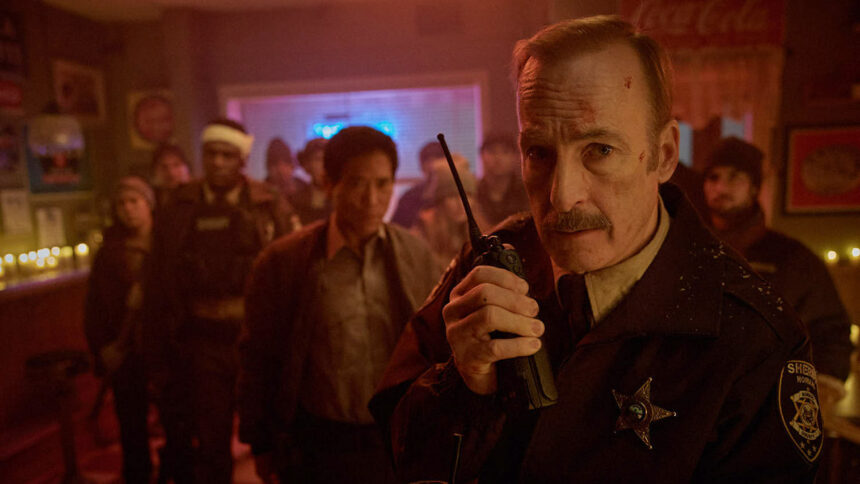
natural The film narrates Odenkirk’s itinerant mayor named Ulysses upon his arrival in Normal, Minnesota, where he intends to serve on a temporary basis until a new officer is elected. Ulysses wrestles with his personal demons when he begins to notice some irregularities in the seemingly idyllic small town. Then he makes an unexpected discovery during a botched bank robbery, and is forced to face off against the entire city.
His only ally is a young character named Alex (Jess McLeod), the son of the deceased Sheriff Ulysses. He realizes that the townsfolk reject Alex, so he offers a modicum of sympathy at a critical moment. It’s then subtly revealed that Alex is trans/non-binary, hence the cold shoulder to the town, an admirable choice for natural A must-do team at a time when studios are cutting or canceling anything that might upset the current US administration.
Wheatley & Company. He wanted to portray the progressive character organically without fuss, and at no point does the film feel like it’s patting itself on the back. He also says the standalone feature has received no pushback from funders.
“The policy of normalizing it — no pun intended — and dealing with it in a humane way rather than making it an issue was really important,” Wheatley says. Hollywood Reporter. “So it’s there, but it’s not a big deal. I think that’s the way to confront or represent these things.”
As for the future of Sharif Odenkirk’s Ulysses, natural Brass has already indicated his desire to continue his story if the demand is there.
“We were talking about that,” Wheatley says. “I can see that there’s an ongoing story for him, but you don’t want to jinx it too much by continuing to talk about it.” “It’s just about making sure another story doesn’t feel like exactly the same circumstances. So I can see it having legs.”
Below, during a recent conversation with THRWheatley also discusses working with writer Odenkirk, particularly his penchant for last-minute rewrites.
***
Most of your dozen films have been in the independent world, but you’ve made a few films in studio or at a neighboring studio in the last few years. Is the independent space where you prefer to be? Or do you just not care as long as you’re on set?
Yes, that’s the point. I just love working. I always wanted to do something big in the studio[[Mig 2]and now I had that opportunity, which was so wonderful. But independent films are great too. It’s about everything that can be developed and prepared. When you’re standing there with a bacon roll in your hand and getting ready to shoot, that’s what it’s all about.

It appears your agent took the initiative and reached out to Bob Odenkirk and his associates. before natural Even the search for a way out has begun. That’s quality acting if you ask me. How common is this approach?
I don’t know. I don’t really know the ins and outs of what clients do. It’s always a sinister and secret world, and they like to keep it that way. My agent, Phil Damicourt, has had it for 13 years. He was the first person interested in what I was doing, and I’ve been with him ever since. It has served me very well.
Bob, his producing partner Mark Professero, and screenwriter Derek Kolstad collaborated on the pair no one films. And while there is some overlap between the second unit and the stunt department, has everyone created an entirely new playbook for the action?
I think this happens naturally when a new manager comes to the project. I was glad I inherited some of the team no one. They all worked together, so they had a shortcut. But there was no pressure at all. I didn’t see any Nobody 2 Even after a long time natural It’s over. So I didn’t know what they were doing on that movie, in particular, and no stylistic things really exchanged.

Bob never said, “Oh, we did this no one“Let’s try something else”?
No, the only time it showed up was when we were searching the sites [in Winnipeg]. Someone will [clear their throat] Then go, “We’ve already shot here.” And I say, “Well, we can’t shoot here then.”
You are known for violence Kill list Scene involving a hammer. during naturalIn the hardware store fight, were you tempted to reunite for more bloodshed?
No, the hammer stuff has been done. He’s in a lot of different movies now. So I try not to repeat myself if I can.
Yes, both Lynne Ramsay and Joaquin Phoenix have reached their limit You weren’t really here.
They knocked it down. (He laughs.)
Yes, they knocked him home. A natural writer, Bob is known for rewriting scenes the night before filming. Is this something he prepared you for ahead of time?
Not particularly, but I’ve worked in all kinds of different settings. I’ve worked with scripts where not a single comma is changed, and I’ve worked with improvisation and very loose scenes that are fleshed out on the day. So once I got the rhythm of what we were doing, it was good. Every film is different in this regard. He’s a rare beast at this. He has a “story by story” and is the star and producer. So he has a lot of influence, but that’s okay too.
Sometimes, it was just a matter of eliminating dialogue in favor of a gesture or facial expression?
Well, everyone on the main team was questioning the script the whole time. We will look at it and think about how to improve it. So, this process may be difficult to do on the day, but it definitely pays off later. I don’t think there’s anything we changed that we regretted afterwards, but it’s just a matter of keeping it as tight as possible. Obviously this extends all the way to editing. In the edit, there’s a lot of ADR and a lot of emphasis and a lot of thinking about its structure. So it doesn’t really stop until you’re done with the audio.
One of the best-written scenes in the film is when Bob’s character, Ulysses, gets into Alex’s (Jess McLeod) truck and has a conversation about what that character’s identity is. It’s accurate and very plausible at a time when progressive themes in American films face greater scrutiny. Did you deal with any resistance from financiers regarding the details of that character?
No, not really. The policy of normalizing it – no pun intended – and dealing with it in a humane way rather than making it an issue is really important. So it’s there, but it’s not a big deal. I think that’s the way to confront or represent these things.

Yes, Ulysses calculates and adjusts before continuing the conversation. It’s that simple.
This is his general approach to the entire film. He takes it, lives and lets live until it isn’t.
Objectively speaking, it makes sense. The entire city turns the concept of “normal” upside down. Alex then helps Ulysses take a stand, and that character does some of the coolest work in the movie.
Yes, that was good. Ulysses has to make a decision at some point. He’s a good guy, but he’s a little affected by the things he’s done in the past. He’s a bit shy about making decisions, and it’s slowly growing that he has to take a stand. He’s interacting with all these different people, and while you can see he’s a nice person, how far will he be pushed?
You think that launch The fire in Winnipeg would provide great chances for snow, but it didn’t work out that way. Did Soundstage Blizzard work out better than you expected?
Well, the timing of the whole movie was about waiting for the snow to fall, and as we got closer to it, we were like, “Oh my God, it’s not going to happen.” I was actually cautious about trying to shoot outdoors at night in Manitoba. It was very cold, snow or no snow. So it was a blessed relief when the production team made the decision to film some of it indoors. But it’s actually criss-crossed with stuff on the outside as well, so hopefully you won’t really see its joints.
There was a lot of talk with the Canadian production team about how cold it was, and we were like, “Yes, yes, yes.” Then, when it actually snowed, we went out to shoot on location, and I had never experienced anything like this before. I stepped out of the warmth of the Winnebago, and all the hair in my nose froze. I took one step outside and said, “Oh my God, this is serious.” So we had a day in the proper cold, which was a very long day.
Aside from the rewrites that day, how similar was the finished film to the script? Did you leave anything noteworthy on the newsroom floor?
No, nothing. It’s all very much there. Derek’s script was already very tight. So there won’t be any deleted scenes.
As a wandering mayor moving from small town to small town, one can imagine more adventures for Ulysses. Do natural Does the team have any ambition to make this a franchise?
Oh yes. We’ve been talking about that. I can see that there’s an ongoing story for him, but you don’t want to jinx it too much by continuing that. It’s just about making sure the other story doesn’t feel like exactly the same circumstances. The thing about Bob and the way he played the character – and from seeing it with a lot of audiences – I think people are excited about the character. So I could see that it had legs.

If there is a sequel, it seems like the opening line will announce a warmer location.
That’s exactly what will happen, yes. (He laughs.) But see, it’s the location, not the vacation. You can be as miserable in the warm as you are in the cold.
As I mentioned, I have now made dozens of films. Have you ever felt like you were getting close to figuring it out or cracking the code?
No, there’s no mastering that. You crawl over one mountain to reveal a larger mountain range in front of you. The challenge is part of the joy of it. Every film is a different challenge, and there are a lot of skills to learn. So I don’t think any artist would say they’ve mastered this. This is the kind of arrogance that comes before a terrible fall, isn’t it?
When you watch your previous films, do you notice the same instinct in your work today?
I don’t know. I have been blessed with more short-term memory. So when I watch my old films, I come back to them fresh every time and say, “Oh.” And without sounding like a big, bulky head, I enjoy watching them. Some of them are so old now that they look like period pieces, which is very interesting. You can see that societal attitudes have changed over time.
I try to plan things as much as I can, but a lot of it is based on instinct, so you can’t really tell by instinct. You can’t tell if this is something that carries over from one film to the next, especially because you’re only interacting with the material and with the cast and crew that day. So, in that regard, I think it’s still the same.
But I know I’m not as nervous as I was when I started. I have confidence that I can put it together now. It’s not so much like a train hurtling down the track with the tracks in front of it anymore.
What about the camera work? Do you still have a lot of the same trends?
Camera work, for me, is a matter of budget. On a low budget, you’re basically handheld because you have no other choice. Then, as you crawl budgets, you can unlock grabbing equipment, or you can create combos and control things. So, the bigger the budget, the more control you have over the finer details. Then you can branch out into controlling long shots and things like that. So there are types of filmmaking in terms of content, but there are also types in terms of budget. I’ve always thought so. A low budget movie is a completely different beast than a mid budget movie or a high budget movie.
Finally, I read that you secretly made music under a pseudonym (Dave Wilder), and no one knew about it until recently. What’s the story there?
I’ve always loved music, but it was an art form that I didn’t understand at all. I couldn’t imagine how people did it, and I wanted to understand it more. So I made a concerted effort to teach myself how to sequence synthesizers and create music. I use it to relax, but it also helps me at work. My conversations with actual composers now make me more understanding of it, but I would never use it in a technical way to tell them specific things I want. I don’t believe in these things. You take back what you tell people, and if you tell them too much, you only take yourself back, and that’s not what I want from composers. Film writers are like actors. You are hiring them for their specific skills. But I enjoy writing music a lot.
***
Normal SPens in theaters April 17.