Logo text
Before Bloomberg, before the High Line, before the $18 cocktail, there was a different New York City. One full of phone booths, newsstands, and Gray Papaya on almost every dirty street corner—a New York where stealing your bike was almost as much a rite of passage as stepping on your first cockroach.
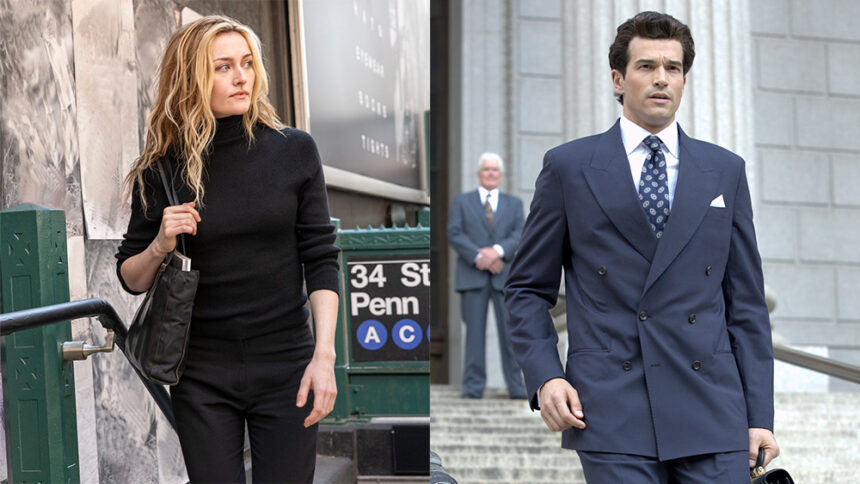
We’re referring, of course, to circa 1990s Manhattan, arguably the pinnacle of human civilization — and a historical period meticulously brought to life in Ryan Murphy’s film. Love Story: John F. Kennedy Jr. and Caroline Bissette. Every detail of that iconic era — the flip-phones, the lofts filled with glass bricks, the crowded magazine stands (remember those?) — seems to have been transplanted from the not-so-distant past to the screen, right down to the “Be Good to the Roxy and the Roxy Will Be Good To You” sign at the old Roxy nightclub in Chelsea (which was recreated for the series in Brooklyn, but more on that in a bit).
The wizard responsible for this fascinating bit of time travel is production designer Alex DiGerlando, who happens to have some first-hand memories of that period from his attendance at NYU during the 1990s. Hollywood Reporter He discovered an old Motorola StarTAC and called him to ask how to do it. Read our conversation below.
***
You lived through the 1990s in New York yourself. What was the overall challenge of recreating it? love story?
The 1990s are a bit of a strange era, a transitional period. You see the 80s and you know it immediately. But there’s a lot of the ’90s that still seeps into what we do now. I don’t know if it’s because he came back, or if he never went away.
What are some specific anachronisms you’ve had to deal with on the streets?
It’s like an old landmine. Everywhere you look, right down to the things you didn’t expect. Horizontal aisle lines — those were the ones that existed at the time. Now everywhere you look there is a series of horizontal lines. We have tried to frame it as closely as possible. Bus lanes and bike lanes are everywhere too. We had to either frame it or paint it in a few cases.
Some of the actual locations in the show still exist. How much work did they need?
A lot of these places, because they were so special at the time, were kind of trapped in amber, and we were really lucky that a lot of them still existed. The Odeon hasn’t changed at all – the chairs have changed, and we replaced them to match what they were at the time. The current chairs are made of red, white and green plastic wicker. At the time, they had these mid-century curved chrome metal chairs that curved back and then cantilevered at the bottom, with red and green Naugahyde upholstery. And then the sign of the Odeon—the thing that was there Big City of Bright Lights – It’s still there.
What about Panna II, the Indian restaurant where JFK Jr. (played by Paul Anthony Kelly) and Caroline (played by Sarah Pidgeon) had their first date?
At that time, there were four restaurants stacked on top of each other, but now there is only Panna. There are a lot of LED lights out there now. So we had to bring in more incandescent bulbs and decorate other windows to make it look like it did back then.

Roxy’s situation was completely different.
This building doesn’t exist anymore. It’s Lantern House on the High Line now — those condominiums have taken over that space. We found a nightclub called Elsewhere in Bushwick, which is a really cool place. The actual Roxy, before it was the Roxy, was an ice rink – huge and spacious, with very high ceilings. Another place is much smaller, but has very high ceilings and is very dark and somewhat cavernous. It had a lot of modern stuff – point-of-sale interfaces, LED lights. We had to strip it all down and bring in candlesticks and hammocks. We built the banquets in the zebra style that Roxy was. We then built a façade on the exterior that reflects the Roxy’s architecture and recreated the neon sign and the “Be Good to the Roxy” sign that was printed on sheet metal.
Wasn’t there originally supposed to be a scene with Caroline at Barneys? This store was a major attraction in New York in the 1990s.
We looked into filming there – and strangely enough, the Barneys building is still empty. But it would have been a very big project to get it back to how it was, and then the scene was simplified. For scheduling purposes, they moved it to the Calvin Klein showroom, because we had already built this collection.
The phone booth scene gets a lot of attention – the girls open one of the booths to steal a Kate Moss Calvin Klein poster.
I think while we were doing the show, the last phone booth in New York had just been removed. We got one from a support house in Los Angeles and had it shipped. As someone who was at NYU in that time period, stealing stickers from phone booths and bus stops was common.
What about smaller props – things that most viewers will never notice?
Each team member develops tunnel vision, reading everything they can, looking at every image we can find, and then trying to mine those data sources for details we can use to tell the story — even if it’s never spoken, but you can see it and it tells you about the character.
Like, for example, John Kennedy Jr.’s bicycles, which are constantly being stolen.
Our prop master put in a lot of work to find out what types of bikes he was already riding and then got them.
The show comes at a moment of intense ’90s nostalgia. Do you have a theory about why?
My 15 year old daughter is very interested in music and 90s stuff in general. I remember thinking in the ’90s that we were stuck in the lean era, and when we look back at the ’70s, we think that’s when all the great things happened. Now, with the distance, I kind of see the appeal. I actually think this is the last era before the smartphone. There’s something oppressive about being tied down to everything all the time. Watching the show, there’s something like a breath of fresh air, where it’s not so plot driven. It is also the last era of monoculture. Whereas now everything is so fragmented – a band like Nirvana today, people might like it, but it’s not going to be the biggest band.
***
Love Story releases new episodes Thursdays at 6pm PT/9pm ET on FX/Hulu. He reads THRInterviews And the coverage is here.