A dangerous expedition into Brazil’s Amazon rainforest, filmed in 1996, turns into a cultural and moral minefield for the world. AmazomaniaIt is a thought-provoking documentary starring Swedish director Nathan Grossman (I, Greta, Climate in treatment) explores the white male gaze and turns the camera on the colonial legacy and film itself.
A tale of two halves, the documentary had its world premiere in the main competition of the 23rd Copenhagen International Documentary Film Festival on Monday 16 March.
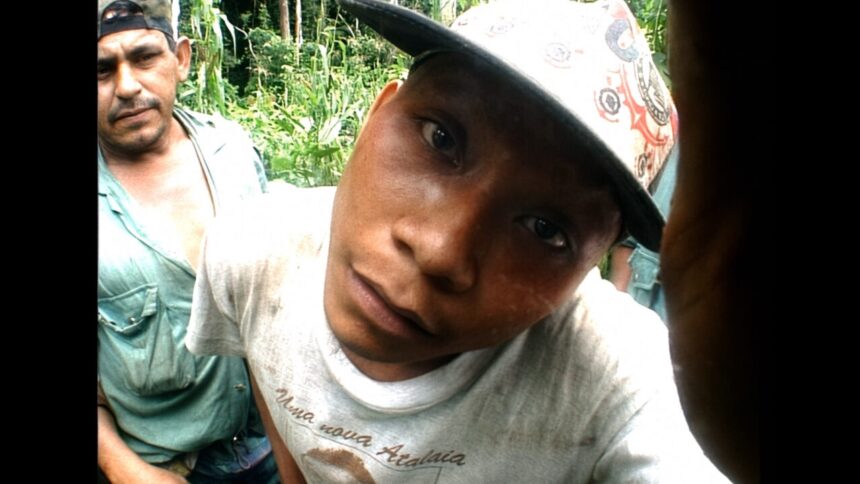
In the first part of the film, Grossman replays tapes of a 1996 trip, organized by a Brazilian civil servant and Swedish journalist Erling Söderström to meet the Corobo tribe, who had chosen to live far from civilization. The expedition ended in a first encounter, with the footage hailed as rare and rare images from a long-hidden world.
The second part of Amazomania It follows Soderstrom on his journey back to the tribe after 30 years. But the trip does not go as hoped. In the process, a profound misunderstanding was revealed. The Kurobo tribe is demanding compensation and insists on its right to tell its story.
“Amazomania “It is a complex study in documentary method and ethics, and a film with enormous confidence in the audience’s judgement,” highlights CPH:DOX.
Grossman directed the film and produced by Cecilia Nissen. The film features cinematography by Grossman, Soderström, and Diego Lageste. Editors Amazomania She is Jordana Berg and Grossman. Outlook Filmsales is handling sales.
The resurfaced footage of the 1996 expedition decades later “forces a re-examination of the contact and aftermath,” the document’s summary says. “By exposing the costs of ‘discovery’, the film confronts the colonial legacy and reveals the long-term ramifications for the kurubo.”
Grossman spoke to THR About how he came to be made AmazomaniaThe conflicts and ethical issues it has raised and will continue to raise, and how the title of the document came about.
You’re in your 30s, so how did you come across or come across old footage and end up making this film?
During the Covid pandemic, a friend of mine told me that he had heard about the existence of the Swedish director Erling’s archive. So, I decided to go visit, thinking that this wouldn’t be the full article. But a large portion of it still exists, was never digitized and was in a rather delicate condition. I felt like I wanted to at least digitize the entire material and look at it.

How many hours of material were there?
It was somewhere around 60 to 70 hours. It took some time to organize and compile the audio clips, because some of the audio clips were of low quality. After some time, I was able to see it all in the right order, and it was clear to me [what it captured] It was very different from the previous showing of this adventure documentary that came out in the early 2000s.
How did you learn about the Kurobo and their opinions while working on the film?
I watched the footage and began discussing it with anthropologists and the Korobo members themselves. I just went in with a very large amount of curiosity and wanted to see the community about this. And I wanted to understand whether they thought it would be appropriate to make a new film about this. I was also interested in their relationship with the Western media. You saw in the original footage that there was this friction. And I’ve also read some academic reports that suggest that the Korobo community has been very disillusioned with looking at the Western media and, indeed, at the camera, as an object. Therefore, we followed the exact rules that have now been established, also by the community itself. It is even mentioned in the film that they now have a precise way of working with journalists and tourists, which is also a result of how the communication was made in 1996.
Could you tell me more about feelings that Were the Korubo tribe members towards the camera?
What’s interesting is that this was a group living in isolation, and one of the highly manufactured things I came across was a really big camera. The Kurobo thought the camera was a gun. Amazomania Really revolves around that. It is not an anthropological film about the Kurobo community specifically. It’s more about looking at Western media and the white man’s gaze and his fascination with this kind of adventure story.

Have you gotten any reactions from people who have seen the film yet?
The nice thing is that almost all of the audiences who saw the film were happy with the adventure, which is the plan of the film, and then when it turns on its head and we get to hear the voices of the community, they really look at their fascination with these images in a different way. The audience is included in this criticism. So, there’s a part of the audience that is seeing the adventure and then looking critically at yourself. I think it’s a nice way to include the audience that way.
Jordana Berg, the editor who also worked End of the world in the tropicsis one of the most talented editors in the world of documentary films. It’s really cool, and we took this careful approach to engaging the audience. Compensation issues are a fairly academic topic. But the cinema room is so great for making sure these intellectual thoughts go deep. When we approximate a specific event, place, and time, we can understand more complex cultural ideas. I think the idea of reparations is very interesting, and it’s been big in the museum world when it comes to artifacts, but I think it’s also interesting to look at it a little bit from the perspective of intangible rights and from the world of journalism.
Do you know a lot about the groups that still live in isolation from civilization, where you see Amazomania Could it help the Western world in the event of possible future interactions?
We may believe that there are no longer groups living in voluntary isolation, and that everyone is part of our Western or global civilization. But this is not true. There are over 200 groups still living in voluntary isolation, and with changes in climate and the global environment, unfortunately, we will have more outreach events. Therefore, it is important to have a film like Amazomania For us in the media, we must also think critically about how to deal with such future events and think about what the best way could be.

Do you think? Amazomania Will it stand the test of time better than the original film?
I hope that in 30 years, things will have evolved further from the way we made this film, and that there will be better practices. on Amazomaniathe [members of the] Korubo Community are the executive producers. They are the stakeholders in the film. But in the future, I hope they can obtain the rights to these materials and also produce their own films about the development of this society.
How many Korubo have you seen? Amazomania?
I worked on the final edit of the film with community representatives in late 2025. So, it’s not that the entire community of 150 people saw it, but community representatives of different ages and genders saw the film. That was a very important step, watching it with them and acting with them [based on their input and] Arguments.
How did you find the address? Amazomania?
It’s crazy, we’ve come up with a new name. I think we all suffer from a slight amazomania. I return to this fascination with this place and this sense of adventure. We didn’t decide on the title until the final steps of the project. Erling is probably more paranoid than most of us, but the title does not refer directly to Erling. I think so [reflects] A broader sense of our Western paranoid outlook.