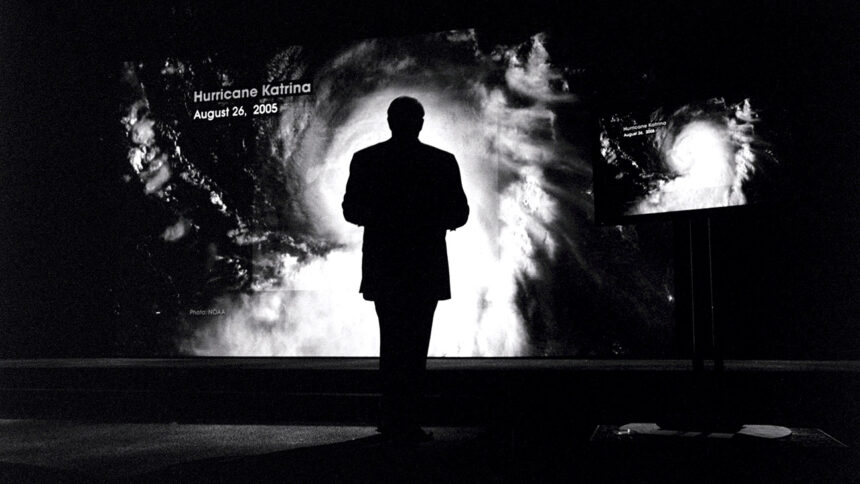

Davis Guggenheim’s 2006 landmark documentary An Inconvenient Truth highlighted the science and risks of the global climate crisis. Paramount Classics/Everett Collection Courtesy
Sustainability issue
“The fact that public opinion is so strongly on the side of doing something makes it imperative that we solve the climate crisis,” says the former vice president and “Inconvenient Truth” prophet, two decades after the documentary’s release.
Every few weeks, Davis Guggenheim finds himself meeting with a complete stranger who wants to talk about the influence of his most famous film.
“It happened just last week – I was in a bar and someone said to me, ‘Your film changed my life when I saw it as a teenager,’” the documentary filmmaker, who directed the landmark 2006 climate change documentary uncomfortable truth, He tells THR. “He created a clean energy company that now has dozens of employees.”
Nearly 20 years after its release – fact In theaters May 2006 – You’d be hard-pressed to find a film that has had a more profound impact on the American consciousness. About 4 million people saw the film in North American cinemas that spring, while tens of millions have seen it elsewhere since, with many of them changing their thinking as a result. Built around a captivating presentation by Al Gore, the film was powerful in its simplicity, bringing home both the science and the dangers of the climate crisis in a way that no issue-oriented documentary has conveyed its message before, or perhaps since.
However, as the film approaches the platinum anniversary of its release, you’d also be hard pressed to imagine how more marginal it could have seemed. To watch An uncomfortable truth Now (and that’s what I did last week) is to feel like you’ve just dug up a time capsule – a snapshot of an awakening long gone.
To watch a Guggenheim film is to return to a time when a Ted Talk could be transformed into cinema, when a crisis could be apolitical, and, perhaps most disturbingly, when an earnest plea could be transformed into meaningful action. And after 90 minutes of simple scientific explanation from the world’s most cheerful prophet, I was once again ready to follow Gore anywhere. And when the former Vice President said, “It’s your time to seize this issue, it’s time to rise up again to secure our future,” I wanted to jump off the couch not just to change a light bulb, but to change the world.
Unfortunately, doing so also means bumping into Trump’s wall. Since coming to office, the president has taken dozens of “historic” deregulation actions. Just last month, his government paid a French energy company $1 billion to abandon two giant wind farm projects on the East Coast and use the check to invest in oil and gas projects instead. When a public official says phrases like: “We are stabbing a dagger into the heart of climate change religion” – This public official is the head of the Environmental Protection Agency – The 2006 film’s lyrics could play as weak comedy.
But Gore sees it differently. In an interview in mid-April, he said that any despair over Trump’s retreat from his policies should be met with a simple thought: They won’t last.
“The fact that public opinion is so strongly on the side of doing something makes it imperative that we solve the climate crisis,” he says. “The availability of solutions has advanced much more quickly than I had hoped,” he points out [in the film] 20 years ago.”
Gore adds that the idea that the film seems more antique than relevant is also doomsday thinking, and he encourages Americans not to buy it.
“In my view, the film is more relevant today than it was when it first came out,” Gore says. “Every night on TV news is like a nature trip through the apocalypse,” he says, adding that many of the solutions the film hopes to find have now spread around the world as well.
“In parts of Pakistan, the common dowry now is three solar panels and an inverter,” he says. “This sounds like the punchline of a man walking into a bar joke, but it’s actually true.” (We checked this; it actually is.)
Guggenheim also believed that the switch of consciousness, once flipped, could not be turned off. “You have an entire generation that grew up with it and changed their lives because of it,” he says. “This is not something one president can undo.”
That generation experienced the film the way Guggenheim did: like a bolt from the sky. In the summer of 2005, Guggenheim — on a whim — attended an Al Gore slide show at the Beverly Hilton Hotel at the invitation of producer Lawrence Bender and activist/producer Lori David. He appeared to feel changed. Soon we will too.

One element that is definitely different is Hollywood itself. Jeff Skoll’s co-media company, which backed the film, closed in 2024, and Paramount, which released the film, is now under new, Trump-friendly management. Guggenheim says he doubts the company will release the film today.
fact Benefited from a unique confluence of personal drama (Gore and his journey as the son of a tobacco family); An audience receptive to the themes that followed the success of the environmental apocalypse film The day after tomorrow; A sort of counterfactual wish fulfillment, as many viewers in 2006 wanted to imagine an alternate universe in which the suddenly appearing Al Gore became president instead of George W. Bush.
The piece is superimposed on Al Gore’s presentation and clips from an audio interview he conducted with Guggenheim. They conducted it one sunny day at Shutters and became so engrossed that they soon realized night had fallen and they were sitting shooting (sustainably) in the dark.
monitoring An uncomfortable truth In 2026, one can’t help but feel a renewed sense of urgency. Many of Gore’s predictions focus on an event horizon of half a century, but even halfway to that point, many predictions have already come true. When Gore and Guggenheim show a time lapse of sea level rise over lower Manhattan, it doesn’t seem like a distant prophecy, but rather an accurate description of what might happen just six years later during Hurricane Sandy.
“This was the time period we were most criticized for—we were called alarmists; we were told we were aggressive,” Guggenheim recalls. “And in many ways, looking back, he was actually very moderate, which is how we often described him.”
Guggenheim says he’s not worried about Trump’s setbacks either. “In the last 20 years since we released the film, there have been a series of cycles. We were very focused on climate change, and then someone brought a snowball to the floor of the Senate and said it was a hoax.” [Oklahoma Republican James Inhofe,in 2015]. But it always comes back because, unfortunately, there’s always another hurricane or another disaster.
The film of course also showed a lot of promise, offering an origin story of sorts to the current optimistic atmosphere of Hail Mary project. In both films, willful scientists band together to save a doomed planet, and one imagines a cinematic universe in which one saw a younger Ryland Grace (Ryan Gosling) and a younger Eva Stratt (Sandra Holler). An uncomfortable truth In 2006 they found a reason to dedicate themselves to a cause that would save the world in 2026.
Gore says he already sees a lot of momentum for this change around the world. The only thing that hasn’t changed: Gore himself. He came to Los Angeles in April for several events (including THR‘s Special Sustainability Summit) and will soon head to Europe for a climate conference. Although he resides in his home state of Tennessee and is approaching eighty years of age, he is a former and recurring Vice President 30 Rock The guest star (Priorities) continues to criss-cross the world, peddling his cautious optimism (“We’re going to win this, but will we win it in time to avoid some more damage… “Disastrous effect?”) and its non-partisan message.
Well, mostly nonpartisan.
“China has made huge investments in future energy sources and high-value assets, while, under Donald Trump, we are foolishly and recklessly doubling down on currency devaluation.” [oil] “I have real assets,” Gore says. “But I’m not worried. Donald Trump is not the first time there has been a slump in climate policy. And every time the policy comes back stronger than ever.”
This story appears in “Hollywood Reporter”Sustainability issue for 2026. Click here to read more.
THR Newsletters
Sign up to get THR news straight to your inbox every day
Subscribe subscription