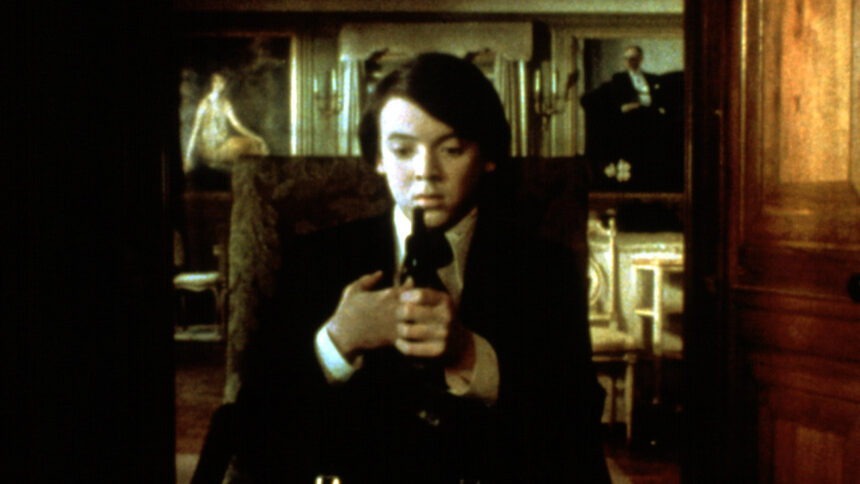
It was a stunning omission. The actor was barely out of his teens when he burst onto the scene in Hal Ashby’s 1971 black comedy harold and Maude, Bud Cort made such an indelible impression that he and the film he starred in (as Ruth Gordon’s decades-younger sidekick/lover) were catapulted to iconic status almost overnight. He was Hollywood’s success story — but this year, in the wake of his death in February, the Oscars telecast didn’t see fit to honor Bud Cort in the In Memoriam segment. Despite his place in the hearts of millions who still cherish him Haroldit didn’t even deserve to be shown on split screen.
If Bud were still alive, I can imagine him responding to this snub with a casual reference to the poor ratings of broadcast television, a twinkle in his eye.
It was 1984. A decade and a change after the performance that first ignited his career, Budd wanted to write a memoir.
I was working as an editor at a small newspaper, and a writer we knew told him I was the person he should meet. I still imagine him entering my office, sitting in front of me, and speaking in his soft voice.
He told me he was rear-ended on the Los Angeles Freeway.
“I physically left my body,” he said. “I could look down and see my body in the car from where I was hovering from above, and I remember having to make a conscious decision whether to get back in it or not. I made the decision to go back. I didn’t have to. I’m still not sure I made the right decision.”
Even though the driver who hit him was clearly at fault, and the law in Los Angeles was on the shooter’s side, the other man sued Budd, calling him a so-called celebrity extravagance. Somehow the driver won – his lawyer brought in the Conehead figures from Saturday Night Live To argue that the damage to Bud from the accident was a make-up, a disguise, or some sort of fancy special effects – and he had to pay an obscene sum of money to the man who nearly killed him.
His delicate beauty was altered by a receding hairline and a long scar on his forehead, which he immediately pointed out to me, as evidence of that accident on the highway.
He said he thought he had what it takes to write a good memoir. I was surprised to learn that he was born in Rye, New York; He looked to me like a pure Californian creature. He told me that he was an orphan in the West, barely in his twenties when he moved in with Groucho Marx and his wife. Not only did he find a new family and shelter, but he also found a reward: the Marxes were constantly entertaining, so during the years he lived with them, Bud met almost every celebrity in Hollywood.
At that time he was a bright young man, even more innocent than his years. He told me about sitting by the pool when someone came up and started talking to him and he knew he was in love, madly in love for the first time.
It was Barbara Streisand. He said she loved him too.
***
I had a slight impression of Bud before we met. He was a pale, wide-eyed boy in some of the tense scenes in Robert Altman’s film mash, His first movie. I remember his ghostly pallor, his dark, dark hair like a Beatles mop, and his painful, bespectacled innocence. From the beginning he was apparently an actor who felt he had to be the star of any film he was in, and he got his wish in his second role with Altman, The Stranger. brewster McCloud, He plays a boy obsessed with birds and convinced he can fly (and perhaps also kill). I can’t say it really worked.
I didn’t particularly enjoy it harold and Maude, The film that made him famous. Although it pains me to admit it, I can’t watch anything with Ruth Gordon in it, even with Bud by her side. But meeting him changed something. The second time I saw her mash*, it was different when I watched Bud: the complex nature of his actual existence seemed to resist the small role, as if there was a whole other movie his character was in, and the movie I was watching was missing him.
My second viewing of Harold and Maud It was even more bizarre, all I could do the whole time I watched was try not to cry. I felt everything turning inside that moon-faced boy, the boy I now know as a fragile and complex adult. He did not emulate emotions, pretend, or cover up; It was raw.
***
I wasn’t expecting to find him so captivating when he walked into my office. That same year when he returned to New York for an off-Broadway production endgame, I discovered something else I didn’t know: he wasn’t just a unique, strange creature, somehow angelic and grave, alive and elusive. I saw the person I knew as vulnerable and heartbroken and heartbreaking, and he had all those things, but he was also a brilliant actor, born for the stage. As I watched him understand this absurd piece, and bring it to life in multiple dimensions, it occurred to me why actors would want to play Beckett.. The challenge was to create something out of a completely different language, out of thin air and metaphysics, and Bud transformed it; It was poignant and bitingly funny. I didn’t know he could do that; That anyone can.
***
On my first trip to Los Angeles in 1988, I called the number Bud had given me.
“I thought about you yesterday,” he said when he heard my voice. “I was going to invite you to the opening Big Top Pee Wee.“I wondered how (if) he could have known I was in town before I called. “Openings aren’t usually very fun, but this was good.” He asked me if I wanted to come with him to a party that evening.
I hadn’t packed anything bright enough to wear, and I was afraid to face what was surely waiting for me, but saying no was a mistake I couldn’t afford to make.
Bud came in his car, which was more ridiculous than I expected, probably a Jeep. He looked confident, like an adult behind the wheel. We headed to Woody Harrelson’s house in Malibu.
A few years later, our party host appeared in a strange little movie that Bud directed, co-wrote, and starred in, ted and venus, Which is probably the less said the better. But that night, Bud decided he’d had enough after about an hour and came to me with a new plan: We’d go out to dinner. (“There’s never any food in this place.”) A few of his friends were joining us: actress Teri Jarre, with her dentist boyfriend (who would eventually pay the check); Comedian Jon Lovitz and his twin sister are unexpectedly blonde.
We stood in line outside a small building, a bustling Malibu restaurant, enduring the inevitable wait. “Do they know we’re here?” Terry Garr said, “Do they know who we are? Who?” We are we?”
We were finally ushered inside and seated at a round table, Bud was to my right. Jon Lovitz, who was to my left, didn’t look at me during the meal, but when I inevitably spilled water, he reached across the table and wiped up the mess without a word.
Rob Lowe was at the table next to us, with a woman and two men. Shortly after we sat down, I noticed that he was no longer sitting at his table but was standing drinking at the small bar across the room. His gaze was fixed longingly on Bud.
“Oh, there’s Rob Lowe,” Bud said at one point, noting how beautiful he was. “He has the smallest scar near his mouth.”
“He’s been cruising you nonstop since we got here,” I said.
Bud demurred, then mentioned how underrated the actor was: “He was so good in that movie…”
Rob Lowe was suddenly standing next to Bud’s chair, shaking.
“I’ve loved you since I was five,” he said.
It seemed as if young Rob was going to do anything Bud asked of him, even if there was a chance that some of Bud’s talent might influence him.
Bud stood up and the two started talking about art and craft.
Teri Jar turned to me and raised her eyebrows. “Isn’t that arousing?!” she said.
***
A few months later I was back in New York when I heard from Bud again. Barely an hour before the morning concert Waiting for Godot At Lincoln Center, he called and asked if I could join him. He’s flown in to see a few of his wealthy friends perform the play – more Beckett!
On stage, Steve Martin handled A To the material with contempt, as if he were above it and perhaps unequipped to make it real. After the show we hid until the actor left; Bud didn’t want to lie to his friend about his performance. Going downstairs into the small dressing room shared by all the actors, we found Robin Williams and F. Murray Abraham and Bill Irwin are in various stages of relaxation after the show.
Bill Irwin introduced Budd to F. Murray Abraham. “I don’t know you. Should I know you?” Ibrahim said in a loud, cold voice. This was revenge. Irwin did not recognize the famous friend the older actor introduced him to. Irwin, at whose house we were sitting, was quick to soften the blow, and Bud’s response was kinder than I expected. He moved to introduce me to Ibrahim, who turned away from me and allowed me to shake my hand. I repeated my name clearly, in a small gesture of defiance.
Meanwhile, Robin Williams, who mixed the script throughout the show with his characteristic manic improvisation, stood quietly dressed. None of the other actors in the dressing room spoke to him. He looked at me as I stood in the doorway.
“Hello,” he said almost affectionately.
“Hello!” I said, my voice as small as a child’s.
I can’t remember when was the last time I called Bud, and on any visit to Los Angeles he never called me. I think I tried calling again a few years later to his LA number and then the number I had for him in Rye, but I may have made that up. I don’t think he called me back to tell me he was in New York.
Maybe we kept trying so many times, we missed each other. Maybe you disappointed him, or the connection was lost.
He was a charming storyteller, with an endless supply of stories, but he seemed very disturbed. I don’t want to say nervousbut he looked wet.
I was surprised to learn he was in Connecticut when he died, as if I had somehow known he was on the East Coast, it would have made a difference. Nursing home; Long illness… Would he have responded if I had contacted him? Would I ever hear his voice again, and see his pale, shining face?
He never wrote those memoirs. I still want to read it.
Helen Eisenbach is a journalist and author. Her articles, reviews and interviews have appeared in Huffington Post, New York Magazine and new york times, Among other publications.