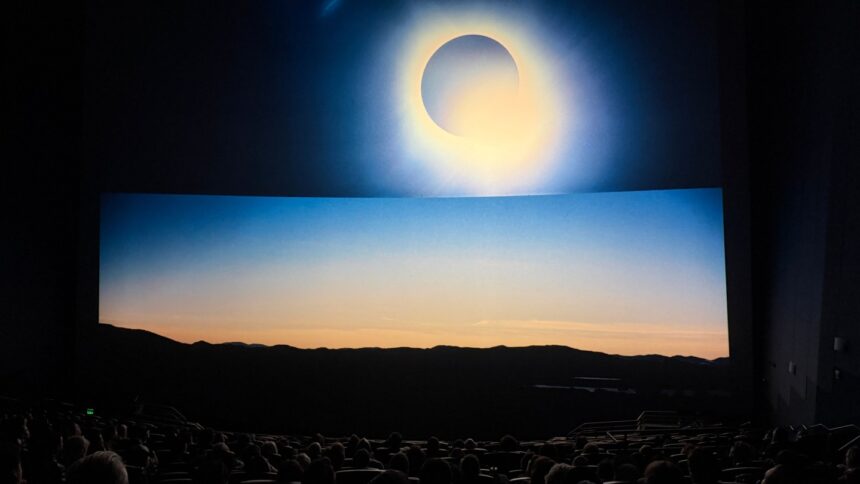
At 12 noon on Wednesday at the Universal CityWalk Theater, the massive auditorium that handles 70mm IMAX screenings was nearly full. The audience wasn’t there for the current box office champion, Hail Mary projector a re-release of Ryan Coogler’s Oscar-winning film Sinners. Instead, they came together to independently produce a short film.
Gus Bendinelli, a professional cinematographer with a side passion for rare celestial events, is in the back eclipsea real-time view of the 2024 total solar eclipse, filmed for a 70mm IMAX projector.
“I feel crazy saying I directed this,” Bendinelli joked after Wednesday’s show. “I got there and rolled. I wasn’t like, ‘Okay, let’s do it again!’
But getting there was the really hard part. It took two years, some very rare camera equipment, and a few thousand miles of driving before Bendinelli was able to screen his short film, in which the star is, well, a star.
Bendinelli’s journey to capture a total solar eclipse began in January 2024. He had only a few months to prepare, or miss his window, because the April 2024 eclipse would be the last over the United States in 20 years.
While solar eclipses, both partial and total, have been captured on film, both physical and digital, many times, these videos involve the application of a solar filter on top of the camera lens.
The downside of using a solar filter? The sun appears an unnatural orange color (think: the color the sun appears to the human eye when using solar eclipse glasses). Shooting with the filter also requires removing it manually during a total eclipse — or when the sun is completely hidden by the moon — which means the hand must enter the frame and interrupt the shot. The upside to the filter is that the sun won’t actually melt the film stock, and if you’re bold and/or ignorant enough to look through the viewfinder, it will probably melt your eyeball.
“I really wanted to find a way to capture a close-up of the eclipse without having to remove a filter during the shot, allowing you to just watch [the eclipse] “It unfolds in real time without any manipulation,” Bendinelli explains.
Initially, Bendinelli had access to two of the six well-known Mitchell-Fries AP 65 cameras, which had the ability to shoot 65mm film stock and were famous for their use in cinematic epics such as Lawrence of Arabia and the more auspicious for his purposes, 2001: Spaceflight.
Next up was the lens, a rare Pentax 800mm lens he found on eBay from a seller in Japan. The lens is over two feet long, and has a Goldilocks quality: the right focal length and aperture that allows the director to get the entire sun in the frame, while still physically fitting Mitchell Fries’s camera.
Bendinelli began testing his assembled device, which also included a specially designed IMAX converter, about a month before the eclipse using camera tech Ian Muller. Bendinelli soon realized that pointing his camera at the sun had a “magnifying glass on an ant” quality to his film, a 65mm film stock designed by Kodak that had incidentally been left over from a Christopher Nolan film. Oppenheimer Shoot.
While burn holes appeared on the film while the camera was warming up, once the film magazine moved quickly enough across the camera, at the required 24 frames per second, the sun never stayed on the film long enough to leave any marks. “Operating these cameras is a bit like revving up a car,” he explains.

With the camera, lens, and film largely in trouble, Bendinelli turned his attention to the biggest factor completely out of his control: the weather.
The path of the 2024 total solar eclipse — the areas where the sun will be completely covered by the moon as seen from Earth — would have stretched in a thin strip from Texas to Maine. “Any eclipse chaser will tell you that their biggest fear is cloud cover,” Bendinelli says. After dabbling in amateur meteorology, studying historical April 8 weather over the past several decades across the South and Northeast, he and Mueller set off toward Texas and Arkansas, two areas that seemed to have the best chance for clear skies.
Three days into their road trip, with 15 hours of driving a day, and five days before the eclipse, they were in Joplin, Missouri. Unfortunately, right behind him was a storm system moving east. So they drove on, and on the sixth day of their journey, the day before the eclipse, they reached what was practically the end of the American continent at Jackman, Maine.
Sixteen miles from the Canadian border, they found a snow-covered roadside station that had a great view of the sky and also overlooked a valley with a lake, surrounded by forested mountains. One camera is set to capture the eclipse, while the second camera is trained on the natural scene to show the changing light. The eight-hour setup day included camera tests, loading fifteen-pound film magazines, lubricating more than a dozen friction points on each camera, and repairing an eleven-hour burnt fuse.
In the end, after months of anticipation and work, it only took Bendinelli about seven minutes to photograph the eclipse, surrounded by a few dozen fellow observers in a quiet corner on the outskirts of the country.

With the two packages of film stored in the mini-refrigerator of his rented truck, Bendinelli headed back across the country. When he arrived in Los Angeles, even before returning home, he headed straight to FotoKem, the Burbank film lab where most of Hollywood’s large-format film projects are developed.
eclipse It features a simple score by musician Nick Ling, but is otherwise presented as a real-time look at a unique astronomical event. A shot of the sun, slowly and then completely disappearing behind the moon, occupies the top half of the 58-foot screen, while a shot of the Maine landscape, which dips from daylight into midday darkness and back again, is located at the bottom.
“I just wanted to give the film this objective point of view, so you can have a subjective experience with it,” the director says.
The film is as much a meditation as it is a film. Gazing up at a screen nearly six stories high, witnessing a unique planetary event, itself the product of a remarkable cosmic coincidence, unique to our place and position within the solar system, is an extraordinary experience. Being able to watch it in a movie theater on a random Wednesday afternoon makes it even better.
eclipse It is also a case study in light, the kind of film that can only be made by a cinematographer. “I feel like a lot of times, as a cinematographer, you’re realizing someone else’s vision, and that can be really satisfying,” Bendinelli says. “Creatively, it was really fun to do something for me.”
eclipseThe opening screening of the film, presented in partnership with Kodak, was attended by a crowd of cinephiles, camera enthusiasts and at least one astrophysicist who flew from Hawaii for the occasion. IMAX 70mm is a viewing format often reserved only for major Hollywood directors (Nolan! Villeneuve! Coogler!). This was the first time the theater presented an independently developed project of the premium format.
It’s this kind of personal experience that Bendinelli hopes to preserve for future shows eclipse. He has no plans to post the footage online. The focus is on IMAX cinemas, exhibitions or other science centers.
“My goal with this project was to try to capture the feeling of seeing a total solar eclipse in person,” Bendinelli says. “But what I realized after it happened is that one of the things that makes seeing it so special is being part of a group of people gathered.” “The eclipse may be the closest thing in nature to a movie. The lights go down and we all look up.”