

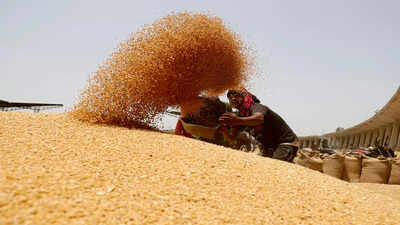
India’s wheat production for the 2025-2026 crop year is expected to remain steady despite weather disturbances, the Agriculture Ministry said on Sunday, even as industry estimates point to lower production.
The ministry said the crop was “stable and resilient despite local damage” caused by unseasonal rainfall and hailstorms. She described the season as “mixed but resilient,” with weather challenges and farmers’ responses shaping the outcome. The Roller Flour Mills Federation of India (RFFI) estimates on April 24 put wheat production at 110.65 million tonnes for 2025-26 (July-June). This is slightly higher than the 109.63 million tons produced last year, but much lower than the government’s previous estimate of 120.21 million tons.
The previous year’s production amounted to 117.94 million tons. Food Minister Sanjeev Chopra said the final figure was likely to fall between the two estimates. He said, “While the Union estimated wheat production at about 110 million tons, the number announced by the Ministry of Agriculture before the rains was 120 million tons. The reality will be somewhere between 110 and 120 million tons.” The crop was planted on 33.4 million hectares this year, with no reports of pest or disease attacks.
Early sowing helped increase the area compared to last year. However, weather conditions affected the crop at key stages. High temperatures in February caused heat stress, reducing grain filling period and impacting crop yields. Later, untimely rains and snowstorms at the ripening stage caused localized damage to both yield and grain quality. The ministry said that some factors may compensate for these losses. About 0.6 million hectares of additional area were planted this year.
Early sowing also helped some crops avoid heat stress. She added that more farmers are using improved seed varieties that are more productive and better able to withstand heat and other stresses. Weed infestation during crop growth was also low. “It is expected that the adverse effects caused by weather anomalies will be largely offset by increased acreage, early sowing, and improved cultivar adoption, thus supporting stable national wheat production compared to the 2024-2025 crop season,” the ministry said. Data from states also shows flat production. In Haryana, arrivals at mandis exceeded the procurement target of 75 lakh tonnes, with 56.13 lakh tonnes purchased already, about 9 lakh tonnes more than the same period last year. Madhya Pradesh raised its procurement target from 78 lakh tonnes to 100 lakh tonnes after reporting higher than expected production. In Maharashtra, wheat production is estimated at 22.90 thousand tons, continuing its steady rise.
The numbers of arrivals from Marathwada and Vidarbha regions remained steady till the end of April. The ministry reiterated its view, saying: “Although local weather-related impacts are observed, the overall wheat production scenario for 2025-2026 remains stable and resilient, supported by increased planted areas, improved agricultural practices, and enhanced adoption of varieties.”